Oaktree Specialty Lending (OCSL): Supplier relationships and what they mean for investors
Oaktree Specialty Lending Corp (OCSL) is a publicly traded business development company that originates and holds secured debt to middle‑market companies and is externally managed and administrated by Oaktree affiliates. The company monetizes through interest income on portfolio loans, plus management/incentive fee flows to its adviser structure, while delivering a steady dividend to shareholders. For investors and operator teams assessing counterparty and vendor risk, the crucial dynamic is OCSL’s close operational integration with Oaktree entities and a small roster of external advisors that support transactions, legal work and restructuring processes. Learn more about supplier mapping and counterparty risk at the NullExposure home page: https://nullexposure.com/.
How Oaktree runs OCSL: adviser, administrator and the fee mechanics
OCSL is externally managed by Oaktree Fund Advisors, LLC and benefits from the broader Oaktree Capital Management platform for deal sourcing and credit oversight. According to a TradingView summary of OCSL’s FY2025 10‑K, the company is managed by Oaktree Fund Advisors and emphasizes long‑term sponsor relationships and bespoke financing solutions (TradingView, FY2025: https://www.tradingview.com/news/tradingview:80f0c3e9dab86:0-oaktree-specialty-lending-corp-sec-10-k-report/).
A prior press release documents a concrete fee accommodation: Oaktree agreed to waive $9.0 million of OCSL’s base management fees as part of a merger arrangement with Oaktree Strategic Income II, phased over two years (GlobeNewswire, Sept 15, 2022: https://www.globenewswire.com/news-release/2022/09/15/2516670/10393/en/Oaktree-Specialty-Lending-Corporation-and-Oaktree-Strategic-Income-II-Inc-Enter-into-Merger-Agreement.html). This underscores the commercially negotiated nature of adviser fees and the economic alignment embedded in sponsor‑to‑BDC arrangements.
-
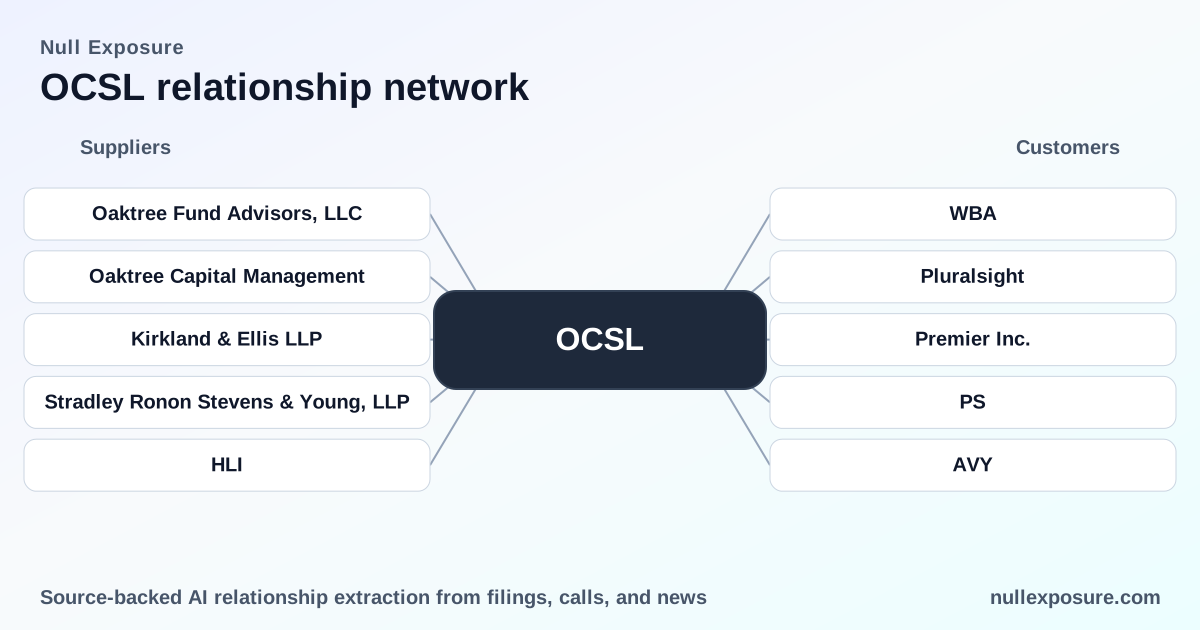
Oaktree Fund Advisors, LLC: Oaktree is OCSL’s investment adviser and administers day‑to‑day operations under an Investment Advisory and an Administration Agreement; fee waivers tied to a 2022 merger illustrate structured commercial concessions (GlobeNewswire, FY2022: https://www.globenewswire.com/news-release/2022/09/15/2516670/10393/en/Oaktree-Specialty-Lending-Corporation-and-Oaktree-Strategic-Income-II-Inc-Enter-into-Merger-Agreement.html).
-
Oaktree Capital Management: The broader Oaktree platform provides branding, deal flow and investment infrastructure for OCSL; market reports describe OCSL as managed by Oaktree Capital Management and benefiting from its alternative investment capabilities (Finviz news, FY2026: https://finviz.com/news/272688/oaktree-specialty-lending-nasdaq-ocsl-and-the-rest-of-the-specialty-finance-segment).
Key takeaway: OCSL’s operating model is highly integrated with Oaktree—this is both a source of competitive advantage (deal sourcing, credit expertise) and a counterparty concentration risk if the adviser relationship were to change.
Learn how to monitor adviser concentration and contract risk with NullExposure: https://nullexposure.com/.
Legal and financial advisors that show up around major transactions
OCSL uses a compact set of external advisors for transactions and special committee matters; these firms matter for execution risk in mergers, financings and disputes.
-
Kirkland & Ellis LLP: Served as legal counsel to OCSL and Oaktree on the cited merger transaction, providing transaction and securities counseling (GlobeNewswire, Sept 15, 2022: https://www.globenewswire.com/news-release/2022/09/15/2516670/10393/en/Oaktree-Specialty-Lending-Corporation-and-Oaktree-Strategic-Income-II-Inc-Enter-into-Merger-Agreement.html).
-
Stradley Ronon Stevens & Young, LLP: Retained as legal counsel to OCSL’s special committee in the same transaction, indicating the company uses independent counsel for conflict‑sensitive matters (GlobeNewswire, Sept 15, 2022: https://www.globenewswire.com/news-release/2022/09/15/2516670/10393/en/Oaktree-Specialty-Lending-Corporation-and-Oaktree-Strategic-Income-II-Inc-Enter-into-Merger-Agreement.html).
-
Houlihan Lokey (HLI): Engaged as financial advisor to the special committee, signaling the use of recognized independent advisers for valuation and deal process oversight (GlobeNewswire, Sept 15, 2022; Houlihan Lokey referenced directly: https://www.globenewswire.com/news-release/2022/09/15/2516670/10393/en/Oaktree-Specialty-Lending-Corporation-and-Oaktree-Strategic-Income-II-Inc-Enter-into-Merger-Agreement.html).
Key takeaway: The legal and financial advisor roster is small but reputable, focused on transaction execution and protecting minority governance interests.
Constraints and what they tell you about OCSL’s operating posture
OCSL’s public disclosures and related reporting surface several operational signals that matter for counterparty risk and procurement strategy:
-
Contracting posture and maturity: OCSL has long‑term financing facilities with explicit maturities—company disclosures note drawing periods expiring in 2029 and facility maturities in 2030, signaling multi‑year capital commitments that shape liquidity planning.
-
Relationship role and criticality: Oaktree entities are service providers with operational responsibility—the Investment Advisory and Administration Agreements delegate day‑to‑day investment decisions and administrative functions to Oaktree Fund Advisors and Oaktree Administrator, making these relationships operationally critical to OCSL’s business.
-
Relationship stage mix: Most strategic adviser relationships are active today, while the firm also reports terminated financing relationships (for example, the OSI2 Citibank Facility was repaid and terminated in May 2025), indicating active portfolio and liability management.
-
Scale and spend signals: Balance sheet and financing figures point to >$100 million in counterparty exposure and capitalized liabilities, while routine administrative expenses are in the $1–10 million range—this combination implies large, material third‑party exposures alongside modest ongoing vendor spend.
-
Global exposure: Disclosures highlight global contagion risk in financial markets, meaning custodians, hedging counterparties and banks across geographies form part of an extended supplier footprint and merit monitoring.
Presenting these as company‑level signals clarifies that OCSL’s supplier governance must treat its Oaktree advisers as mission‑critical and its banking/servicing counterparties as systemic exposures.
What investors and operator teams should do next
-
Monitor adviser continuity and fee arrangements: Adviser agreements are core to value realization at OCSL; track any amendments, fee waivers or special committee engagements that could shift economics (see the 2022 fee waiver disclosure: GlobeNewswire).
-
Track terminated and active facility changes: Facility repayments and terminations (e.g., the OSI2 Citibank Facility repaid May 14, 2025) materially alter liquidity and leverage profiles—maintain a rolling view of borrowings and undrawn capacity.
-
Treat legal and financial advisers as execution buffers: The presence of Kirkland, Stradley Ronon and Houlihan Lokey reduces transaction execution risk, but does not eliminate concentration risk tied to the Oaktree operating platform.
If you want a concise supplier risk scorecard or ongoing monitoring for OCSL and its advisers, visit NullExposure and start a supplier map: https://nullexposure.com/.
Bottom line: OCSL’s investment performance and operational resilience are tightly coupled to Oaktree’s advisory platform, with a limited set of external advisors supporting transaction execution. Investors should price adviser concentration and the company’s large financing footprint into any valuation and risk framework. For tailored monitoring and supplier relationship intelligence, visit NullExposure: https://nullexposure.com/.