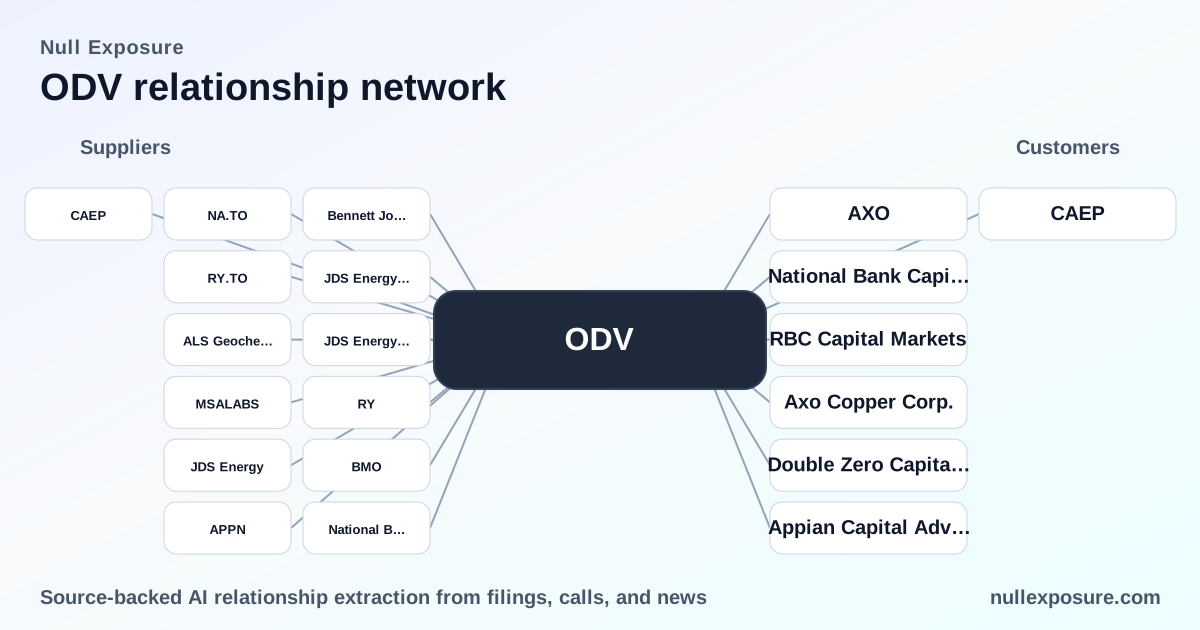
Osisko Development (ODV): The supplier map behind Cariboo’s push to production
Osisko Development is a Canada-focused gold developer that monetizes by progressing high-grade assets toward construction or sale while funding development through capital markets and project financing. The company advances the Cariboo Gold Project with a project-management oriented operating model, supplements working capital with equity offerings and credit facilities, and leverages specialist contractors and analytical labs to convert exploration into mineable reserves. For sourcing and counterparty diligence on Osisko, see the firm overview and relationship intelligence at https://nullexposure.com/.
Why the supplier roster matters to investors now
Osisko’s recent activity shows a disciplined shift from pure exploration toward construction execution and balance-sheet management. Key suppliers are not optional vendors; they are execution partners whose contracts materially change capital timing and execution risk. Underwriting banks, a project and construction manager, legal advisers, and analytical labs collectively shape the company’s path to a final investment decision and first production.
- Financing partners determine runway — underwritten bought-deals shift dilution and cash timing.
- A single PMC accelerates schedule but centralizes execution risk.
- Lab and assay partners underpin reserve quality and reporting integrity.
If you are building a vendor-risk model for ODV or assessing counterparty exposure for premium finance, start with these confirmed relationships and the sources below. Learn more and subscribe at https://nullexposure.com/.
Vendor-by-vendor: the relationships that matter (FY2026 coverage)
JDS Energy & Mining Inc.
Osisko’s wholly-owned subsidiary Barkerville Gold Mines Ltd. entered a definitive Project and Construction Management Services Agreement with JDS to advance the Cariboo Gold Project, signaling a move toward integrated project delivery and tighter technical oversight ahead of a potential construction decision (GlobeNewswire, Feb 9, 2026; E-MJ, Feb 2026).
National Bank Capital Markets
National Bank Capital Markets acted as a co-lead underwriter and co-bookrunner in Osisko’s bought-deal public offering that closed in early 2026, providing placement capacity for equity issuance and improving near-term liquidity (GlobeNewswire, Feb 3, 2026; Resource-Capital, FY2026).
RBC Capital Markets
RBC was a co-lead underwriter and co-bookrunner in the $143.8 million bought-deal public offering completed in January 2026, reflecting engagement of large-cap Canadian investment bank distribution channels (GlobeNewswire, Feb 3, 2026; Resource-Capital, FY2026).
BMO Capital Markets
BMO Capital Markets participated in the syndicate for the bought-deal offering as a bookrunner, contributing underwriting capacity and distribution for the equity raise finalized in early 2026 (GlobeNewswire, Feb 3, 2026; IRW-Press, FY2026).
Cantor
Cantor was named among the co-lead underwriters and co-bookrunners supporting the January 2026 bought-deal public offering, expanding the syndicate’s North American distribution reach (GlobeNewswire, Feb 3, 2026; IRW-Press, FY2026).
Bennett Jones LLP
Bennett Jones served as legal advisor to Osisko Development in connection with the sale of the San Antonio gold project and other corporate transactions executed in the period, providing transactional and regulatory counsel (Sahm Capital and InvestingNews coverage of the San Antonio sale, FY2026).
ALS Geochemistry
Osisko submits drill core and samples to ALS Geochemistry’s analytical facility in North Vancouver for sample preparation and assay work, indicating reliance on a major independent lab for geological assurance and reporting (GlobeNewswire drilling update, Feb 12, 2026; Yahoo Finance, FY2026).
MSALABS
MSALABS handles sample preparation and analysis at its Prince George facility with expeditor logistics from Osisko’s logging sites, representing a secondary analytical provider used in infill drilling programs (GlobeNewswire drilling update, Feb 12, 2026; Yahoo Finance, FY2026).
Appian
Public commentary ties Appian’s existing US$450 million facility to Osisko’s capital structure as an important liquidity complement to the equity raise, suggesting multi-source project financing rather than sole reliance on public equity (SimplyWallSt coverage, FY2026).
Operating model and company-level constraints (how Osisko contracts and scales)
Because the constraint dataset contains no explicit contracting excerpts, the following observations are company-level operating signals derived from the supplier list and transaction behavior.
- Contracting posture: Osisko uses a mixed model of third‑party project management (outsourced PMC) and capital markets funding (bought-deal equity), reflecting an asset developer that outsources heavy construction coordination while retaining strategic control.
- Supplier concentration: Relationships are distributed across specialist functions — tier‑one investment banks for underwriting, a single named PMC for execution oversight, and multiple analytical labs for assay work — implying moderate concentration risk centered on the PMC and underwriting syndicate.
- Criticality: Technical and financial partners are mission-critical; failure in project management or delays in financing will materially shift the timing of capital deployment and cash flow realization.
- Maturity: Engagements span established financial institutions and reputable service providers, indicating mature procurement practices appropriate for a developer transitioning to construction.
These signals should be integrated into a counterparty risk model: weight PMC continuity and lab integrity higher for near-term execution, and underwriter syndicate strength for funding stability.
Investment implications: what this roster changes about risk and upside
The supplier map re-casts Osisko as a developer with a clear execution vector and funded runway into project delivery. Key takeaways for investors and operators:
- Execution risk is now concentrated on JDS (project management) and capital markets. Successful coordination between the PMC and underwriting timeline will control the pace to FID and capital spend.
- Equity dilution has been used proactively to de-risk near-term liquidity; the bought-deal closes the immediate funding gap but raises sensitivity to commodity cycles and execution milestones.
- Assay integrity is supported by established labs, reducing geological uncertainty on near-term infill results — a necessary input for reserve conversion and lender diligence.
Primary risks to monitor: schedule slippage at the PMC level, unexpected assay disputes, and adverse market conditions that would increase the cost of incremental capital.
If you require a deeper counterparty diligence report or ongoing alerts on ODV supplier events, start your inquiry at https://nullexposure.com/.
Practical next steps for risk and partner management
- Maintain active monitoring of PMC contract milestones and any change orders that could increase capital requirements.
- Track underwriting syndicate statements and follow-on financings for dilution and runway signals.
- Verify chain-of-custody and third‑party audit results from ALS and MSALABS during reserve conversion.
For continuous supplier intelligence, methodology, and alerts tied to Osisko Development, visit https://nullexposure.com/ and subscribe for institutional-grade coverage.
Osisko’s supplier roster confirms the company is operating at a development inflection: funded, contracted, and dependent on a small set of execution partners whose performance will determine value realization. Investors and operators should prioritize PMC continuity and financing cadence in their next round of diligence.