Orion Engineered Carbons (OEC): Supplier Relationships and Operational Constraints — What Investors Need to Know
Orion Engineered Carbons produces and sells carbon black globally and monetizes through the sale of commodity and specialty-grade carbon black to tire, rubber, coatings and advanced material customers. Revenue is driven by production volumes, product mix (standard vs. specialty grades) and feedstock cost management; profitability therefore depends as much on procurement and contracting posture as on end-market demand. For investors evaluating supplier risk, the key questions are who supplies carbon black oil, how contracts are structured, and how those inputs affect margin volatility and capital allocation. Explore OEC supplier intelligence at https://nullexposure.com/.
How OEC’s economics tie to suppliers and feedstock
OEC is a classic industrial supplier-facing business: inputs define margins. The company reports trailing revenue of $1.81 billion and EBITDA of $233.3 million, with an EV/EBITDA of 8.23 — metrics consistent with a mid-cycle specialty chemicals operator where feedstock sourcing and operational uptime determine near-term profitability. OEC sells into relatively concentrated manufacturing customers (tires and rubber) while purchasing carbon black oil and other feedstocks from a broad supplier base. Procurement discipline and contract structure are therefore central to value capture.
The company’s financials show mixed operational results: modest operating margin and negative trailing EPS, reflecting commodity price swings and cyclical demand. For active investors, supplier exposure is not a peripheral disclosure — it is an operational lever that changes the direction of cash flow and return on invested capital.
Contracting posture: a mix of short‑ and long‑term arrangements
OEC’s procurement disclosures state that “the majority of our carbon black oil supply is covered by short and long-term contracts with a wide variety of suppliers.” This language is a clear company-level signal that:
- Contract mix provides flexibility: combining short- and long-term contracts allows OEC to hedge price and secure base volume.
- Supplier diversity reduces concentration risk: a wide variety of suppliers lowers single-source vulnerability.
- Buyer role is explicit: OEC operates primarily as a buyer of feedstock, giving it negotiating leverage when market supply is adequate but exposing it to spot volatility when markets are tight.
Those characteristics mean OEC’s procurement strategy trades off price certainty against cost efficiency: long-term contracts secure supply and stabilise margins; short-term contracts allow capture of favorable market moves. Investors should treat this as an operating constraint driving near-term margin variability and capital allocation decisions.
Every captured relationship: what the record shows
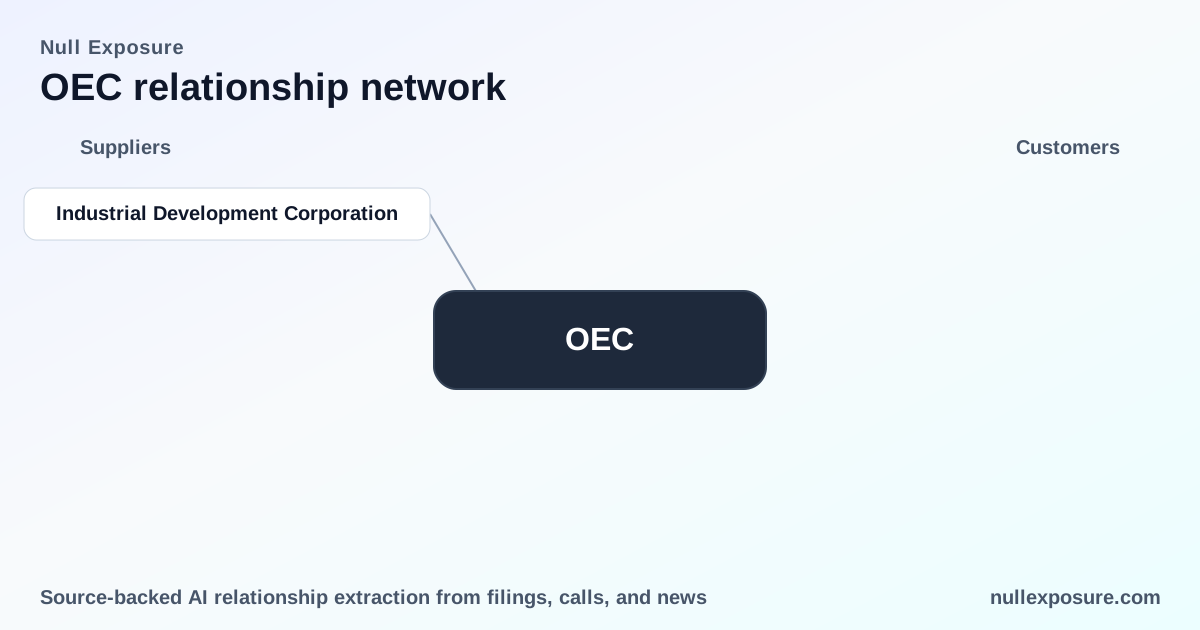
Industrial Development Corporation — In May, the Industrial Development Corporation approved a R43.7 million financing facility for Orion Minerals’ acquisition of a controlling stake in the Okiep copper project in the Northern Cape; this item was captured in supplier-scoped monitoring but does not document a supplier contract with OEC. Source: IOL Business Report, 10 July 2024 — https://iol.co.za/business-report/companies/2024-07-10-okiep-has-potential-for-more-high-grade-shallow-copper-deposits--orion/.
This entry is the only relationship flagged in the supplier scope results. It records a financing action by South Africa’s IDC tied to Orion Minerals’ copper project rather than a direct supplier agreement with Orion Engineered Carbons; treat it as a monitored market event rather than a counterparty supplier contract.
What the constraints tell investors about operational execution
The procurement disclosures and extracted constraints collectively portray a mature procurement function with pragmatic risk allocation:
- Contract duration: The mix of short- and long-term contracts indicates the company actively manages procurement windows to balance supply security and price exposure.
- Role clarity: OEC operates clearly as a purchaser of feedstock, implying procurement policies, working capital strategy, and supplier scorecards are material to performance.
- Supplier base: The company signals diversity of suppliers, which is a positive for operational resilience and reduces counterparty single-point failure risk.
These are company-level signals. They show OEC is not hostage to a single feedstock provider, but the quality of execution — contract pricing, hedging discipline and logistics — is the lever that determines whether this approach adds or erodes shareholder value.
Risk map and implications for downside
Investors should weigh several concentrated risks tied to supplier dynamics:
- Feedstock price volatility: Because carbon black production is feedstock-intensive, input price swings translate into gross margin pressure when pass-through is limited.
- Operational continuity: Long-term contracts reduce outage risk but do not eliminate it; logistics and plant uptime remain critical.
- Margin compression in weak demand cycles: With negative trailing EPS and modest operating margin, OEC’s ability to absorb input cost shocks without capital-intensive mitigation is constrained.
Monitor working capital trends, contract renewal terms disclosed in filings, and any supplier concentration disclosures that could change the risk profile. Institutional ownership is high (approximately 95.9%), which raises the bar for demonstrable improvement in procurement execution before consensus expectations realign.
Explore deeper supplier analytics at https://nullexposure.com/ — our platform centralises supplier-scope signals and procurement constraint tracking.
Actionable checklist for investors and operating executives
- Review the next company filing for contract maturity schedule and the share of fixed-price vs. index-linked feedstock contracts. This will reveal how much near-term margin is locked.
- Monitor working capital and inventory turns as leading signals of procurement stress or improved sourcing efficiency.
- Watch for any material supplier disclosures or single-source dependencies; if supplier diversity declines, reassess downside scenarios.
Each of these items directly links supplier posture to cash generation and valuation multiples. Given OEC’s current EV/EBITDA and analyst target price of $6.35, procurement execution is a primary lever to narrow the gap between market price and intrinsic value.
For ongoing monitoring and supplier relationship intelligence, visit https://nullexposure.com/.
Bottom line
Orion Engineered Carbons runs a procurement strategy that balances short- and long-term contracts and positions the company as an active buyer of carbon black oil. That contracting posture is a strength if executed well — it underpins resilience and margin management — but it is also the principal operational risk if volatility or logistics issues surface. The supplier-scoped record currently captures a single external financing event (Industrial Development Corporation financing for an unrelated mining project); it does not document a direct supplier contract with OEC. Investors should prioritise contract disclosure, working capital trends, and supplier concentration metrics when assessing OEC’s capacity to deliver sustainable returns.