Orion Energy Systems (OESX): what the supplier and capital-market relationships mean for investors
Orion Energy Systems researches, designs, manufactures and installs energy-management systems and industrial/retail lighting, and it monetizes through product sales, installation services and project implementations across commercial and industrial customers in North America. The company supplements operating cash by accessing public capital markets as needed — most recently executing a public offering managed by an equity underwriter — while continuing to third‑party source components for its EV charging business. For an at-a-glance advisory and continuous monitoring, visit https://nullexposure.com/.
The single visible counterparty: an underwriter, not a parts supplier
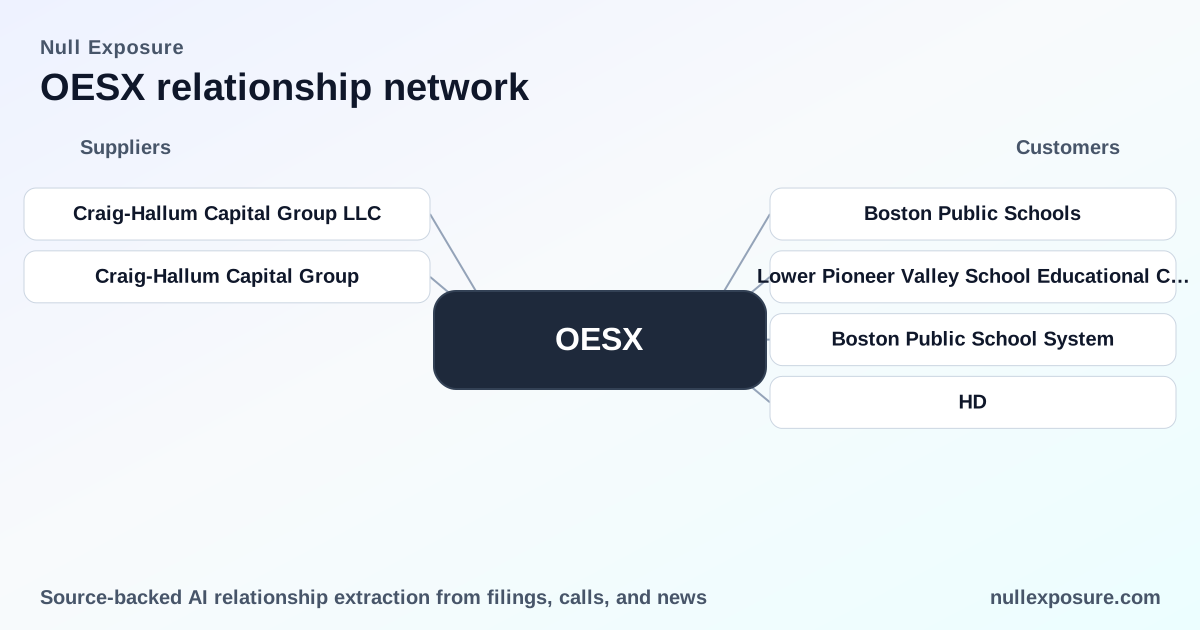
The relationship dataset identifies Craig‑Hallum Capital Group LLC as Orion’s counterparty in recent capital-market activity. According to a GlobeNewswire press release dated January 30, 2026, Craig‑Hallum acted as sole managing underwriter for Orion’s priced public offering of common stock. TradingView and QuiverQuant also reported the underwriting agreement and bookrunning arrangement in late January 2026, confirming Craig‑Hallum’s role in the transaction. (Sources: GlobeNewswire January 29–30, 2026; TradingView; QuiverQuant; SahmCapital.)
- Craig‑Hallum Capital Group LLC: Craig‑Hallum served as sole bookrunning manager and sole managing underwriter for Orion’s proposed and priced public offering in late January 2026, executing the firm’s equity raise and underwriting functions for the deal (GlobeNewswire Jan 29–30, 2026; TradingView; QuiverQuant).
What the documented constraints tell you about Orion’s supplier posture
Orion’s own disclosures and the relationship signals create a coherent operating portrait:
- Orion is an active buyer with modest committed purchase exposure. The company disclosed $3.6 million of purchase commitments as of March 31, 2025, related primarily to inventory purchases; that commitment sits against roughly $81.45 million of trailing‑twelve‑month revenue, indicating commitments equal to approximately 4–5% of annual revenue — material but not dominant on the balance sheet (Orion disclosure, March 31, 2025).
- The EV charging segment is externally sourced. Orion states that it third‑party sources all EV charging stations and components installed by that business line, confirming a reliance on external manufacturers for that product category (company disclosure).
- Procurement scale is in the $1M–$10M band. The disclosed $3.6 million in purchase commitments places Orion in a moderate spend band; procurement is significant enough to require contract management but not at a scale that suggests enterprise-level supplier dependency.
These are company-level signals: none of the constraint excerpts explicitly ties these procurement facts to Craig‑Hallum, and the underwriting relationship is strictly capital-market, not a goods supplier.
How these signals translate into operational risk and opportunity
- Capital markets are an active funding channel. The presence of a sole underwriter for a public offering shows Orion is prepared to access equity financing when needed; this reduces short‑term liquidity risk but also dilutes shareholders depending on usage of proceeds. GlobeNewswire’s January 2026 notices confirm this capital‑raising posture (GlobeNewswire Jan 29–30, 2026).
- Supply-chain exposure is targeted and manageable. Third‑party sourcing of EV chargers concentrates product risk in outsourced manufacturers, but the modest purchase commitments relative to revenue mean that any single supplier disruption is less likely to threaten the entire business unless the EV segment scales rapidly.
- Contracting posture: transactional and tactical. The company’s purchase commitments and third‑party sourcing language indicate a contracting approach that is transactional, oriented toward inventory and component procurement rather than long-term vertical integration. That posture preserves capital flexibility but creates dependence on component availability and pricing.
Relationship-by-relationship detail (complete coverage)
- Craig‑Hallum Capital Group LLC — Craig‑Hallum is the sole managing underwriter and bookrunning manager for Orion’s public offering announced in late January 2026; they executed the equity raise and underwriting agreement according to company press materials and market reporting. (Sources: GlobeNewswire Jan 29–30, 2026; TradingView; QuiverQuant; SahmCapital.)
What investors and operators should monitor next
Orion’s commercial profile—product sales + installations with an outsourced EV charging supply—creates a clear checklist for both investors and procurement/operations leaders:
- Monitor filing-level detail on the use of proceeds from the January 2026 offering to determine whether funds support working capital, margin enhancement initiatives, R&D for proprietary components, or simply balance-sheet repair. The underwriter relationship signals access to capital but does not replace the need to scrutinize deployment.
- Track supplier agreements for EV charging hardware and any disclosed single‑source arrangements; given the third‑party sourcing statement, supplier concentration in EV components is the primary operational risk vector.
- Reconcile purchase commitments with inventory turns and backlog: $3.6 million in committed purchases is meaningful relative to Orion’s revenue profile, so watch how that figure evolves in subsequent quarterly disclosures.
If you want a dedicated supplier-risk brief on Orion that maps procurement exposure to cash-flow scenarios, get started here: https://nullexposure.com/.
Actionable investor checklist
- Review the offering prospectus and related GlobeNewswire notices from January 2026 to confirm capital allocation and dilution assumptions.
- Demand visibility into EV charging suppliers and contingency plans for component shortages or price inflation.
- Watch quarterly updates for changes in purchase commitments and any movement in the $1M–$10M procurement band that would indicate scale‑up or contraction.
Final read: balance risk, monitor capital use, and keep supplier focus
Orion’s current public‑market activity confirms a hybrid model: product + services monetization supported by capital markets, while the EV segment relies on external manufacturers and a mid‑range procurement scale. That combination creates clear levers for value—successful deployment of offering proceeds and disciplined supplier management—alongside concentrated execution risks in outsourced components. For continuous tracking of these dynamics and tailored supplier‑risk reports, visit https://nullexposure.com/.
Bold takeaways: Craig‑Hallum is an equity underwriter, not a parts supplier; Orion maintains moderate procurement commitments ($3.6M) and outsources EV charging hardware; capital markets are an active liquidity channel for the company.