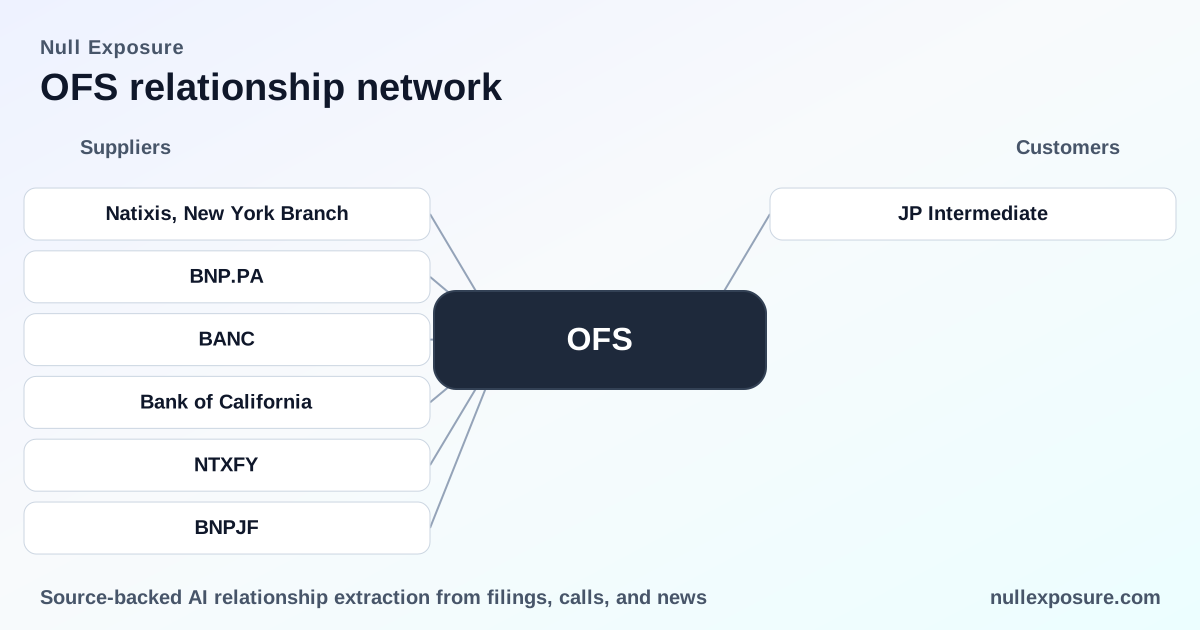
OFS Capital’s funding counterparties: what investors need to know
OFS Capital is a publicly traded business development company that monetizes by originating and managing private debt—primarily senior secured and subordinated loans—with selective equity stakes, producing interest income, fees and occasional capital gains that fund dividends to shareholders. The firm leverages bank credit facilities and notes to finance originations and manage liquidity, so the integrity and tenor of its lending counterparties are direct drivers of NAV stability and funding cost. For deeper counterparty mapping and monitoring tools, visit https://nullexposure.com/.
How OFS funds growth and why counterparties matter
OFS operates as an asset manager and lender: investment returns are generated through interest spreads on private credit positions and realized exits, while leverage amplifies those returns. The company’s operating model relies on a small set of external funding and administrative relationships that are both material and operationally critical. Investors should treat counterparties—especially banks that provide revolving facilities and corporate lines of credit—as one of the primary risk levers for NAV volatility and liquidity execution.
Key funding and service characteristics that define OFS’s posture:
- Contracting posture: multiple multi-year facilities and unsecured notes underpin funding; maturities and refinancing choices determine short-term liquidity flexibility.
- Concentration risk: single portfolio investments have previously represented material proportions of NAV; funding and administrative relationships are concentrated and therefore critical.
- Operational criticality: OFS depends on third-party administrators, custodians and advisors for compliance and day-to-day management—service interruptions would be disruptive.
- Maturity and spend profile: funding involves both large facilities (tens to hundreds of millions) and smaller credit lines; that range supports active investment activity but requires active liability management.
If you want a concise map of counterparties and exposures for portfolio diligence, see https://nullexposure.com/ for monitoring and reporting options.
Counterparty relationships — lender and facility summaries
Below are every relationship listed in the public relationship results, each summarized in plain English with source references.
Natixis, New York Branch
OFS’s subsidiary executed a revolving credit and security agreement with Natixis, New York Branch that provides borrowings up to $80 million and replaces the prior credit facility with BNP Paribas. Source: TradingView reporting on OFS Q4 2025 results (March 2026) — https://www.tradingview.com/news/tradingview:e948ee386a660:0-ofs-capital-corporation-announces-fourth-quarter-2025-financial-results/.
Natixis (corporate)
Company management confirmed they refinanced and repriced funding lines, replacing BNP with Natixis and issued new notes to stabilize funding for ongoing investment activity, signalling an active liability-management strategy. Source: TradingView summary of OFS 2025 filings (March 2026) — https://www.tradingview.com/news/tradingview:1c3ad3040cf1c:0-ofs-capital-2025-10-k-40-7m-investment-income-2-47-eps-from-operations/.
BNP Paribas
Historically a principal lender to OFS, BNP Paribas provided a non-recourse floating rate facility originally sized at $150 million, which OFS reduced and subsequently replaced as it restructured funding. The facility’s prior maturity profile (noted in earlier filings) represented a multi-year funding commitment. Source: InsiderMonkey earnings call transcript (FY2024/FY2025 discussions) — https://www.insidermonkey.com/blog/ofs-capital-corporation-nasdaqofs-q3-2024-earnings-call-transcript-1384465/ and https://www.insidermonkey.com/blog/ofs-capital-corporation-nasdaqofs-q3-2025-earnings-call-transcript-1639828/.
BNP (alternate ticker references)
In the Q4 2025 close-out disclosures, OFS disclosed that in connection with the Natixis facility closing it fully repaid its credit facility with BNP, underscoring a deliberate move away from BNP-provided funding. Source: Benzinga recap of the Q4 2025 earnings call (March 2026) — https://www.benzinga.com/insights/news/26/03/51036088/ofs-capital-q4-2025-earnings-call-transcript.
Banc of California (capital line)
OFS maintains a $25 million floating-rate corporate line of credit with Banc of California, which management reported as undrawn at certain quarter-ends and was later extended to February 2028—serving as a flexible liquidity backstop. Source: InsiderMonkey (FY2025 transcript) and TradingView/Benzinga reporting on Q4 2025 developments — https://www.insidermonkey.com/blog/ofs-capital-corporation-nasdaqofs-q3-2025-earnings-call-transcript-1639828/ and https://www.tradingview.com/news/tradingview:e948ee386a660:0-ofs-capital-corporation-announces-fourth-quarter-2025-financial-results/.
Bank of California / bank of California (alternate labelings)
Public commentary uses several casings for the same counterparty; all references indicate the same Banc of California facility that provides OFS with additional liquidity and was explicitly extended to Feb 28, 2028. The extension and the undrawn status at reporting are consistent across transcripts and news coverage. Source: InsiderMonkey and Benzinga Q4 2025 call coverage (March 2026) — https://www.insidermonkey.com/blog/ofs-capital-corporation-nasdaqofs-q4-2025-earnings-call-transcript-1708840/ and https://www.benzinga.com/insights/news/26/03/51036088/ofs-capital-q4-2025-earnings-call-transcript.
What these relationships mean for investors — focused analysis
- Funding replacement and repricing are active priorities. Management replaced a large BNP facility with Natixis and issued notes to stabilize liquidity, reflecting a proactive funding strategy to manage cost and tenor rather than passive rollover risk.
- Concentration and materiality are real exposures. Company disclosures flag single-portfolio concentration and the materiality of third-party service providers; combined with large credit facilities, counterparty failures or abrupt covenant changes would have outsized NAV and liquidity implications.
- Maturities and spend bands drive refinancing risk. Public evidence shows a mix of $150M-class facilities, a $25M corporate line, and unsecured notes—this structure supports deployment but requires continuous access to capital markets and bank funding windows.
Operationally, the constraints reported by OFS are company-level signals: long-term contract tenors exist alongside active refinancing behavior, the firm depends on service providers for administration and custody, and spend bands range across the $1M–$100M+ spectrum—collectively implying that counterparty monitoring should be a repeatable part of any investment diligence.
For institutional tools and counterparty monitoring dashboards that map these exposures in real time, visit https://nullexposure.com/.
Bottom line and recommended investor actions
OFS’s funding relationships are concentrated among a small set of banks and noteholders; the recent shift from BNP to Natixis is deliberate liability management that reduces immediate rollover risk but leaves concentration and portfolio-level NAV sensitivity intact. Investors should prioritize three actions:
- Monitor facility covenants and maturity windows for the Natixis and Banc of California lines.
- Track any further unsecured note issuances or redemptions that change leverage or liquidity.
- Maintain oversight of administrative third parties because service interruptions can materially affect operations and reporting.
If you need a counterparty exposure report formatted for investment committees or risk desks, visit https://nullexposure.com/ to request tailored output and monitoring.