OFSSO (OFS Capital 7.50% Notes 2028): Supplier relationships, operational constraints, and investor implications
OFS Capital operates as a credit-focused investment vehicle that monetizes through interest income on a diversified portfolio of middle‑market debt and fee arrangements with its adviser and administrative affiliates; the 7.50% notes due 2028 provide fixed coupon exposure to that underlying credit platform. This note sits above the operating company and therefore is sensitive both to OFS Capital’s asset performance and to the contractual ecosystem that delivers investment selection, administration, and brand licensing. For deeper supplier‑risk monitoring and supplier scorecards, visit https://nullexposure.com/.
Why supplier relationships matter for a credit issuer like OFSSO
Investors in a fixed‑rate note issued by an externally managed credit firm are effectively underwriting not just the portfolio of loans and bonds, but the operational infrastructure that sources, services, and governs those assets. Key suppliers—administrators, advisors, and lenders—drive underwriting quality, balance sheet flexibility, and the company’s ability to meet coupon and principal obligations. The following sections walk through every supplier relationship surfaced in public reporting and then translate contractual signals into investment‑grade operational risks and opportunities.
Active lending counterparties: what the public record shows
Natixis — administrative agent on new secured revolver
OFS Capital announced a new secured revolving credit and security agreement providing up to $80 million, led by Natixis as administrative agent, which upgrades the company’s near‑term liquidity profile and replaces legacy bank arrangements (FY2026). Source: TradingView coverage of the company announcement (Mar 10, 2026).
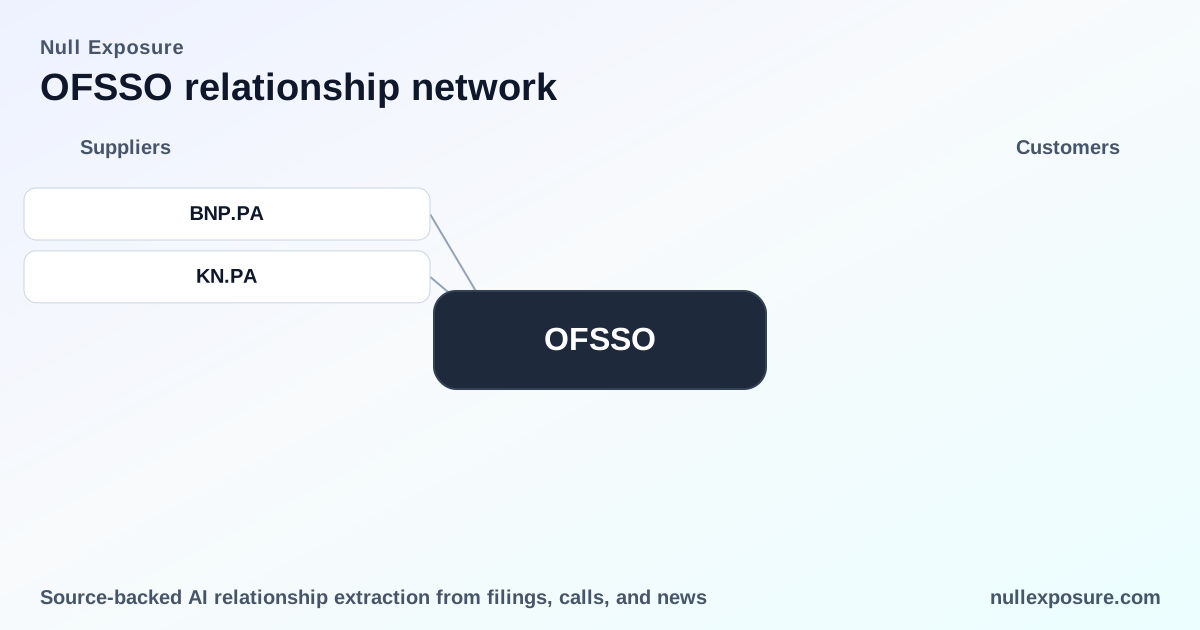
BNP Paribas — prior revolving facility terminated
In connection with the new financing, OFS Capital repaid in full and terminated its 2019 BNP Paribas‑administered revolving facility with all liens released, removing BNP Paribas as the current lender and eliminating the prior encumbrance on assets (FY2026). Source: TradingView coverage of the company announcement (Mar 10, 2026).
What the supplier constraints reveal about OFS Capital’s operating model
The filings and company disclosures surface a tight, outsourced operating model with clear contract types, counterparty focus, and concentration of operational control.
-
Licensing and brand control (company signal tied to OFSAM): The company entered a license agreement with OFSAM that grants a non‑exclusive, royalty‑free right to use the “OFS” name for as long as OFS Advisor or an affiliate remains the investment adviser. This is a direct licensing relationship with the OFSAM group documented in corporate disclosures.
-
Long‑term advisory posture (company signal): OFS Capital’s Investment Advisory Agreement is structured to renew annually but historically remains in force year‑to‑year subject to board approval and certain shareholder votes; the Investment Advisory Agreement dated November 7, 2012, was re‑approved on April 3, 2024, indicating an established multi‑year operating cadence.
-
Service provider dependence (company signal and explicitly named affiliates): OFS Advisor performs day‑to‑day investment advisory services and OFS Services, an affiliate, provides administrative functions. Filings state there are no internal employees and the company depends on OFSC senior professionals for diligence, underwriting, and portfolio management, making these supplier relationships operationally critical.
-
Contractual royalty structure (relationship‑level): Under the license with OFSAM, the company is a licensee with rights tied to the continuity of OFS Advisor’s advisory role; the licensor role is held by OFSAM.
-
Active, negotiated fee arrangements (company signal): OFS Advisor agreed to temporary fee reductions for certain assets for the years ending 2022–2024 and renewed the concession for 2025, demonstrating constructive, active negotiations on management fees and a willingness by the adviser to alter economics in constrained market conditions.
-
Geographic and counterparty focus (company signal): Investment activity is concentrated in U.S. middle‑market companies, which sets the risk profile for the portfolio and determines the relevant counterparty set for services and lending.
-
Segment focus on services (company signal): The material portion of third‑party relationships is in services—investment advisory, administration, proxy voting, and related governance—rather than large external vendors for technology or manufacturing.
Collectively, these constraints show a company with high operational leverage to a small set of affiliated suppliers and a financing posture that relies on secured bank facilities to manage liquidity.
For supplier‑risk dashboards and to track future supplier events for OFSSO, go to https://nullexposure.com/.
Investment implications — what investors should price in now
-
Operational concentration is a credit risk multiplier. The company has no internal employees and depends on OFS Advisor/OFS Services/OFSC professionals to execute underwriting and asset management; any disruption to those affiliates would materially affect portfolio performance and, by extension, note‑holder recoverability. This is a critical single‑point dependency highlighted in company filings.
-
Liquidity profile improved but monitor lender composition. The $80 million revolver led by Natixis strengthens near‑term liquidity, and the termination of the BNP Paribas facility removes a prior lien. Assess revolver covenants and collateral scope in ongoing monitoring because secured facilities can shift recovery dynamics.
-
Fee concessions indicate alignment but also potential margin pressure. Temporary management fee reductions through 2025 demonstrate adviser alignment with capital preservation, but also flag pressure on operating economics that could be symptomatic of slower portfolio growth or valuation compression.
-
Geographic and borrower focus concentrates credit risk. The middle‑market U.S. borrower base delivers yield but concentrates exposure to U.S. economic cycles and sector idiosyncrasies; stress in that segment would directly pressure interest income available to service the notes.
Quick reference: every supplier relationship covered here
- Natixis — administrative agent for new $80 million secured revolving credit and security agreement (FY2026). Source: TradingView news reporting on the company announcement (Mar 10, 2026).
- BNP Paribas — prior 2019‑era revolving facility was repaid and terminated with liens released (FY2026). Source: TradingView news reporting on the company announcement (Mar 10, 2026).
- OFS Advisor / OFS Services / OFSAM / OFSC — named in company filings as the adviser, administrator, licensor, and professional network that run investment selection, administration, and provide the OFS trade name; these relationships are active and critical to operations according to the Investment Advisory and Administration Agreements (filings dated November 7, 2012; re‑approved April 3, 2024, plus fee reduction disclosures through 2025).
Next steps for investors
- Review revolver covenants and collateral schedules to understand lien priority against the noteholders.
- Track adviser continuity clauses and the license agreement tied to OFSAM to understand brand and services continuity risks.
- Monitor portfolio composition by borrower industry and tranche to quantify middle‑market stress sensitivity.
If you want integrated supplier risk scores for OFSSO and automated alerts when any named supplier files a material notice, start with our platform at https://nullexposure.com/. For bespoke diligence or to model how adviser disruption would affect note servicing capacity, contact us through https://nullexposure.com/ for a customized briefing.
Bold takeaway: The credit characteristics of the 7.50% notes are inseparable from OFS Capital’s outsourced operating model; strong lender support (Natixis revolver) reduces immediate liquidity risk, but concentrated adviser dependency and middle‑market credit exposure remain primary drivers of credit risk for note investors.