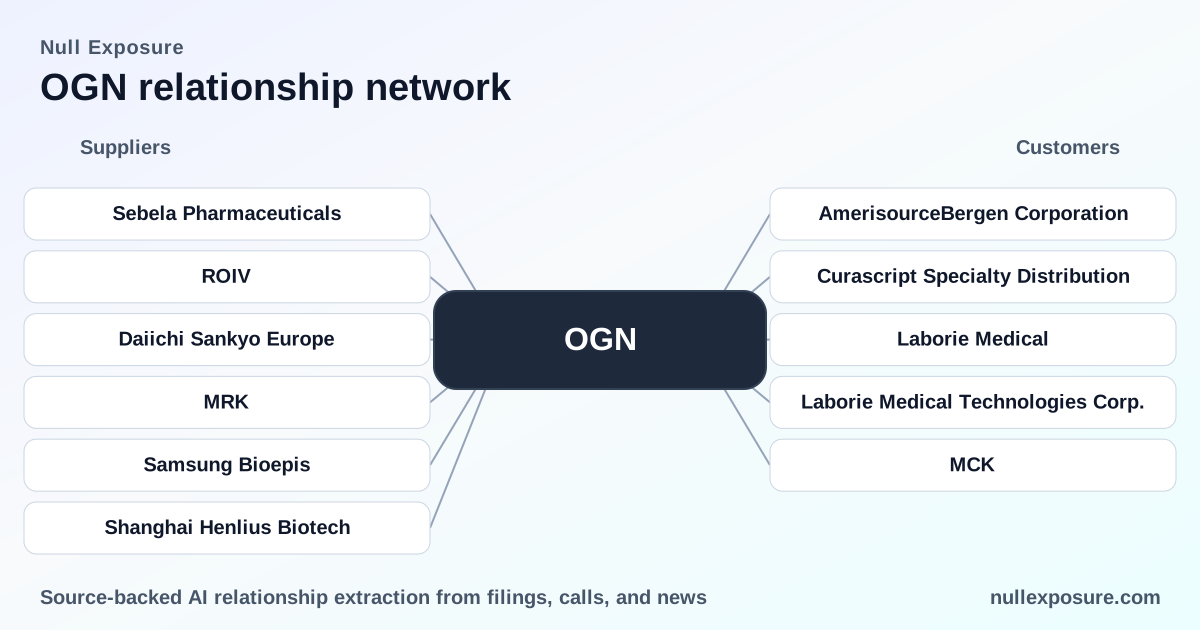
Organon & Co (OGN): Supplier relationships driving a portfolio rebuild in women's health
Organon monetizes a heritage pharmaceutical franchise through product sales in reproductive health, contraception, psychiatry, HRT and anesthesia, supplemented by targeted licensing and M&A to refill its pipeline and extend commercial reach. The company uses licensing deals, distribution agreements and selective acquisitions to convert external R&D and regional assets into near-term revenue, while relying on third-party manufacturers and service providers to deliver finished product — a working model that preserves capital but concentrates operational risk. For investors assessing supplier exposure, Organon’s recent activity shows an explicit strategy to de-risk product gaps via licensing and bolt-on buys while accepting supply-chain concentration for cost efficiency. Learn more about how these supplier relationships are tracked at https://nullexposure.com/.
How Organon structures supplier relationships — the operating posture
Organon runs a mixed contracting posture: it outsources manufacture, packaging and logistics to third parties while keeping commercialization and portfolio strategy in-house. Company disclosures identify third-party contract manufacturers, logistics providers and service vendors as active, material inputs to the business, and also confirm that certain materials are sole-sourced and critical for key women’s health and established brands. That combination produces two persistent characteristics for investors:
- High operational leverage to a small number of external manufacturers and service providers, which improves capital efficiency but concentrates single-source failure risk.
- Mature, transactional relationships for manufacturing and services, where Organon buys capabilities rather than building them, making commercial and regulatory continuity dependent on counterparty execution.
These signals come from Organon’s own filings and public statements describing reliance on external development, manufacturing, fill/finish and logistics partners in FY2026.
What recent supplier and partner moves say about strategy
Organon’s deal flow in FY2026 favors licensing high-fit women's health assets and selective tuck-in acquisitions to shore up revenue growth. Licensing deals (like MIUDELLA) expand the contraceptive portfolio quickly with limited capex, while distribution agreements and targeted M&A (Dermavant) broaden geography and therapeutic exposure. At the same time, the company is executing cost saves and planning supply-chain separations to improve gross margin starting in 2027 — a bifurcated push to grow near-term sales while reducing dependency and cost over time.
If you need a consolidated view of these supplier relationships and how they affect counterparty risk, visit https://nullexposure.com/ for investor-grade supplier reporting.
Supplier and partner catalogue — plain-English summaries with sources
Sebela Pharmaceuticals
Organon entered an exclusive licensing agreement to commercialize MIUDELLA®, a hormone-free copper IUD developed by Sebela, to strengthen its contraception franchise and accelerate women's-health sales. (Source: Intellectia news report, 2026-03-10 — https://intellectia.ai/news/stock/sun-pharmaceutical-makes-nonbinding-offer-to-acquire-organon-for-10b14b)
Roivant Sciences Ltd. (Dermavant)
Organon agreed to acquire Dermavant from Roivant and other sellers for roughly $1.2 billion, expanding its dermatology footprint and adding marketed products and late-stage assets to its portfolio. (Source: Simply Wall St summary referencing the acquisition, FY2026 — https://simplywall.st/stocks/us/pharmaceuticals-biotech/nyse-ogn/organon)
Daiichi Sankyo Europe
Organon signed a distribution/commercialization agreement with Daiichi Sankyo Europe to market the cholesterol-lowering therapy Nilemdo (bempedoic acid) across France and several Nordic markets, creating a new cardiovascular revenue stream in Europe. (Source: ad-hoc-news coverage and related trading press, FY2026 — https://www.ad-hoc-news.de/boerse/news/ueberblick/organon-shares-show-signs-of-a-turnaround/68482979)
Merck
Management is executing a supply-chain separation from Merck as part of a broader cost-savings program; the company expects gross-margin expansion to begin in 2027 following $200 million in operating expense reductions and supply-chain changes. (Source: Tikr commentary, FY2026 — https://www.tikr.com/blog/down-72-in-3-years-can-organon-nyse-ogn-stock-finally-recover-in-2026)
Samsung Bioepis
Organon’s portfolio and potential partnership dynamics were referenced in market commentary noting access to assets developed with Samsung Bioepis, signaling exposure to biosimilars and biologic partnerships that diversify therapeutic coverage beyond core categories. (Source: TradingView summary referencing Moneycontrol reporting, FY2026 — https://www.tradingview.com/news/moneycontrol:a7146f11e094b:0-sun-pharma-terms-10-billion-organon-buy-report-as-speculative/)
Shanghai Henlius Biotech
Organon announced FDA approval of POHERDY, a biosimilar to PERJETA, in conjunction with Shanghai Henlius Biotech, indicating collaboration on biosimilar commercialization in the oncology segment. (Source: Yahoo Finance coverage, FY2026 — https://finance.yahoo.com/news/organon-secures-fda-approval-extending-160400612.html)
Risk profile and supplier constraints — what the filings say
Organon’s public disclosures and FY2026 commentary establish several company-level constraints worth modeling into any investment thesis:
- Critical materiality: The company explicitly acknowledges sole-sourced materials that are critical for key products, underscoring a single-point-of-failure risk for certain formulations and packaging lines.
- Manufacturer and service-provider dependency: Organon depends on third-party contract manufacturers for formulation, packaging and fill-finish, and on logistics providers for storage and shipping, which makes supply continuity and quality oversight central to commercial execution.
- Active relationship stage: These third-party ties are operational today; the company operates with an active outsourcing model rather than one-off or prospective contracts.
- Segment concentration: The outsourcing signal is concentrated in manufacturing and services, which drives operating leverage but concentrates supplier risk into those functional buckets.
These are company-level constraints described in Organon’s disclosures and should be factored into scenario analysis rather than being assigned to any single counterparty.
If you want to map these constraints against counterparty concentration and maturity for portfolio monitoring, see our supplier analytics at https://nullexposure.com/.
Investment implications and next steps for investors
Organon’s FY2026 supplier activity is strategically coherent: licensing deals and targeted acquisitions plug product gaps quickly while cost-savings and supply-chain reconfiguration aim to restore margins. For investors, the trade-offs are clear:
- Upside: Faster time-to-market for contraceptives and dermatology assets can lift near-term revenue, improving the revenue-per-share metric that currently sits at $23.95 (TTM).
- Downside: Profitability is exposed to third-party manufacturing continuity and sole-source inputs; with a trailing P/E of 8.81 and forward P/E of 5.03, valuation leaves limited room for execution missteps.
Recommended actionable steps:
- Prioritize due diligence on manufacturing continuity and single-source items cited in filings.
- Monitor the Dermavant integration and MIUDELLA commercialization milestones as early read-throughs on revenue trajectory.
- Watch margin progression in 2027 as supply-chain separations take effect.
For a consolidated supplier risk report tailored to investment committees, visit https://nullexposure.com/ and request the Organon supplier dossier.
Bottom line
Organon’s supplier and partner moves in FY2026 are deliberate: license to grow the contraception line, acquire to broaden therapeutics, and reorganize supply chains to lift margins. That combination supports a constructive revenue outlook but leaves concentrated supplier risk that will determine whether operational execution converts strategic intent into durable value. For investors, the focus should be on milestone delivery from MIUDELLA and Dermavant, and on whether scheduled supply-chain changes improve gross margin as projected.