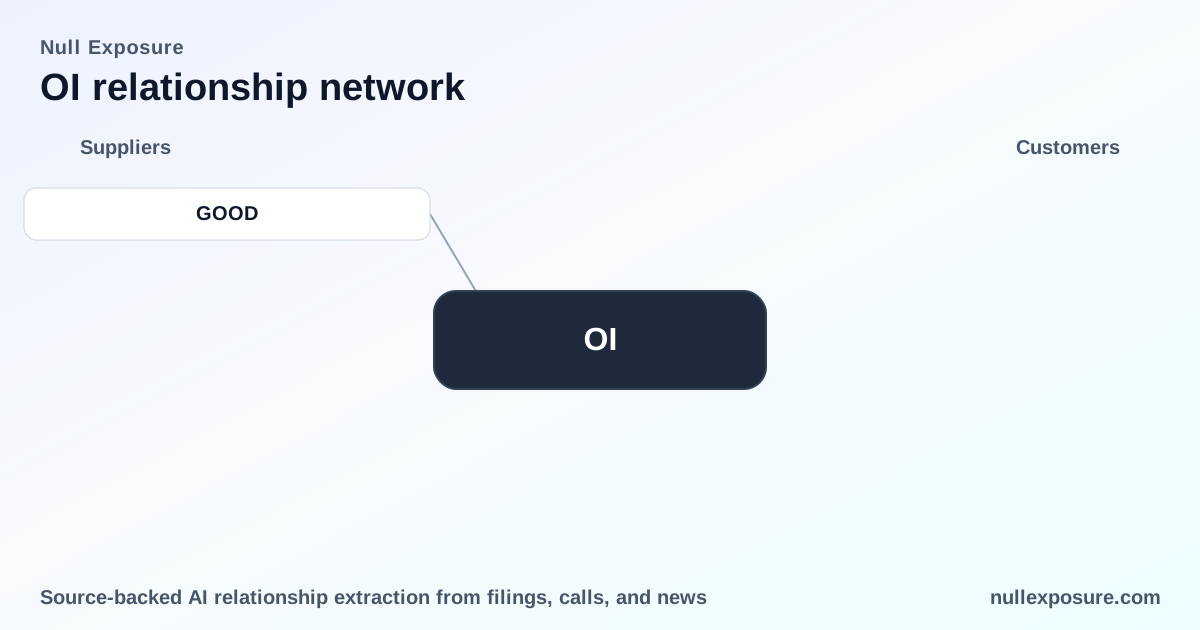
O-I Glass Inc (OI): Operational relationships and what they mean for investors
Thesis: O-I Glass is a global manufacturer of glass containers that monetizes through long-cycle, industrial-scale supply contracts and volume-based sales to food and beverage customers, with raw-material and energy inputs dominating operating costs and warehouse/logistics relationships supporting distribution. For investors evaluating supplier and landlord counterparties, the picture is one of high operational criticality and large, predictable spend on energy and working-capital facilities, complemented by localized property leases that support production-to-market logistics. Learn more about how we assemble these commercial relationships at https://nullexposure.com/.
How O-I makes money and why counterparty links matter O-I generates roughly $6.4 billion of annual revenue and reported about $1.1 billion of gross profit on the latest trailing twelve months, reflecting a capital- and energy-intensive industrial business. The company’s profitability is sensitive to commodity and energy costs—energy obligations alone are disclosed as more than $1.3 billion in contracted payments over the next five years, creating both scale and predictability in procurement but also concentration in a single spend category. The glass business monetizes through container sales to beverage and food manufacturers, while logistics and warehousing relationships convert production into shipped goods; thus landlords and financial counterparties directly affect O-I’s ability to deliver product and manage cash flow.
For a rapid view of supplier links and counterparty intelligence, visit https://nullexposure.com/ for enhanced profiles and relationship mapping.
A complete look at the supplier/landlord relationships found in public materials Below are the relationships surfaced in the public record and summarized in plain English. Each entry is short and source-cited.
-
Gladstone Commercial Corporation — HeraldTribune press coverage reported that two buildings owned by Gladstone serve as warehousing and distribution facilities for glass container products manufactured by O-I Glass. This indicates O-I’s reliance on third-party industrial real estate for regional distribution. (HeraldTribune press release, March 2026; reported via newswire.)
-
Gladstone Commercial Corporation — A Gladstone Commercial press release (ACCESS Newswire, January 20, 2026) states Gladstone executed lease extensions with Owens-Brockway Glass Container Inc. (O-I Glass) at a 290,000 sq. ft. building in Brockport, Pennsylvania and a 154,000 sq. ft. building in Lexington, North Carolina. These lease extensions reflect ongoing, active logistics commitments aligned with O-I’s regional supply chain footprint. (Gladstone Commercial press release, Jan 20, 2026.)
Operating-model constraints and what they signal about supplier posture The public disclosures and extracted constraints point to four company-level signals investors should treat as structural characteristics of O-I’s supplier posture:
-
Long-term contracting for energy: O-I discloses long-term energy contracts (terms reported at one to three years in Europe, and aggregated five-year payment projections of ~$1.328 billion), which signals a deliberate strategy to lock energy input pricing and availability. This is a cost-management posture that reduces short-term volatility but increases multi-year supplier exposure to specific energy providers and contract terms. (Company disclosures through FY2025–FY2026.)
-
Large, concentrated spend: The magnitude of contracted energy spend—annual expectations between $191 million and $527 million over the next five years—constitutes a material proportion of operating cash flow and creates concentration risk around energy suppliers and markets. Treat energy counterparties as strategic partners rather than tactical vendors.
-
Active financial programs for payables: The company shows an active supply-chain finance (SCF) program with approximately $69 million (2025) and $82 million (2024) outstanding to financial institutions, which signals reliance on third-party financing to optimize working capital and supplier payments. This is an active liability and counterparty relationship with banks and insurers. (Company disclosure of SCF program balances, year-end 2024–2025.)
-
Scale and criticality over maturity: These constraints together indicate high criticality (energy and logistics directly affect production), significant scale (hundreds of millions to over a billion dollars in commitments), and contract maturity concentrated in multi-year bands rather than spot contracts—traits that favor stability but create concentrated counterparty exposure.
What the Gladstone relationships mean in practical terms Gladstone’s lease extensions and the use of its properties for warehousing underline two operational realities:
-
Logistics continuity: Securing large industrial footprints in Brockport and Lexington through lease renewals supports O-I’s ability to store and stage finished goods close to customer clusters, reducing transit times and costs. (Gladstone Commercial press release, Jan 20, 2026.)
-
Third-party real estate dependency: The use of externally owned distribution facilities creates landlord counterparty and lease rollover risk; a materially adverse action by a landlord or a regional market shock could constrain O-I’s distribution agility. (HeraldTribune coverage, March 2026.)
Investment implications and risk checklist Investors and operators should weigh these relationship characteristics when assessing O-I as a supplier counterparty or portfolio holding:
-
Operational exposure to energy pricing and counterparties is high: With large, contracted energy spend, O-I’s margins are tightly coupled to energy contract terms and supplier performance. That makes supplier credit quality and contract terms central to downside risk control.
-
Working-capital financing is embedded: The active SCF balances indicate dependence on external financial institutions for payables smoothing; disruptions in bank markets or tighter financing terms would have immediate cash-flow implications.
-
Real-estate and logistics counterparties matter for distribution resilience: Gladstone lease renewals show O-I’s preference for stable, long-dated logistics arrangements; from an investor standpoint this increases predictability but concentrates counterparty exposure.
-
Financial profile supports industrial scale but profitability is pressured: O-I reports roughly $1.016 billion of EBITDA on $6.4 billion revenue but a negative reported EPS in the latest period; operational risks—energy, labor, logistics—will be the primary drivers of margin recovery or deterioration.
Mid-analysis action: for a deeper counterparty map that ties these operational facts to legal and financial documents visit https://nullexposure.com/ to access linked relationship profiles and source records.
What to watch next
- Contract renewals for major energy suppliers and any shift from fixed to variable pricing.
- Changes in SCF program utilization and counterparty composition among banks.
- Lease expirations or disposals of key warehousing locations that could force logistical re-shoring or higher transport costs.
- Company-level metrics such as operating margin and quarterly revenue trends that will reflect how contractual fuel and logistics costs pass through to earnings.
Conclusion and recommended investor posture O-I is a capital-intensive industrial operator whose supplier landscape is dominated by large, multi-year energy contracts and targeted logistics leases such as those with Gladstone Commercial. For investors and operators evaluating relationships, prioritize counterparty credit, contract tenure, and the flexibility of logistics networks. Those factors will determine whether O-I’s operating model delivers durable cash flow or remains vulnerable to commodity and financing cycles.
If you want a linked, transaction-level view of these relationships and the underlying source documents, start your due diligence at https://nullexposure.com/ — the platform centralizes the filings and press records that underpin these conclusions.