Oil States International (OIS): Supplier and lending relationships that shape operational risk and liquidity
Oil States International operates and monetizes by selling oilfield products and services across drilling, completion, subsea and production segments while funding working capital and growth through bank facilities and strategic acquisitions. Revenue is product and services-driven; liquidity and deal execution depend on a syndicated credit posture that is currently anchored by Wells Fargo as administrative agent. For a concise view of counterparties and what they imply for suppliers, lenders and operators, see Null Exposure’s supplier coverage: https://nullexposure.com/.
Why counterparties matter for investors: a short framing
Oil States is a capital-intense equipment and services supplier to the oil and gas industry. That operating model translates into two investor-facing realities: (1) supplier and technology relationships influence product differentiation and field deployment, and (2) bank and lender relationships determine financing flexibility and covenant-driven constraints on capital allocation. Understanding who supplies critical controls, and who underwrites the balance sheet, is a core part of counterparty and credit analysis for OIS.
The core supplier and lender list you need to know
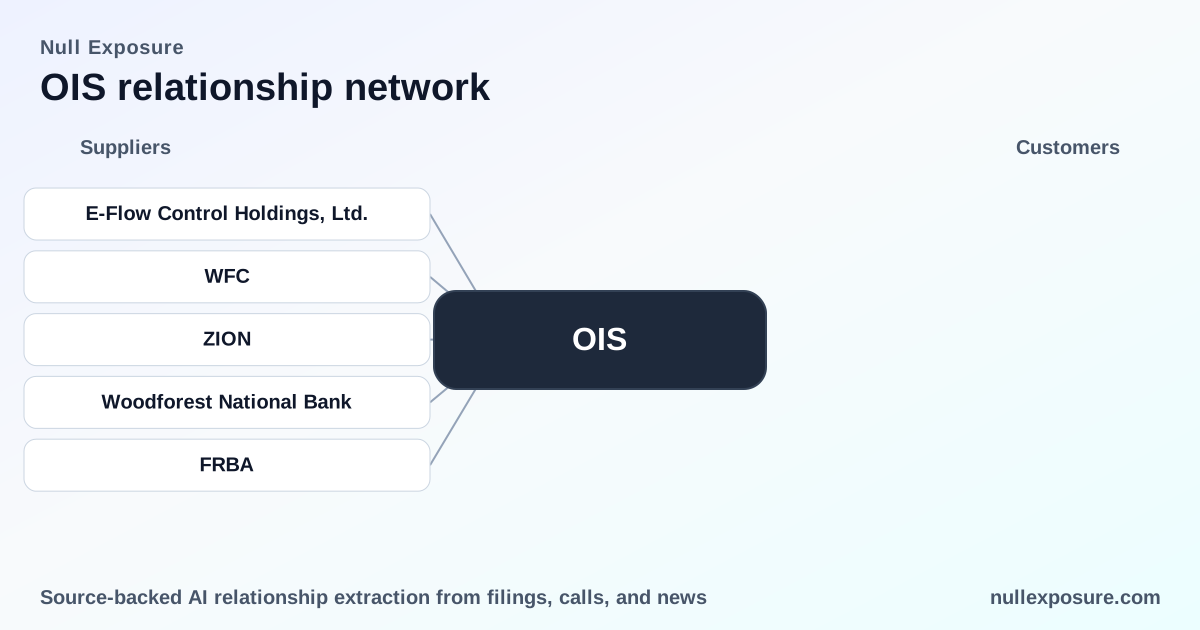
Below I cover every relationship reported in the source feed. Each entry is a plain-English snapshot with the source cited.
-
E-Flow Control Holdings, Ltd.
Oil States integrates E-Flow controls into its Managed Pressure Drilling and Riser Gas Handling Systems, with E-Flow powering, operating and fully monitoring those systems—indicating a technology supplier relationship that is embedded in field equipment. This relationship dates back to the company’s acquisition activities noted in press coverage; see Oilfield Technology coverage of the E-Flow acquisition (August 2022). -
Wells Fargo Bank, National Association (Wells Fargo / WFC)
Wells Fargo serves as the administrative agent on Oil States’ Cash Flow Credit Agreement and leads an amended and restated credit facility secured by substantially all U.S. assets and certain foreign subsidiary stock, with interest tied to Term SOFR or a base rate and standard leverage and interest-coverage covenants—making Wells Fargo the primary banking counterparty and the operational underwriter of OIS’s liquidity. See the company’s January 28, 2026 press release reported on BizWire and additional coverage on TradingView and The Globe and Mail (January 2026). -
Zions Bancorporation, N.A. dba Amegy Bank
Zions/Amegy is named as one of the participating lenders under the Cash Flow Credit Agreement, signalling a syndication that spreads credit exposure beyond the administrative agent. The lender list appears in the same January 2026 disclosure about the new credit agreement (BizWire, FY2026). -
Woodforest National Bank
Woodforest is listed among the lenders in the new Cash Flow Credit Agreement and therefore is a participant in the bank syndicate that funds OIS’s working capital and acquisition activity. This participation is disclosed in the January 2026 press release (BizWire, FY2026). -
First Bank
First Bank is also named as a lender under the Cash Flow Credit Agreement, rounding out the smaller regional banking participants in the facility and spreading the credit risk across several institutions (BizWire coverage, January 2026).
What these relationships signal about operations and risk
Oil States exhibits a hybrid operating model: product differentiation through technology integrations (e.g., E-Flow controls) paired with a traditional bank-financed capital structure. Key implications for investors:
-
Contracting posture: OIS uses multi-bank credit facilities rather than relying solely on public markets for short-term liquidity, with Wells Fargo acting as administrative agent. That structure gives the company negotiating leverage with a lead bank but also concentrates administrative control. Source: January 2026 press releases and trading coverage.
-
Concentration vs. distribution: While the lending package is syndicated (Wells Fargo + Zions/Amegy + Woodforest + First Bank), Wells Fargo’s role as administrative agent creates a single point of control for covenant waivers and default negotiations. This is a material governance and liquidity consideration for creditors and counterparties. See BizWire and Globe and Mail coverage (FY2026).
-
Criticality of suppliers: The integration of E-Flow controls into core drilling systems demonstrates supplier-critical technology—loss of access to that control platform would be operationally meaningful for certain product lines. See Oilfield Technology (FY2022).
-
Maturity and historical financing behavior: Historical use of bank facilities to fund acquisitions (for example, a 2010 acquisition funded by a Wells Fargo loan facility) indicates a persistent reliance on bank credit for growth and M&A. That historical pattern is relevant to forecasting future capital allocation and leverage behavior. See ProactiveInvestors coverage (FY2010).
Constraints and company-level signals
The supplier-relations feed provided contains no explicit constraint entries. As a company-level signal, that absence means no additional constraint metadata (e.g., explicit supplier termination clauses, minimum purchase commitments, or maturity schedules) was recorded in this dataset for suppliers. Investors should therefore treat contract-level detail as unavailable here and use public filings or direct vendor schedules to validate covenant triggers, amortization timing, and any supplier SLAs.
Practical investor takeaways
- Liquidity and covenant risk are the dominant counterparty exposures: Wells Fargo’s role as administrative agent concentrates influence over the credit agreement structure, covenants and collateral remedies; the syndicate membership spreads nominal exposure but does not eliminate administrative concentration. (BizWire, Globe and Mail, TradingView, January 2026.)
- Operational disruption risk is concentrated around specific technology suppliers: E-Flow’s controls are embedded in key systems, making that relationship operationally material. (Oilfield Technology, FY2022.)
- Historical precedent shows repeat bank financing for acquisitions, which frames expectations for future capital raises or refinancing needs. (ProactiveInvestors, FY2010.)
If you want a consolidated counterparty view and a deeper breakdown of covenant language, collateral schedules and supplier criticality, start here: https://nullexposure.com/.
How to use this intelligence in a risk framework
- Stress-test covenant thresholds under higher rates and lower EBITDA scenarios given the Term SOFR linkage in the credit agreement. (Refer to the January 2026 facility summary.)
- Validate operational resilience for lines that rely on E-Flow controls; factor supplier substitution costs into outage loss assumptions. (Oilfield Technology, 2022.)
- Monitor communications from Wells Fargo as administrative agent for any amendments or waivers—those announcements are the earliest public signals of covenant pressure.
For a practical next step—request the full counterparty dossier, covenant excerpts and supplier SLA summaries at Null Exposure: https://nullexposure.com/.
Final assessment
Oil States runs a differentiated engineering business that depends on a small set of critical supplier technologies and a bank-centric financing model. That combination creates a profile where operational idiosyncrasies (technical integrations like E-Flow) and liquidity/covenant dynamics driven by Wells Fargo as administrative agent dominate near-term investor risk. Track lending announcements and supplier operational disclosures as the two primary lead indicators for credit and operational outcomes.