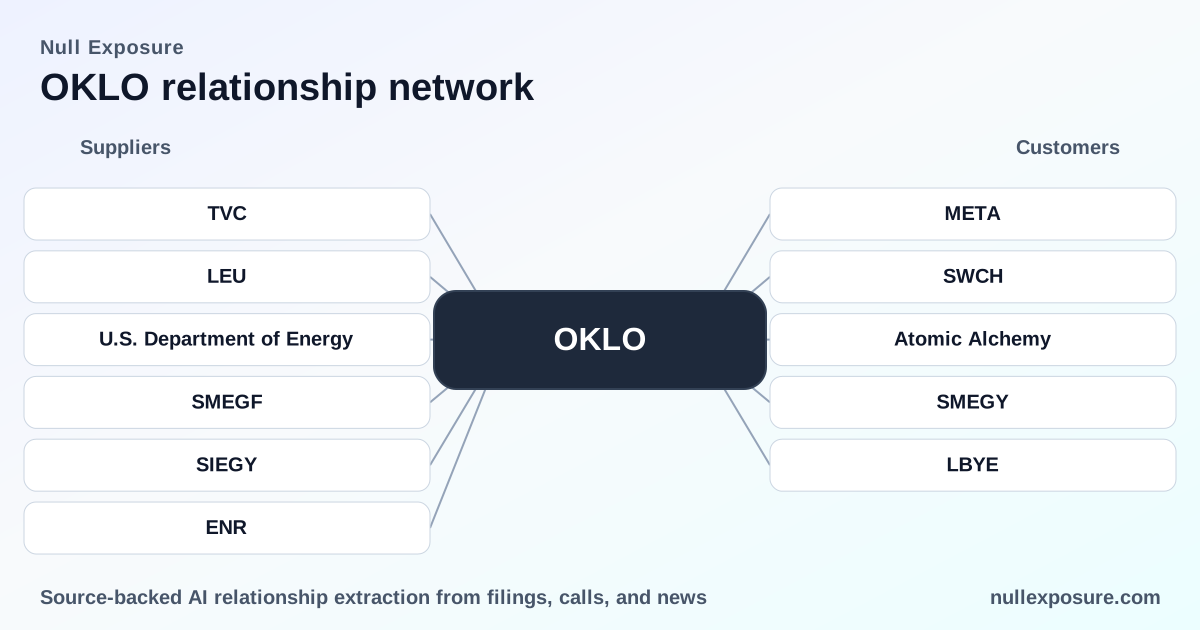
Oklo Inc. (OKLO): Supplier relationships that shape commercial nuclear rollout
Oklo designs and develops small fission power plants and monetizes through deployment and commercialization of its Aurora reactor — selling electricity and integrated reactor systems to commercial customers, licensing technology and engineering services, and participating in government-funded R&D and fuel-service arrangements. The company’s path to revenue depends on securing long-lead equipment, fuel supply and strategic partners that convert technical design into bankable projects and repeatable customer deliveries.
For a concise supplier-risk and partner map, visit https://nullexposure.com/ to see how these relationships slot into project economics and counterparty exposure.
What matters to investors: commercialization through partners and de-risked supply chains
Oklo is progressing from lab-scale development toward commercial deployments. Key value drivers are: (1) access to reactor-critical equipment (power conversion systems), (2) reliable fuel supply and back-end services (HALEU and used fuel handling), and (3) commercial offtake or anchor customers. Each relationship reported in public sources addresses one of these drivers: Siemens Energy for conversion hardware, Centrus for HALEU-related services, the U.S. Department of Energy for R&D funding, and the Tennessee Valley Authority as a potential source of used fuel.
Because Oklo’s revenue is currently zero and operating metrics show negative profitability, partner contracts and government awards are the primary near-term signals investors should watch. Binding design-and-delivery contracts and joint ventures materially reduce execution risk for initial Aurora deployments.
Explore supplier exposure analysis and contract-level impacts at https://nullexposure.com/.
Company-level operating constraints and what they imply for procurement strategy
Oklo’s public commentary on supply chain exposures frames a company-level constraint: global supply chain vulnerabilities are a material business risk. The company cites dependence on networks for turbine components, electrical systems and construction materials, which signals:
- Contracting posture: Oklo must negotiate long-lead, binding supply agreements for critical equipment and favor suppliers with delivery guarantees and proven nuclear experience.
- Concentration: Reliance on a small set of highly specialized suppliers increases single-supplier concentration risk for capital projects.
- Criticality: Components such as the power conversion system are schedule-critical; vendor performance directly affects commissioning timelines and cash flows.
- Maturity: Partnerships with established industrial suppliers and government R&D awards signal a transition from prototype R&D toward commercial maturity, but procurement complexity remains elevated.
These are company-level signals; they are drawn from Oklo’s supply-chain commentary and not assigned to any single counterparty unless explicitly named in source excerpts.
Relationship-by-relationship breakdown (FY2026 reporting)
-
Tennessee Valley Authority — Oklo is exploring obtaining used nuclear fuel from TVA’s seven reactors, potentially creating a pathway for feedstock or fuel recycling initiatives. Source: The Oak Ridger, Feb 19, 2026 (https://www.oakridger.com/story/news/local/2026/02/19/find-out-more-about-orano-and-oklos-nuclear-plans-for-oak-ridge/88716755007/).
-
Centrus Energy Corp. (Intellectia report 1) — Oklo and Centrus announced plans to explore a joint venture for HALEU deconversion services at Centrus’ Piketon site, aiming to integrate enrichment and deconversion to improve efficiency and lower fuel costs. Source: Intellectia (FY2026) (https://intellectia.ai/news/stock/oklo-nuclear-startup-faces-stock-volatility-amid-regulatory-challenges).
-
Centrus Energy Corp. (Intellectia report 2) — A second Intellectia notice reiterates the Centrus–Oklo JV exploration for HALEU deconversion, indicating multiple market reports tracking the fuel-supply collaboration. Source: Intellectia (FY2026) (https://intellectia.ai/news/stock/oklo-stock-continues-rise-supported-by-doe-award).
-
U.S. Department of Energy — The DOE awarded over $19 million across five companies for nuclear fuel recycling research, with Oklo receiving funding to study radioactive materials in hot liquid salt, supporting its technology roadmap and lowering R&D funding needs. Source: Intellectia report on DOE awards (FY2026) (https://intellectia.ai/news/stock/oklo-stock-continues-rise-supported-by-doe-award).
-
Siemens Energy (Procurement Magazine) — Oklo signed a binding contract with Siemens Energy for the design and delivery of the power conversion system for the Aurora powerhouse, securing a key vendor for a schedule-critical system. Source: Procurement Magazine (FY2026) (https://procurementmag.com/news/oklo-siemens-strategic-procurement-clean-energy).
-
Siemens Energy (247WallStreet) — Coverage notes the binding Siemens Energy contract announced in February 2026 as a de-risking event for Oklo’s supply chain, directly addressing a major procurement milestone for Aurora. Source: 247WallStreet, Feb 25, 2026 (https://247wallst.com/investing/2026/02/25/oklo-is-down-24-but-reddit-is-betting-on-a-250-target-by-july-4/).
-
Siemens (SimplyWallSt) — Simply Wall St highlights partnerships with Siemens and Meta as commercial signals supporting planned Aurora deployments and technology solutions for power customers. Source: Simply Wall St (FY2026) (https://simplywall.st/stocks/us/utilities/nyse-oklo/oklo/news/oklo-pairs-fuel-recycling-bet-with-aurora-reactor-progress-a).
-
Siemens Energy / Meta / Liberty Energy (SimplyWallSt) — A Simply Wall St article records binding agreements with Meta, Siemens Energy and Liberty Energy, indicating commercial interest from large counterparties across data centers, power technology and energy services for Aurora reactors. Source: Simply Wall St (FY2026) (https://simplywall.st/stocks/us/utilities/nyse-oklo/oklo/news/oklo-pairs-fuel-recycling-bet-with-aurora-reactor-progress-a).
Investment implications and risk checklist
- Positive: strategic vendor commitments. The Siemens Energy binding contract is a major positive — it secures a schedule-critical subsystem and reduces delivery risk for initial plants.
- Positive: fuel-supply pathbuilding. Conversations with Centrus for HALEU deconversion and TVA for used fuel suggest Oklo is actively solving upstream and back-end fuel constraints that otherwise block commercial deployments.
- Positive: government support accelerates R&D. DOE funding for hot liquid salt research lowers Oklo’s R&D burden and validates aspects of its fuel-recycling roadmap.
- Risk: supply-chain concentration and global exposure. Oklo’s reliance on specialized international supply networks for turbine, electrical and construction components leaves the company exposed to geopolitical and logistics shocks; this remains a meaningful execution risk until multiple suppliers and inventory buffers are proven.
- Operational sensitivity: vendor performance on the power conversion system and HALEU logistics will directly determine construction schedules, commissioning and first cash flows.
For a deeper supplier risk score and counterparty exposure map, go to https://nullexposure.com/ to see contract-level and maturity indicators across Oklo’s ecosystem.
Bottom line
Oklo’s public relationships show purposeful steps to de-risk commercialization: a binding Siemens Energy contract for a critical plant subsystem, exploratory fuel partnerships with Centrus and TVA, and DOE-backed R&D funding. These relationships materially improve Oklo’s ability to move Aurora reactors toward revenue-generating deployments, but global supply-chain vulnerability and component concentration remain principal execution risks until supply diversification and successful commissioning are demonstrated.
To evaluate counterparty concentration and procurement maturity for Oklo’s projects, visit https://nullexposure.com/ for structured exposure analysis and supplier scoring.