Okta: Identity Supplier Relationships and What Investors Should Price In
Okta Inc. runs a subscription-first identity and access management platform, selling single sign‑on, multi‑factor authentication and lifecycle management to enterprises and channel partners. The company monetizes primarily through recurring SaaS contracts and channel distribution, capturing revenue as term licenses and professional services while leveraging cloud hosting partners and resellers to scale globally. For investors, Okta’s growth and margin trajectory is tied as much to distribution and cloud hosting relationships as to product adoption.
Explore further at NullExposure.
How Okta makes money and why supplier ties matter
Okta’s commercial model is straightforward: enterprise subscriptions and channel-led sales drive high-margin recurring revenue, underpinned by professional services and integrations. Financials reflect scale and public‑market maturity — revenue TTM ~$2.92B, gross profit ~$2.26B, and positive EBITDA — and a valuation that prices growth (trailing PE ~58.9, forward PE ~20.24). Institutional ownership is concentrated (over 92%), signaling that large investors treat Okta as a core cybersecurity exposure.
From an operating perspective, supplier relationships affect three practical investor dimensions:
- Contracting posture: Okta sells enterprise contracts with term commitments and uses cloud providers and resellers to localize delivery and accelerate renewals.
- Criticality and concentration: Identity is mission‑critical for customers; dependence on a small set of strategic partners to reach regulated markets creates concentrated execution risk.
- Maturity and optionality: A public company with positive margins and scaled platform economics can negotiate favorable terms with suppliers while investing in regional infrastructure.
There are no explicit supplier constraints reported in the materials reviewed; present signals above are company‑level observations rather than relationship‑specific limits. If you want a focused supplier-risk briefing, see NullExposure.
The supplier relationships you must track
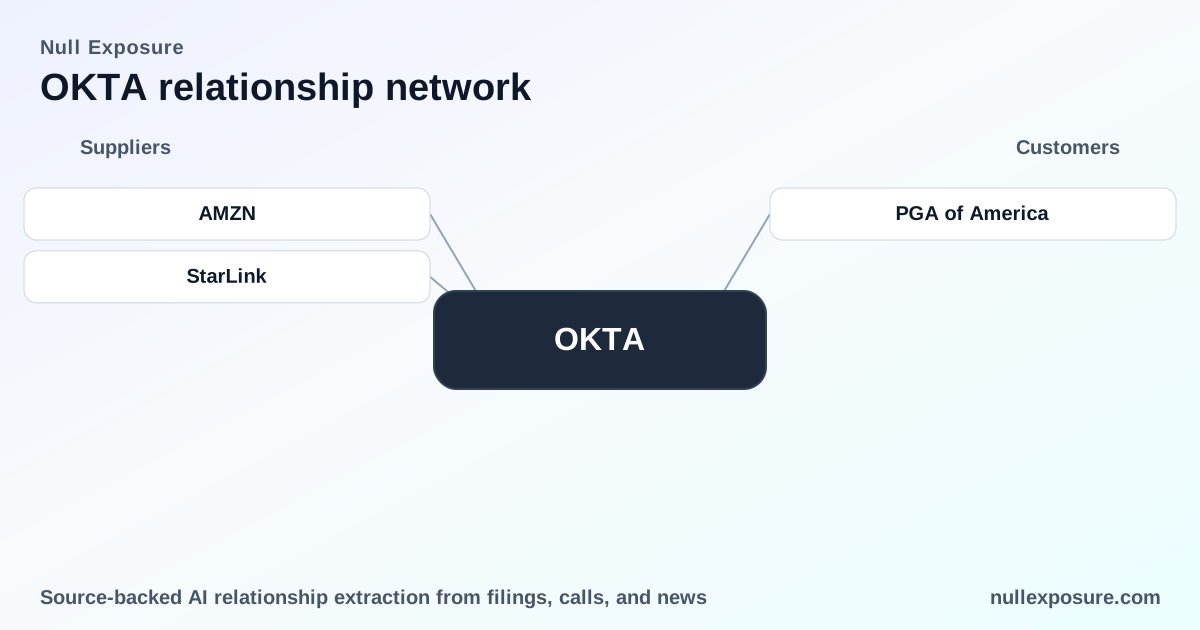
Amazon Web Services — India platform tenants (Sahm Capital, Jan 23, 2026)
Okta launched in‑country Okta Platform tenants hosted on AWS in India to provide local data storage, improved disaster recovery and compliance support for the DPDP Act and regulated sectors; this is an explicit push to win regulated Indian enterprise workloads. According to Sahm Capital reporting on January 23, 2026, hosting on AWS in India is a strategic lever to capture compliance-conscious customers (https://www.sahmcapital.com/news/content/how-oktas-india-ai-identity-push-at-okta-okta-has-changed-its-investment-story-2026-01-23).
StarLink — regional distributor / channel expansion (Reuters/TradingView, Oct 16, 2025)
StarLink is positioned as Okta’s strategic distributor in its region and will deploy an existing channel ecosystem to extend Okta’s market reach, focusing on zero‑trust and user experience propositions. A Reuters report syndicated via TradingView on October 16, 2025, described StarLink’s role in accelerating partner and enterprise adoption for Okta’s identity products (https://www.tradingview.com/news/reuters.com,2025-10-16:newsml_Zaw8cVrYy:0-pressr-starlink-and-okta-join-forces-to-empower-organisations-with-zero-trust-and-enhanced-user-experience/).
AWS — India hosting tied to AI and non‑human identities (Sahm Capital, Jan 27, 2026)
Okta’s tie to AWS in India is not only about data locality but also about supporting identity for both human users and AI agents, positioning the company to participate in spend as organizations formalize controls around non‑human identities. Sahm Capital’s January 27, 2026 piece highlights the strategic value of AWS hosting for Okta’s play in AI‑driven workloads (https://www.sahmcapital.com/news/content/okta-targets-indian-compliance-demand-with-local-data-centers-for-regulated-sectors-2026-01-27).
What these relationships imply for revenue and risk
The supplier notes above form a coherent commercial picture. AWS relationships underwrite Okta’s ability to sell into regulated markets by delivering local data residency and disaster recovery, which directly supports enterprise contract wins and renewals. The StarLink distribution agreement increases go‑to‑market scale in regionally important territories without proportionally increasing fixed sales costs.
Key investor implications:
- Revenue upside: Localized hosting on AWS opens procurement channels in jurisdictions with strict data residency laws, increasing addressable market in regulated industries.
- Cost and margin dynamics: Using hyperscalers preserves CapEx flexibility but creates variable cost pressure and dependence on cloud pricing; Okta’s margin profile must be monitored against cloud hosting costs embedded in gross margin.
- Concentration risk: Reliance on a small number of hyperscalers and large distributors concentrates operational risk — outages, pricing disputes, or contractual changes could have outsized impact.
- Strategic optionality: Okta’s public scale and strong institutional backing enable negotiation leverage with suppliers and the ability to invest in redundancy or alternate regions.
If you want supplier maps and exposure scoring across partners, NullExposure provides tailored briefings — visit NullExposure.
Constraints and operating‑model characteristics investors should price in
There are no explicit third‑party constraints disclosed for Okta in this supplier review. Company‑level operating signals are the useful guide:
- Contracting posture: Okta operates as an enterprise SaaS vendor with recurring subscription revenue and term contracts; supplier relationships are negotiated to support multi‑year enterprise renewals rather than one‑off transactions.
- Concentration: Institutional ownership and the company’s route to market (large enterprise deals + channel partners) create both stability and concentration risk; a handful of suppliers and distributors materially affect geographic scale.
- Criticality: Identity is a mission‑critical security layer for customers; this increases stickiness and renewal rates but also raises expectations for uptime, compliance and locality that suppliers must meet.
- Maturity: Okta is a scaled public company with positive EBITDA and cashflow characteristics that allow it to absorb supplier costs, invest in regional infrastructure, and diversify hosting if necessary.
These are company‑level signals, not relationship‑specific constraints.
Bottom line — what to watch next
Okta’s supplier moves into India with AWS and its channel expansion with StarLink are clear, strategic plays to accelerate regulated enterprise adoption and to monetize emerging demand for AI identity controls. Investors should watch:
- Contract wins and renewals in regulated industries (India, financial services, healthcare).
- Gross margin sensitivity to hyperscaler pricing and the share of revenue coming through distributor channels.
- Any formal supplier constraints or exclusivity language that could restrict Okta’s negotiating flexibility.
For a deeper supplier-risk assessment or to commission a bespoke exposure report, visit NullExposure.
Actionable takeaway: Okta’s supplier relationships materially de‑risk and expand its addressable market in regulated geographies, but they also concentrate exposure to hyperscalers and distributors — price growth upside against vendor dependency when modeling future free cash flow.