OKTG supplier relationships — what investors need to know
OKTG operates as a supplier that monetizes through contractual delivery of services and/or licensed products to enterprise and financial-sector buyers, generating recurring revenue streams and transaction-linked fees tied to client usage and distribution. This business model depends on high service availability, concentrated contract durability with anchor customers, and consistent product differentiation that supports renewal economics and margin preservation. For investors evaluating supplier counterparty risk and revenue durability, the key questions are concentration, contractual visibility, and the external market signals that connect OKTG to financial products and distribution partners. For deeper vendor intelligence and exposure mapping, visit https://nullexposure.com/.
Quick read: what the public signal shows
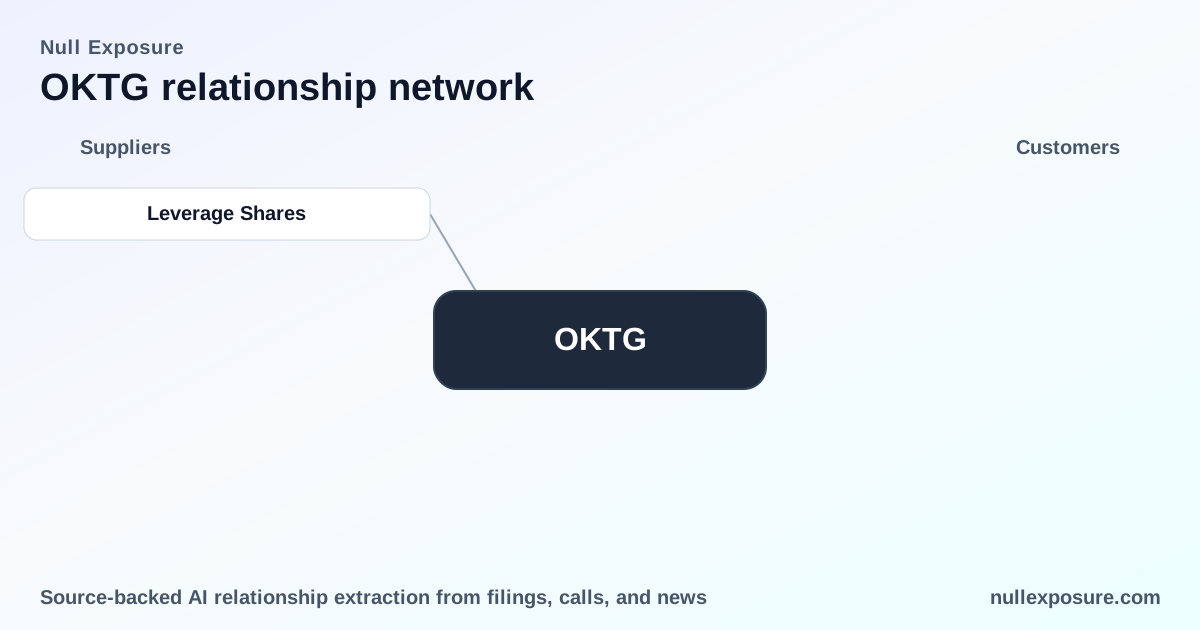
Public-sourced signals for OKTG are sparse but specific. The only relationship captured in the reviewed sources links OKTG to a market product reference from Leverage Shares—a leveraged ETF product tied to an OKTA exposure—recorded in FY2026. This single public mention suggests limited visible supplier partnerships in the monitored channels, which itself is an informative operating signal for counterparties and underwriters.
What the Leverage Shares mention means for investors
Leverage Shares appears in the dataset with a FY2026 entry referencing the “Leverage Shares 2X Long OKTA Daily ETF.” According to QuiverQuant’s capture on March 10, 2026, that mention connects a financial-product issuer to the OKTA/OKTG axis, indicating market-level derivative and distribution interest around technologies or tickers in this sector. Source: QuiverQuant capture, FY2026 (March 10, 2026).
Relationship-by-relationship coverage
This section lists every relationship captured in the reviewed results and provides a short plain-English summary to preserve transparency.
- Leverage Shares — The referenced line item is “Leverage Shares 2X Long OKTA Daily ETF,” recorded by QuiverQuant in FY2026; the record shows a market product that leverages OKTA exposure and is logged as related to OKTG in the source capture on March 10, 2026. This indicates that leveraged financial products are tracking the underlying technology exposure that intersects OKTG’s supplier footprint. Source: QuiverQuant, FY2026 (March 10, 2026).
How the operating model constraints shape investor risk
There are no explicit supplier constraints recorded in the reviewed constraints set; that absence is itself a company-level signal. From an investor lens, the lack of disclosed constraints implies limited public evidence of supplier-side contractual encumbrances, exclusivity clauses, or material off-balance commitments tied to suppliers in the monitored sources. Translate that into practical operating implications:
- Contracting posture: The absence of documented constraints suggests standard commercial contracting, rather than highly restrictive long-term supplier lock-ins that would transfer material execution risk to OKTG.
- Concentration: With only one public relationship captured, vendor concentration cannot be confirmed by this data; investors should assume concentration risk remains an open question until diligence verifies counterparty counts and revenue share by client.
- Criticality: The recorded relationship ties to financial-product references rather than supplier-delivered technical integrations; therefore, public signals point to market-level relevance rather than documented mission-critical supplier contracts.
- Maturity: Few visible supplier relationships in public sources suggest an early or under-disclosed supplier profile in public channels, which increases the value of direct diligence on contract terms, SLAs, and customer retention metrics.
Financial and operational implications for investors
- Revenue durability: Recurring revenue depends on renewals and the stickiness of integrations; investors should prioritize obtaining contract length, renewal rates, and termination clauses from management or counterparty confirmations.
- Counterparty and distribution risk: The Leverage Shares mention shows that financial-market instruments reference the sector exposure; investors should track whether OKTG is directly integrated into such products or is an adjacent data point used by issuers.
- Disclosure gap as a risk premium: Limited public relationships create an information gap; assign a premium to model uncertainty until supplier lists and material contract terms are produced.
Practical next steps for diligence
- Request the top 10 supplier contracts by spend and the top 10 customers by revenue contribution to assess concentration and counterparty risk.
- Obtain representative service-level agreements and termination provisions to quantify operational criticality and potential revenue fragility.
- Monitor market products and ETF issuers for additional signals of distribution or synthetic exposure that drive downstream demand for OKTG’s services.
For a consolidated view of supplier exposure and to benchmark OKTG against comparable supplier profiles, explore our platform at https://nullexposure.com/.
Bottom line and risk-adjusted view
The public record for OKTG’s supplier relationships is narrow; the only captured link is a FY2026 market-product mention from Leverage Shares referencing a leveraged OKTA ETF. That single mention is not sufficient to validate diversified supplier scale or deep distribution partnerships—investors should treat disclosure sparsity as a material diligence item. Obtain contract-level evidence to remove ambiguity around concentration, criticality, and renewal economics before sizing position risk or pricing credit protections.
For further supplier mapping and comparative risk scoring, visit https://nullexposure.com/ — the next step for investors who require rigorous, source-backed vendor intelligence.