Universal Display (OLED): Supplier Relationships, Concentration Risk, and Strategic Implications for Investors
Universal Display commercializes proprietary OLED emitter materials and licenses OLED technologies to display and lighting manufacturers, generating revenue through product sales of phosphorescent materials and licensing royalties tied to device manufacturers' adoption. The company captures value by pairing intellectual property with outsourced chemical manufacture and site-level services, monetizing both material sales and IP assets. For a closer diligence package on supplier exposure and counterparty risks, visit https://nullexposure.com/.
High-level thesis for investors
Universal Display operates a hybrid model: intellectual property and materials development at the core, with outsourced manufacturing and operational services supporting scale. That structure concentrates sourcing and operational counterparty risk while preserving margin capture through proprietary chemistry and royalty streams. Given a market capitalization around $4.5 billion and strong profitability metrics (profit margin ~37%, operating margin ~38% in trailing twelve months), the supplier stance is a material component of the investment thesis.
What the record of relationships tells you
This company relies on a small set of long-tenured partners for production and site services and has recently expanded its IP base through acquisitions. The following relationships appear in the public record and should be part of any supplier-risk review.
PPG Industries, Inc.
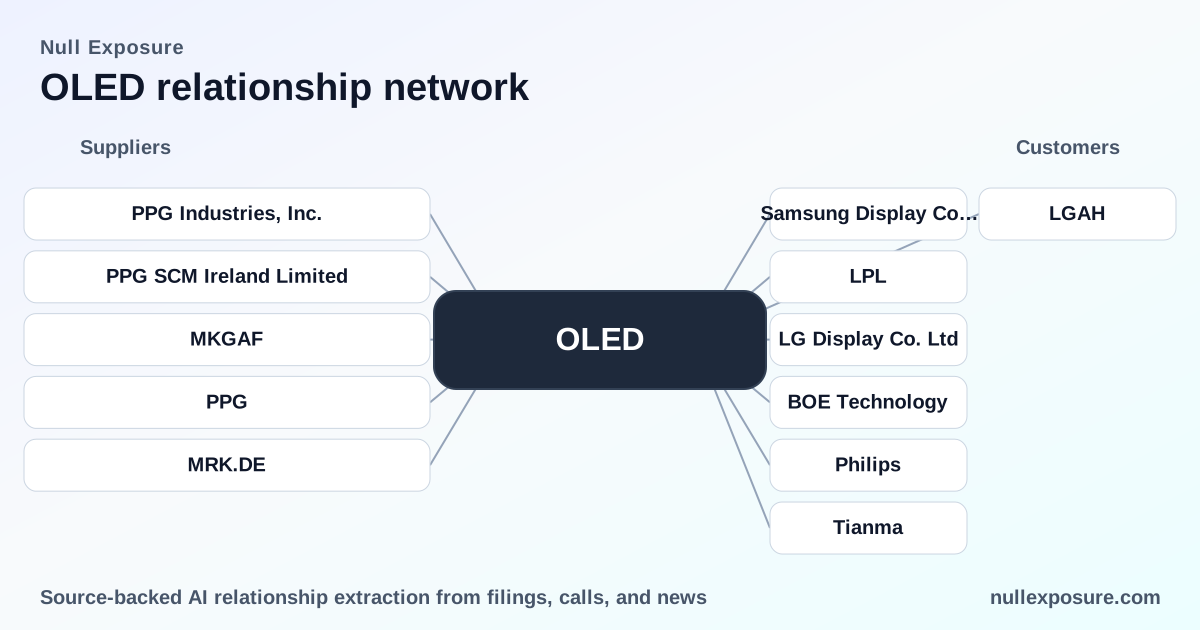
Universal Display has an Amended and Restated OLED Materials Supply and Service Agreement with PPG Industries dated October 1, 2011, evidencing a long-term commercial manufacturing relationship for OLED emitter materials. According to Universal Display’s FY2024 10‑K, this agreement formalizes PPG’s role in producing critical chemical materials used in UDC’s emitter business. (Source: Universal Display FY2024 10‑K)
PPG (news coverage and industry context)
PPG has been UDC’s exclusive manufacturer of phosphorescent OLED emitter materials since 2000, a relationship cited repeatedly in industry press and earnings transcripts and characterized internally as foundational to scaling UDC’s materials business over 25 years. This historical exclusivity indicates both a tested supply chain and significant supplier concentration. (Sources: optics.org industry reporting FY2021–FY2023; AlphaStreet earnings call transcript, March 2026)
PPG SCM Ireland Limited
An affiliate, PPG SCM Ireland Limited, provides specified operation and maintenance services to UDC Ireland at the Shannon, Ireland manufacturing site, according to the company’s public filings. This shows UDC delegates not only manufacturing but also site-level operational responsibilities to PPG affiliates for its European footprint. (Source: Universal Display FY2024 10‑K)
Merck KGaA (Darmstadt, Germany)
Universal Display entered into a definitive agreement to acquire OLED patent assets from Merck KGaA, and public reporting confirms completion of an acquisition of intellectual property assets that included PSF and related OLED technologies. This transaction strengthens UDC’s IP estate and reduces dependence on external licensors for certain emitter chemistries. (Sources: AlphaStreet earnings call transcript, March 2026; InsiderMonkey Q4 2025 transcript; CityBiz report, FY2025)
Business model constraints and what they signal for contracting posture
Universal Display’s disclosures and market coverage present several company-level signals relevant to contracting and supplier strategy:
- Supplier concentration is high. The filing notes that “substantially all chemical materials were purchased from one supplier,” a clear concentration signal that elevates counterparty risk for production continuity (company-level disclosure).
- Material spend is meaningful and committed. Purchase commitments for inventory totaled $46.5 million as of December 31, 2024, placing procurement at the $10m–$100m spend band—this indicates recurring, material purchasing commitments rather than one-off buys (company-level disclosure).
- Lease and facility obligations are smaller but ongoing. Lease obligations of roughly $4.3M–$4.4M in near-term years suggest fixed operational commitments in the $1m–$10m band (company-level disclosure).
These constraints combine to paint a contracting posture that is long-duration and concentrated: long-standing supplier agreements with significant committed spend make substitution difficult and raise the premium on supplier governance, contingency planning, and diversifying manufacturing capacity.
Operational criticality and maturity of supplier relationships
- Criticality: Manufacturing and site services provided by PPG affiliates are directly tied to the production of proprietary emitter materials; disruption to that channel would immediately impact revenue-generating product sales and derivative royalties. The exclusive manufacturing history amplifies this criticality.
- Maturity: Relationships with PPG span decades, and the company publicly flagged a 25‑year partnership milestone—this is a mature, entrenched supplier dynamic that benefits reliability but increases switching friction.
Risk implications for investors and operators
- Concentration risk is real and measurable. Given the “substantially all” language on materials sourcing and $46.5M in purchase commitments, investors must price in supplier idiosyncratic risk and monitor backup sourcing or internalization plans.
- IP acquisition reduces, but does not eliminate, operational dependence. The Merck KGaA asset acquisition strengthens UDC’s IP moat, yet manufacturing and operational dependency on PPG affiliates remains a live operational risk.
- Contractual tail risk. Long-term supply agreements can lock in favorable scale economics but constrain flexibility if market demand shifts or if counterparty performance degrades.
For procurement and supply-chain teams, the priorities are clear: validate contingency production capacity, negotiate fail-safe service levels in critical contracts, and quantify the financial impact of supplier disruption scenarios.
If you need a structured supplier risk map and vendor due diligence playbook tailored to Universal Display’s footprint, check our resources at https://nullexposure.com/.
Recommended investor diligence steps
- Demand transparency on alternative manufacturers and contingency capacity beyond PPG.
- Review the financial and operational terms of the PPG supply agreement (renewal dates, exclusivity clauses, termination rights).
- Validate integration and planned synergies from the Merck KGaA IP acquisition—specifically whether it reduces external licensing or manufacturing dependency over the medium term.
Final takeaway and action
Universal Display’s commercial model is high-margin and IP-rich, but materially reliant on a small set of suppliers and long-standing manufacturing partners. The Merck KGaA patent acquisition strengthens the IP position, but counterparty concentration with PPG and affiliates remains the principal supplier risk for investors and operators to monitor.
For a deeper vendor-risk dossier and to benchmark Universal Display’s supplier exposure against peers, visit https://nullexposure.com/. For direct support in constructing contractual mitigations and scenario stress tests, the team at Null Exposure can assist—start here: https://nullexposure.com/.