Olin Corporation (OLN): Supplier posture, key counterparties and operational constraints investors should price in
Olin is a vertically integrated chemicals and ammunition manufacturer that monetizes through the sale of industrial chemicals, intermediates and Winchester-branded ammunition and components. The company leverages long-term raw material and energy contracts, site-specific manufacturing assets and strategic acquisitions to stabilize margins across cyclical end markets; Olin reported roughly $6.78 billion in revenue and $654.9 million of EBITDA on a trailing basis while maintaining a market capitalization near $2.76 billion. Investors must evaluate Olin as a capital‑intensive operator with material long‑dated contractual obligations and concentrated raw‑material exposure that both stabilize supply and crystallize financial downside when partners close or markets shift. For a concise view of Olin’s supplier footprint, see the company summary at https://nullexposure.com/.
How Olin organizes purchasing: long-term anchors with short-term hedges
Olin’s filings and disclosures outline a clear contracting posture: a two‑speed supplier strategy. The company locks critical feedstocks and utilities under long-term arrangements while managing commodity price and currency exposure with short-duration derivatives.
- Long-term supply relationships and leases: Olin discloses supply contracts for ethylene, propylene, cumene and energy with initial terms “ranging from several to 20 years,” and leases with remaining terms up to 90 years, signaling site-specific capital commitments and limited rapid re‑sourcing options. These arrangements support production continuity but embed high fixed obligations and make operational performance sensitive to counterparty and physical‑asset shocks (2024 Form 10‑K).
- Short-term hedging: Commodity and currency hedges predominantly expire within one year, indicating an active near‑term risk management posture for volatility while leaving long-term price risk tied to contracted volumes (2024 Form 10‑K).
- Large financial counterparties: The counterparties to forward contracts include major banks such as Wells Fargo, Citibank, JPMorgan, Toronto‑Dominion and Bank of America, concentrating counterparty credit exposure among a handful of global institutions (2024 Form 10‑K).
- Spending and remediation scale: Purchase commitments for raw materials and utilities are in the hundreds of millions to multi‑billion dollar range, and environmental‑related cash outlays are forecast at roughly $25–$35 million annually for remediation work, representing recurring cash commitments beyond normal operating spend (2024 Form 10‑K).
- Business‑unit supplier concentration: Winchester’s propellant purchases are sourced predominantly from one of the U.S.’s largest propellant suppliers, indicating single‑supplier concentration for that ammunition input (2024 Form 10‑K).
These signals combine to describe a business model that is capital intensive, supplier‑anchored, and exposed to counterparty and site‑specific operational risk.
For a deeper supplier risk scan and relationship map, visit https://nullexposure.com/.
Supplier and partner relationships investors need to know
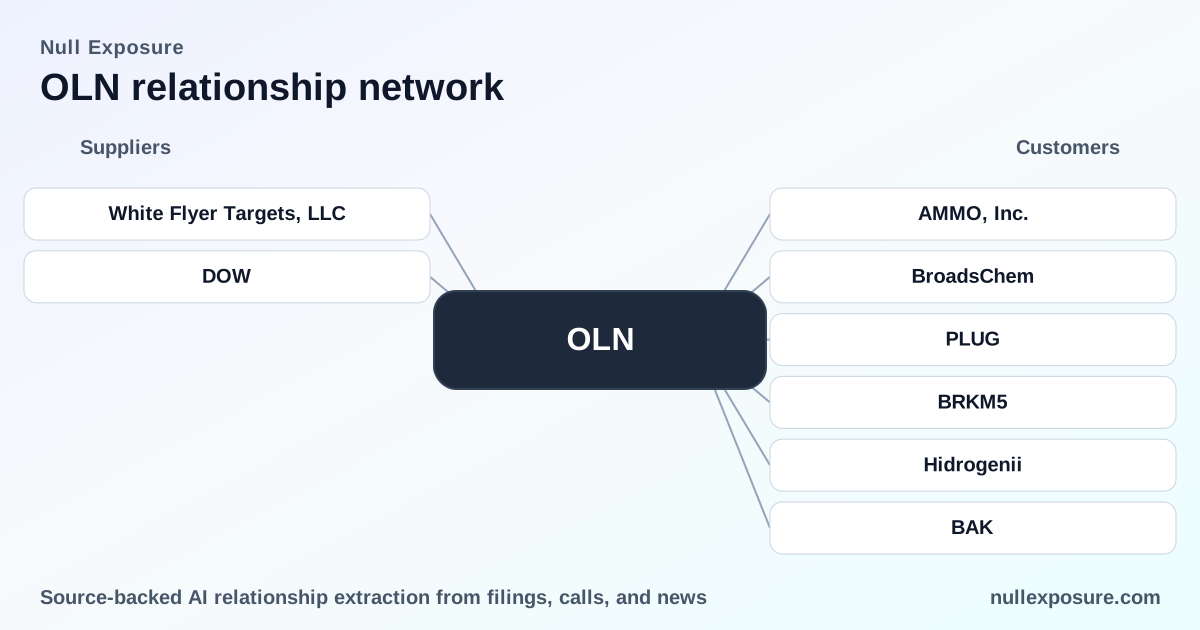
White Flyer Targets, LLC — tactical acquisition to bolster Winchester product set
Olin acquired the assets of White Flyer Targets, LLC on October 1, 2023 for $63.5 million, reflecting a targeted bolt‑on that expands Winchester’s addressable market for clay target products and related ammunition demand, as disclosed in Olin’s 2024 Form 10‑K (FY2024 10‑K filing).
Dow — direct source of stranded cost exposure after external plant closure
On the Q4 2025 earnings call, Olin quantified approximately $70 million of stranded costs resulting from Dow’s closure of its Freeport propylene oxide plant, a supplier disruption that crystallized near-term cash and restructuring costs tied to previously expected feedstock or co‑product flows (2025 Q4 earnings call).
What these relationships reveal about operational risk and optionality
The White Flyer purchase shows Olin continuing to use M&A to capture downstream integration and revenue diversification. The Dow disclosure is the clearest evidence that third‑party plant closures can generate material stranded costs for Olin because of interdependent supply arrangements and fixed plant economics.
- Counterparty closure risk is real and measurable: The Dow example demonstrates that even a single upstream closure creates tens of millions in stranded cost exposure.
- Acquisitions reduce market dependence but increase integration risk: White Flyer is small relative to Olin’s core chemicals business but represents vertical diversification that improves product mix resilience while adding integration execution requirements.
- Financial counterparties are concentrated: Short‑term derivative counterparties are large banks, concentrating credit risk if market stress impairs those institutions.
Due diligence checklist for investors and operators
Focus diligence on the intersection of contract maturity, spend concentration and counterparty credit:
- Stress test earnings for scenarios where a major raw‑material supplier closes or tightens volumes, as Dow’s Freeport closure produced explicit stranded costs.
- Confirm the maturity profile of supply contracts by feedstock and geography and quantify the cost of re‑sourcing or buy‑through commitments.
- Review environmental reserve adequacy against the company’s stated $25–$35 million annual remediation outlays.
- Monitor reliance of Winchester on a predominant propellant supplier and match that to inventory and secondary‑supplier development plans.
These are practical actions for procurement teams and buy‑side analysts to prioritize. For model templates and supplier concentration scores, go to https://nullexposure.com/.
Final takeaways for portfolio and operations managers
Olin’s operating model is a compound of long‑dated physical commitments and short‑dated financial risk mitigation. Long‑term contracts and site leases provide production stability but lock in fixed obligations; commodity hedges limit near‑term volatility but leave structural price and counterparty exposure. The Dow stranded cost event is evidence that supplier closures produce tangible balance sheet and cash impacts. White Flyer demonstrates an opportunistic approach to downstream diversification that reduces some revenue cyclicality but increases operational scope.
Investors and operators should price Olin not as a pure commodity chemical cyclical but as a capital‑intensive industrial with concentrated supplier relationships and non‑trivial remediation and contract obligations. For more supplier relationship intelligence and to map exposure across counterparties, visit https://nullexposure.com/.