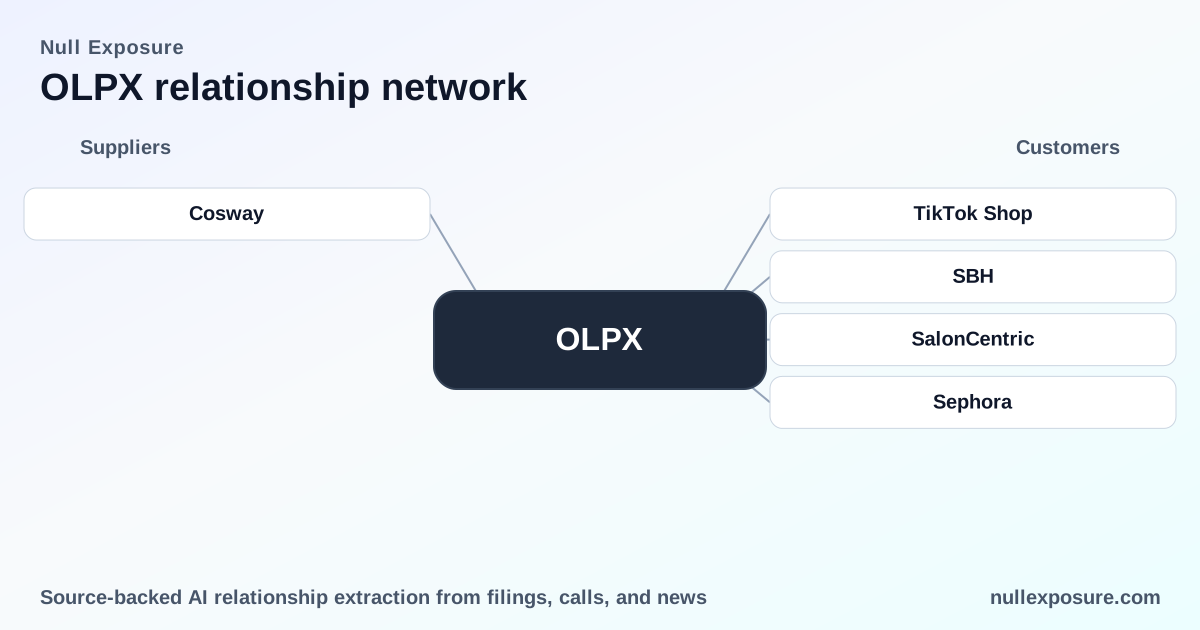
Olaplex (OLPX): Supplier Concentration Is a Core Operational Risk — and an Event-Driven Exposure for Investors
Olaplex is a branded hair‑care manufacturer and retailer that monetizes its intellectual property and formulations through product sales to salons and consumers, wholesale partnerships, and direct‑to‑consumer channels. The business model is high‑margin on gross profit but operationally highly dependent on third‑party manufacturing and fulfillment, creating a supplier-concentration risk that directly impacts revenue continuity and inventory availability. For investors assessing counterparty and supply‑chain exposure, the supplier profile in Olaplex’s FY2024 filings requires active monitoring. For a structured view of supplier risk and contract-level signals visit https://nullexposure.com/.
How Olaplex makes money and why supply relationships matter
Olaplex sells finished hair‑care products to both professional and retail channels. The firm outsources production to third‑party contract manufacturers and relies on external warehousing and distribution partners to get products into salons and retail shelves. Revenue is driven by product sales and brand penetration; margin realization and revenue continuity are therefore directly tied to supplier performance and capacity. The current financials show stable revenue near $423M (TTM) but thin operating margins and negative EPS, which increases sensitivity to production disruptions and input cost pressure.
The concentration problem: what the filings reveal
Olaplex’s public filings identify a pronounced single‑vendor concentration that elevates operational risk. The company’s FY2024 Form 10‑K discloses that one named manufacturer, Cosway, produced a portion of Olaplex’s finished goods that represented a significant share of sales and purchases in 2024. The same filing also states that finished products are produced by five contract manufacturers across the U.S. and Europe, and that third parties handle warehousing and distribution. These disclosure elements together paint a supply chain that is outsourced but heavily concentrated on a single counterparty for the bulk of product output.
Key operational signals:
- Single large manufacturer exposure — one supplier accounted for a majority share of sales and a substantial share of purchases in recent years.
- Geographic concentration — manufacturing and fulfillment are primarily located in Southern California.
- Third‑party manufacturing model — finished goods are produced by contract manufacturers; warehousing and distribution are outsourced.
- Active and material relationship posture — the relationships are operational and central to current product flow.
These signals should be read as company‑level constraints shaping Olaplex’s contracting posture, bargaining power, and recovery options in the event of supplier disruption.
Relationship detail: Cosway
Cosway manufactures a material portion of Olaplex’s products and inventories. According to Olaplex’s FY2024 Form 10‑K, Cosway manufactured products that accounted for 61% of Olaplex’s net sales and 48% of inventory product purchases in 2024. (Olaplex FY2024 Form 10‑K)
This level of concentration positions Cosway as a single point of failure for the business’s revenue flow and inventory replenishment. (Olaplex FY2024 Form 10‑K)
Contracting posture, criticality and maturity of the supplier footprint
Olaplex operates under a contract‑manufacturing posture with multiple third‑party manufacturers in the U.S. and Europe, but the effective maturity of that stance is uneven: the firm has the structure of diversified suppliers on paper, while actual sourcing is concentrated. The FY2024 disclosures describe five manufacturers overall but reveal that the bulk of sales have historically funneled through one large supplier relationship. This creates several practical consequences for investors and operators:
- Concentration risk is a current, not theoretical, hazard. A supplier that accounts for a majority of product output is functionally critical to revenue and inventory health.
- Geographic clustering increases correlated operational risk. Southern California manufacturing and fulfillment concentration exposes supply to local disruptions (labor, regulatory, weather, logistics).
- Contract leverage is asymmetric. High dependence reduces Olaplex’s near‑term bargaining power with the key supplier and limits speed of re‑sourcing during interruptions.
- Operational maturity is mixed. Outsourced production is standard for specialty consumer brands, but the reliance on a dominant manufacturer indicates incomplete execution of diversification strategies.
(Source: Olaplex FY2024 Form 10‑K; company filings covering manufacturing and fulfillment disclosures.)
If you are modeling downside scenarios or counterparty stress, quantify the revenue interruption that a temporary loss of the major manufacturer could inflict and stress‑test inventory and lead times. For practical supplier risk scoring and scenario playbooks see https://nullexposure.com/.
Financial and market implications for investors
The supplier profile compounds several measurable financial sensitivities for Olaplex:
- Revenue volatility risk: With one vendor tied to a majority of net sales, any production shortfall directly compresses top line and flow‑through to margins.
- Inventory and working capital pressure: Concentrated purchasing drives inventory concentration; replacement sourcing or emergency production increases cost and lengthens cash conversion cycles.
- Valuation multiple volatility: Market expectations priced into Olaplex’s EV/Revenue and EV/EBITDA assume continuity of supply; evidence of supplier disruption would re‑rate the company given thin operating margins.
- Operational leverage under stress: With negative EPS and modest operating margins, a material supply interruption could push results materially into loss and trigger downward analyst revisions.
(Source: Olaplex FY2024 Form 10‑K; company financial metrics TTM.)
If you are evaluating exposure or building a watchlist of single‑supplier risk, start with contract disclosure, manufacturing location, and any rights of first refusal or exclusivity clauses in vendor agreements. Learn more about supplier clauses and exposure mapping at https://nullexposure.com/.
Bottom line and investor actions
Olaplex is a profitable brand at the gross level with significant revenue concentration risk embedded in its outsourced manufacturing model. The single large manufacturing relationship — evidenced by material sales percentages — is the most consequential counterparty exposure in Olaplex’s operational profile. Investors should treat supplier disclosures as high‑priority risk indicators, incorporate stress scenarios tied to production loss, and monitor any operational updates from the company about diversification or contingency capacity.
Actionable next steps for investors and operators:
- Review Olaplex’s subsequent SEC filings and investor presentations for any announced supplier diversification or backup capacity.
- Model sensitivity to a 30–60 day manufacturing outage from the major supplier and estimate cash and inventory runway.
- Assess jurisdictional and logistics risk given the Southern California concentration noted in filings.
For a deeper supplier risk assessment framework and alerts that track vendor concentration, visit https://nullexposure.com/ — a practical resource to translate supplier disclosures into investor signals.
Sources: Olaplex Holdings Inc., FY2024 Form 10‑K filings and accompanying supplier disclosures (manufacturing, geographic concentration, and material vendor percentages).