OMAB: Concession-driven airport cash flows underpinned by top-tier local credit ratings
Grupo Aeroportuario del Centro Norte SAB de CV (OMAB) operates and monetizes long-term airport concessions across northern and central Mexico, collecting aeronautical charges, retail and real-estate concession revenues, parking and services; the business converts passenger volume into high-margin, recurring cash flow that funds maintenance capex and returns to shareholders. OMAB’s concession model delivers predictable operating leverage and strong profitability, which is reflected in robust margins, double-digit returns on equity and a valuation supported by favorable credit treatment. For a concise supplier-level dossier and sourcing context, visit the Nillexposure homepage: https://nullexposure.com/.
How the company makes and manages money — crisp operating characteristics
OMAB holds government-granted concessions to build, operate and maintain airports; revenues are a mix of regulated aeronautical fees and discretionary commercial income, giving the company both stability and upside with passenger recovery. The balance sheet and operating metrics show the business is cash-generative with scale: trailing revenue of roughly $15.96 billion, EBITDA of about $9.82 billion, a profit margin ~33.5%, and ROE ~48.8% (latest twelve-months). Market capitalization is about $5.25 billion, with forward valuation multiples that reflect both growth and capital intensity (EV/EBITDA ~10.5). These figures position OMAB as a mature, high-margin infrastructure operator with concentrated geographic exposure to Mexico.
- Contracting posture: concession-based, long dated, operator-of-record with obligations for maintenance and service-level performance.
- Concentration: single-country footprint (Mexico) concentrates regulatory and traffic risk.
- Criticality: airports are strategic assets with high local economic importance, supporting a defensible cash flow profile.
- Maturity: established operator with repeatable commercialization of airport retail and ancillary services.
Learn more about how suppliers and counterparties interact with concession operators at the Nillexposure hub: https://nullexposure.com/.
What the credit rating relationships show for OMAB
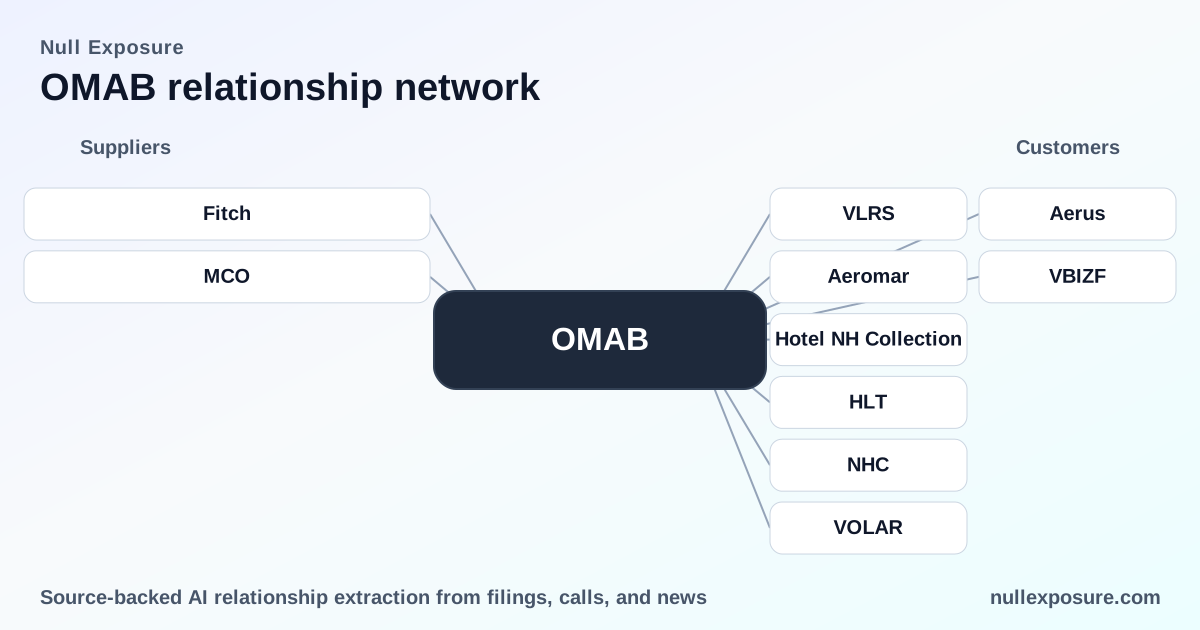
OMAB’s supplier relationship profile in available press focused on credit rating agencies and local rating outcomes, which are material because ratings affect funding cost and covenant structures.
Fitch
A Reuters dispatch republished on TradingView reported that Fitch assigned the Mexican-scale rating of AAA(mex) to the emissions, with a stable outlook — an endorsement of the company’s credit standing within Mexico’s sovereign and regulatory context (Reuters via TradingView, June 27, 2025: https://es.tradingview.com/news/reuters.com,2025-06-27:newsml_MNP9NKkVg:0/).
Moody’s Local
The same Reuters item noted that Moody’s Local assigned an AAA.mx national rating with a stable perspective, aligning with Fitch’s local-scale view and signaling symmetry across major domestic rating providers (Reuters via TradingView, June 27, 2025: https://es.tradingview.com/news/reuters.com,2025-06-27:newsml_MNP9NKkVg:0/).
These rating actions are meaningful for supplier relationships because higher local-scale ratings lower OMAB’s cost of domestic debt and improve access to local institutional funding, which in turn shapes payment terms and vendor-credit risk across the service and construction supply chain.
Constraints and supplier-risk signals (company-level)
The review found no explicit supplier constraints recorded in the current relationship payload. As a company-level signal, the absence of flagged constraints indicates no publicly captured contractual red flags, special collateral stipulations, or unusual supply-side encumbrances in the examined records. That silent signal combines with OMAB’s concession structure to produce a practical operating profile:
- Stable counterparty expectations: concession terms and regulated tariffs standardize revenue flows and payment certainty to suppliers.
- Predictable maturity cadence: concession lifecycles create known capital expenditure windows rather than spot supply shocks.
- Supplier criticality: key suppliers (construction, security, IT, retail operators) remain critical to operations but operate within predictable contracting frameworks.
Investors should treat the lack of recorded constraints as a signal of low immediate supplier distress in the public record, not as proof of zero supplier risk — primary exposures remain tied to traffic volumes, tariff regulation, and capital investment cycles.
What investors should watch next — risk vectors and upside catalysts
Credit ratings at the local AAA level are an important positive for OMAB: they compress domestic funding spreads and provide room to finance capex for terminal upgrades and commercial expansion. That rating support underpins OMAB’s forward P/E (~13.3) and EV/EBITDA (~10.5), enabling the company to fund growth without substantially diluting returns.
Key risk vectors to monitor closely:
- Passenger traffic volatility: passenger throughput drives most discretionary revenue and affects vendor payment flows.
- Regulatory and tariff adjustments: changes to aeronautical fees or concession renewals are value-critical.
- Concentration to the Mexican market: sovereign-related shocks or local macro weakness would transmit directly to cash flow.
- Capex cycles and contractor performance: large terminal or runway projects create concentrated supplier exposure.
On the positive side, high operating margins and strong profitability (profit margin ~33.5%) give OMAB operational flexibility to absorb cyclical swings and manage supplier relationships proactively. Investors should track quarterly passenger metrics, rating agency commentary, and concession-renewal timelines as primary inputs to supplier-risk modeling.
How to act on this profile — practical next steps for investors and operators
OMAB’s concession economics and local AAA credit ratings create a constructive backdrop for both creditors and strategic suppliers. For investors, prioritize monitoring passenger trends, regulatory filings and rating updates; for suppliers and operators, use the rating strength as leverage to negotiate competitive payment and financing terms while planning for traffic-driven volume swings.
For an integrated supplier-risk and relationship view, consult the Nillexposure homepage and supplier resources: https://nullexposure.com/.
Bottom line
OMAB is a concession-heavy, high-margin airport operator with strong local credit affirmation from major rating providers. The local AAA ratings reported in June 2025 reduce domestic funding stress and support favorable supplier terms, while the firm’s concentrated Mexican footprint and passenger-dependence remain the principal risk exposures. Investors and counterparties should treat the rating alignment as a structural positive but continue active surveillance of traffic, tariff and concession developments. For a consolidated supplier-risk assessment and ongoing updates, visit Nillexposure’s landing page: https://nullexposure.com/.