Omnicom Group (OMC): Platformizing ad services through data, commerce and retained agency economics
Omnicom is a global advertising and marketing holding company that monetizes through a mix of long-duration client retainers, media-buying spreads, creative and data services, and increasingly productized commerce and identity offerings. The company fortifies gross margins by owning agencies with recurring fee structures while pursuing strategic acquisitions and integrations to capture higher-margin, data-driven services. For investors and operators assessing supplier relationships, the critical question is whether these integrations convert ad spend into sticky, annuity-like revenue streams or simply add complexity to project-based work. Learn more about supplier signals and integrations at NullExposure.
How recent deals change the economics: Flywheel, Ascential and Acxiom in plain terms
Omnicom has shifted from pure creative and media-buying toward productized data and commerce capabilities that cross-sell to existing large-brand clients. Three relationship entries in recent filings and transcripts document that strategy:
-
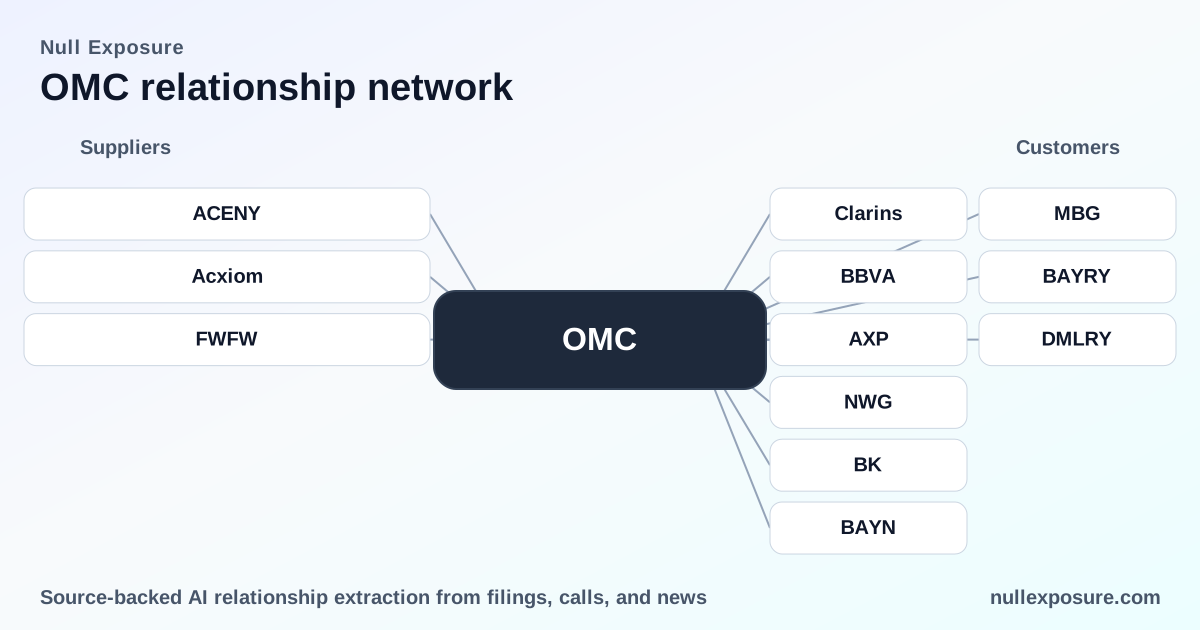
Ascential plc — Omnicom acquired Flywheel Digital, the digital commerce business of Ascential plc in January 2024, bringing commerce capabilities in-house and adding a direct channel into retailer and e-commerce commerce technology. This is a straight acquisition to own a commerce product and capture higher-margin transactions in digital commerce. According to Omnicom’s 2024 Form 10-K, the Flywheel acquisition closed in January 2024 (FY2024 filing).
-
Acxiom — Omnicom integrated Acxiom’s Real ID into its new Omni platform, combining identity capability with Omnicom’s proprietary data to strengthen identity resolution and addressability across channels. Acxiom’s identity assets represent a strategic bolt-on that enhances client measurement and targeted media performance. A Q4 2025 earnings call transcript published by InsiderMonkey describes the integration and platform launch (Q4 2025 / FY2026 commentary).
-
Flywheel — Beyond the acquisition, Flywheel’s Commerce Cloud was integrated into the Omni platform to create an end-to-end commerce-to-identity solution, positioning Omnicom to sell packaged commerce + identity + media products. Flywheel transitions Omnicom from agency services into technology-enabled commerce execution for clients. The Q4 2025 earnings call transcript on InsiderMonkey documents the integration of Flywheel’s Commerce Cloud into the Omni platform (Q4 2025 / FY2026 commentary).
Each of these relationships is disclosed as part of Omnicom’s platform build: the 10‑K documents the Flywheel acquisition, and the Q4 2025 earnings commentary describes the combined Omni platform integrating Acxiom, Flywheel and Omnicom data.
What the supplier moves mean for Omnicom’s operating model
No explicit third-party constraints were returned for supplier relationships; therefore the following are company-level signals describing Omnicom’s operating posture and business model characteristics:
-
Contracting posture: Omnicom operates with a mix of long-term retainers and project work; the acquisition and platform strategy increase the share of recurring, subscription-like revenue by productizing services (commerce cloud, identity services). This shift strengthens renewal economics and raises lifetime value of clients.
-
Concentration: As a holding company with major global clients, client concentration risk persists; platform products aim to diversify revenue by selling productized services across the entire client base rather than relying only on top account retainers.
-
Criticality: The integration of identity (Acxiom) and commerce execution (Flywheel) increases Omnicom’s criticality to clients that prioritize direct-to-consumer commerce and unified measurement—clients increasingly treat Omnicom as a strategic supplier for commerce and identity infrastructure, not only creative services.
-
Maturity: Core agency businesses are mature and lower-growth; the recent acquisitions represent a mid-stage move to scale newer, higher-growth product lines but require integration execution to convert into material margins.
These signals indicate that Omnicom is evolving its supplier and product footprint toward higher-margin, more recurring revenue streams but faces execution risk on integration and cross-selling.
Financial posture and valuation context — risk-adjusted view
Omnicom generates meaningful scale with revenue TTM of $17.27 billion and EBITDA of approximately $2.79 billion, while its operating margin remains healthy at about 14.9% even as net EPS shows temporary pressure (diluted EPS TTM of -$0.27). The company offers a 3.73% dividend yield and trades with a forward P/E around 8.4, reflecting a value orientation from the market alongside a low beta of 0.71. Analyst consensus target price sits near $100.9. These metrics frame supplier investments as follows:
- If integrations convert to recurring revenue, upside is valuation expansion via margin accretion and a higher multiple.
- If integrations fail to scale, Omnicom risks incremental SG&A and execution drag without durable margin uplift.
Midway through implementation, operators should prioritize measuring recurring revenue conversion, client retention on bundled products, and the margin profile of platform versus legacy agency lines. For more structured supplier analysis and coverage, visit NullExposure.
What operators and procurement teams should track in these relationships
For sourcing and vendor management, the Omnicom supplier posture implies a set of practical checkpoints:
- Contract terms: Push for transparent SOWs and service-level definitions when buying bundled commerce + identity offerings to avoid scope creep.
- Data governance and portability: Insist on clear data usage, portability and measurement clauses given the centrality of identity assets (Acxiom integration).
- Integration timelines and milestones: Track concrete milestones for platform feature releases and client onboarding to validate the revenue ramp from recently acquired assets.
- Pricing mix visibility: Request line-of-business reporting that differentiates recurring subscription-like fees from one-off project revenue.
These operational items translate vendor relationships into measurable supplier risk and opportunity.
Bottom line for investors and operators
Omnicom is reinventing parts of its business model through acquisitions and platform integrations that aim to convert agency relationships into productized, recurring revenue. The Flywheel acquisition and Acxiom integration together form the nucleus of a commerce + identity play that, if executed, raises client stickiness and creates higher-margin revenue. Financially, Omnicom maintains scale and cash return to shareholders via dividends while offering potential upside through margin improvement and recurring revenue growth.
If you are evaluating supplier exposure or partnership strategies with Omnicom, prioritize contract clarity, data governance and concrete performance milestones. Explore deeper supplier intelligence and ongoing updates at NullExposure.
Key relationship takeaways:
- Ascential / Flywheel acquisition (January 2024): Omnicom purchased Flywheel Digital from Ascential to own commerce capability inside the holding company (Omnicom 2024 Form 10‑K).
- Acxiom integration (Q4 2025): Omnicom integrated Acxiom’s Real ID into its Omni platform to strengthen identity and measurement capabilities (Q4 2025 earnings call transcript, InsiderMonkey).
- Flywheel Commerce Cloud (Q4 2025): Flywheel’s Commerce Cloud was combined with Omni’s data stack to offer packaged commerce + identity + media solutions to clients (Q4 2025 earnings call transcript, InsiderMonkey).
For ongoing supply-side diligence, integration monitoring, and relationship mapping, visit NullExposure.