OneMain Holdings (OMF): The Ally Partnership and What It Means for Operators and Investors
OneMain Holdings generates revenue by originating and servicing consumer and small-balance auto loans, then funding that franchise through a mix of capital markets, long-term liabilities, and retained earnings. The company monetizes through interest margin on unsecured and secured loans, fees, and insurance products, while scaling distribution with third-party channels rather than heavy branch or proprietary dealer networks. For investors and suppliers evaluating OneMain as a counterparty, the firm is capital-intensive, distribution-driven, and operationally dependent on third-party partners—a profile that creates both durable cash flow and concentrated operational exposures.
Explore supplier intelligence and relationship mapping at https://nullexposure.com/.
Why the Ally tie matters: a scalable auto channel, not a strategic pivot
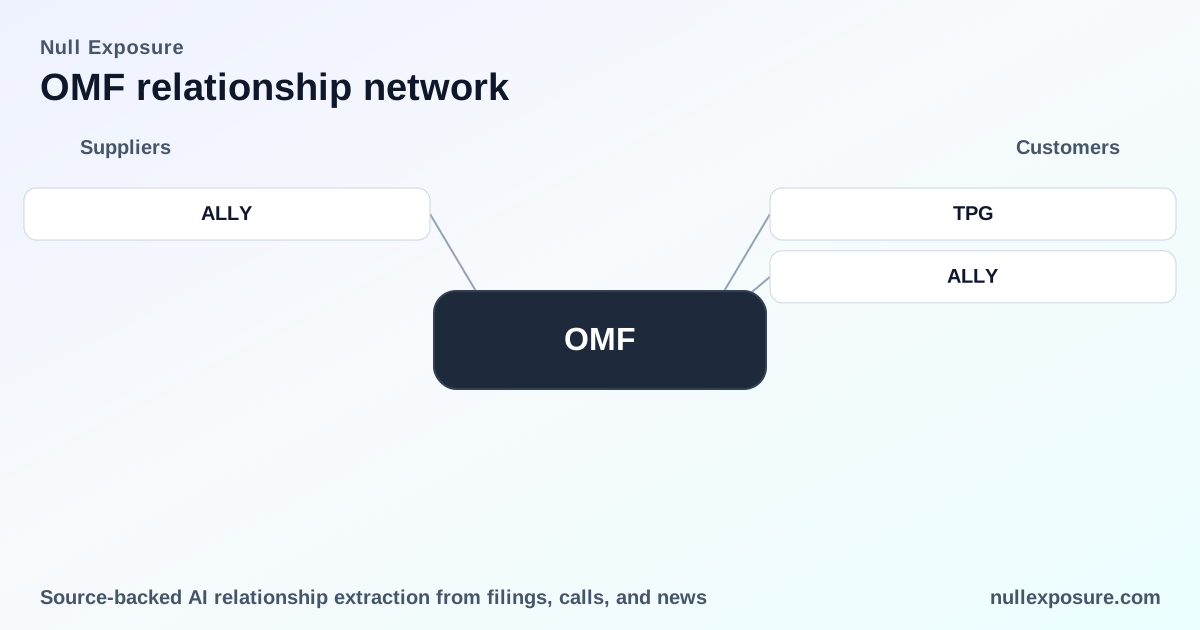
OneMain has been explicit about using partner channels to accelerate auto lending without a large fixed-cost buildout. The partnership with Ally Financial expands OneMain’s dealer footprint to roughly 1,700 dealerships, converting a distribution constraint into a lever for loan growth and seasoning diversification. That kind of pass-through arrangement is a low-capex route to volume and is consistent with OneMain’s business model of scaling originations while keeping balance-sheet funding and servicing centralized.
According to a Globe and Mail summary of OneMain’s FY2026 earnings remarks, “On the auto side, a pass-through partnership with Ally now spans roughly 1,700 dealers, providing a scalable channel to expand auto lending without heavy infrastructure investment.” Source: https://www.theglobeandmail.com/investing/markets/stocks/OMF/pressreleases/82253/onemain-holdings-earnings-call-highlights-growth-and-caution/ (Mar 10, 2026).
Learn how to evaluate supplier relationships like this at https://nullexposure.com/.
The on-the-record relationships you need to know
- According to a March 10, 2026 Globe and Mail earnings summary, OneMain described an Ally pass-through partnership reaching approximately 1,700 dealerships; this underscores the partnership’s role as a distribution multiplier rather than an asset-sourcing JV. Source: https://www.theglobeandmail.com/investing/markets/stocks/OMF-N/pressreleases/82253/onemain-holdings-earnings-call-highlights-growth-and-caution/ (Mar 10, 2026).
- A Finviz report covering OneMain’s Q4 commentary noted completion of a legacy auto lending migration to new technology infrastructure and the rollout of the partnership with Ally, highlighting technology modernization enabling third-party channel expansion. Source: https://finviz.com/news/302760/omf-q4-deep-dive-resilient-loan-growth-and-credit-performance-amid-cautious-outlook (Mar 10, 2026).
- The Globe and Mail referenced the pass-through structure in a second earnings release entry, reinforcing that the Ally relationship functions as a scalable, dealer-facing origination channel rather than an integrated retail platform. Source: https://www.theglobeandmail.com/investing/markets/stocks/OMF/pressreleases/82253/onemain-holdings-earnings-call-highlights-growth-and-caution/ (Mar 10, 2026).
Each of the above items is the same underlying Ally relationship viewed across company commentary and market reporting; collectively they document conversion of product capability (auto finance) into an expanded dealer distribution footprint.
How OneMain’s operating model amplifies supplier risk and opportunity
OneMain’s business model characteristics that matter to investors and vendors are clear and actionable:
- Contracting posture — long-term capital and obligations. The company’s history of issuing long-dated instruments (for example, a 60-year junior subordinated debenture issued in 2007) signals a preference for long-term funding structures that support loan book duration and capital stability. This is a company-level signal of long-dated contractual exposure and creditor relationships.
- Concentration and criticality — reliance on third-party systems and channels. Management explicitly relies on third-party vendors for information systems, communications, data management, and transaction processing, which makes those suppliers operationally critical to core functions such as origination and servicing.
- Maturity and governance — active third‑party risk management. OneMain incorporates cybersecurity and vendor risk reviews within a formal Enterprise Third Party Risk Management program, indicating that supplier relationships are active, monitored, and governed rather than ad hoc.
These characteristics together create a clear supplier profile: strategic vendors and distribution partners are central to OneMain’s ability to grow and run the business, while long-term capital commitments underpin balance-sheet stability. That combination drives both opportunity for vendor revenue and exposure to concentrated operational risk.
What investors and operators should watch next
- Operational resilience and integration risk. The Ally partnership depends on the successful post-migration technology stack and seamless dealer integration. Any friction in onboarding or servicing could compress origination volumes and margin.
- Counterparty concentration. A single large channel that supplies meaningful volume creates dependency risk; the deposit and capital mix alongside long-term debt influence the firm’s ability to absorb shocks.
- Vendor security and regulatory scrutiny. Active third-party risk programs reduce but do not eliminate cybersecurity or compliance exposures; suppliers that touch PII, loan boarding, or payment flows are elevated in criticality.
OneMain’s financial profile supports these observations: $2.973 billion in trailing revenue, a 26.3% profit margin, approximately $5.8 billion market capitalization, and a forward P/E near 6.8, indicating strong current earnings generation relative to price. These metrics underline why distribution expansion through partners like Ally is both value-accretive and strategically consequential.
Practical implications for suppliers and counterparties
For vendors evaluating a relationship with OneMain:
- Expect longer contract lengths and formal SLAs, given the firm’s long-term funding posture and governance program.
- Price for integration and ongoing compliance support; OneMain prioritizes vendors that can demonstrate strong cybersecurity controls and vendor governance.
- Recognize that distribution partnerships can scale quickly if the platform migration remains stable—there is operational upside for vendors that can support dealer rollout and servicing.
If you are an investor or operator deciding whether to enter or expand tie-ups with OneMain, prioritize operational due diligence on the post-migration tech stack and confirm contractual protections that cover integration, data security, and termination economics.
Explore supplier risk signals and relationship maps at https://nullexposure.com/.
Bottom line
OneMain’s relationship with Ally is a clear strategic lever: it converts a capital-efficient, partner-driven distribution strategy into near-term origination growth while concentrating operational reliance on vendors and technology. For investors, that profile delivers defensible cash flow and predictable earnings, tempered by concentration and integration risk that require active management. For suppliers, the business represents meaningful recurring revenue with elevated expectations around security, governance, and long-term contractual commitment.
For a deeper view of supplier footprints and relationship health, visit https://nullexposure.com/.