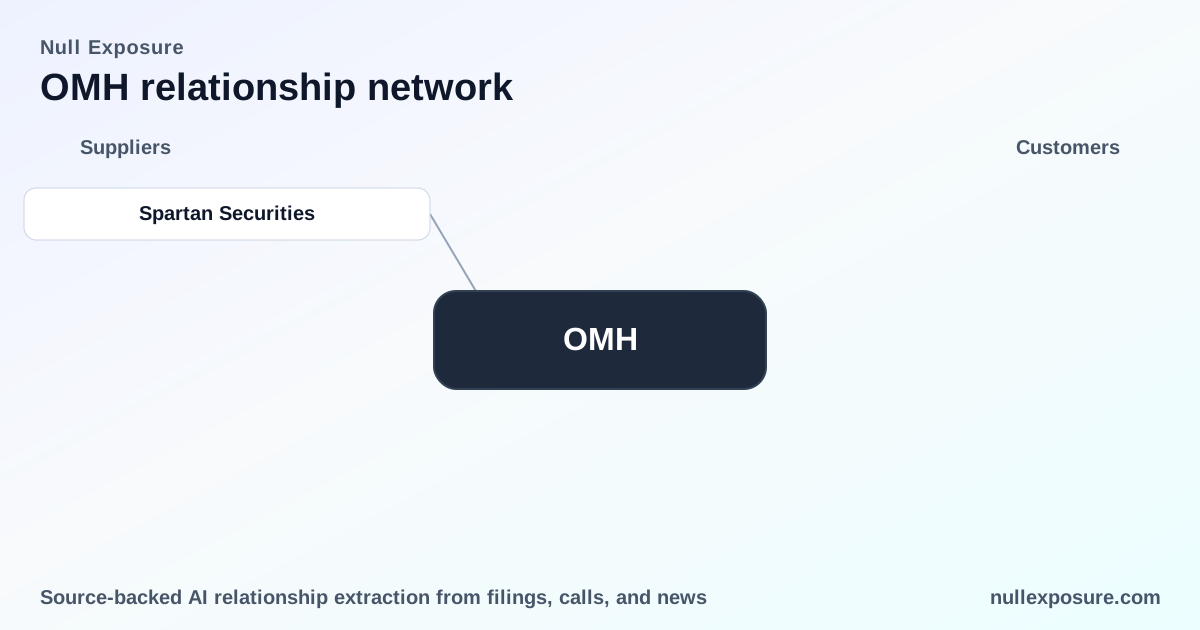
OMH (Ohmyhome): Supplier relationships and what they signal to investors
Ohmyhome operates as a real estate services company focused on digital brokerage and transaction-related services, monetizing through transaction and service fees tied to property listings and closings alongside ancillary offerings. For equity holders and potential counterparties, the company’s supplier footprint is narrow but strategically important: capital markets partners that enable financing and liquidity events and operational suppliers that will be necessary as the business scales. For investors evaluating OMH supplier exposure, the key questions are concentration of critical suppliers, the company’s contracting posture around capital and distribution partners, and how supplier risk interacts with OMH’s current financial profile.
Explore supplier intelligence and counterparty risk at https://nullexposure.com/.
Snapshot investors need before drilling into relationships
OMH is small-cap and loss-making but showing revenue growth: Market cap ~ $33.1M; Revenue TTM $13.07M; Gross profit $4.83M; EBITDA -$2.53M; Diluted EPS -$1.33. Price-to-Sales is 2.53, Price-to-Book 4.98, and institutional ownership is extremely low at 0.175%, indicating limited institutional engagement. The company’s latest quarter reported through September 30, 2025, and the stock carries a 52-week range of $0.588–$4.33. These metrics frame supplier risk: OMH is operating with constrained capital and a reliance on external funding and market access to scale.
Why supplier relationships matter for OMH’s operating model
Supplier relationships for OMH are not about commodity inputs or long-term manufacturing chains; they are about access to capital, go-to-market distribution, and professional services that enable transactions and regulatory compliance. Given OMH’s current financial position, capital providers and transaction intermediaries are functionally critical: they determine the company’s ability to fund growth initiatives, provide working capital, and execute liquidity events. Contracting posture is therefore skewed toward dependence on a small set of high-impact counterparties rather than broad supplier diversification. Concentration of critical suppliers increases operational leverage: a single counterparty failure or adverse commercial term can materially affect execution capacity.
Capital markets partner: Spartan Securities
A Business Times report on March 10, 2026 identified Spartan Securities as the sole bookrunner for OMH’s IPO, with the company expecting to raise more than US$146 million under the offering, making Spartan the exclusive capital markets intermediary for that transaction (Business Times, 2026-03-10). Source: https://www.businesstimes.com.sg/startups-tech/real-estate-platform-ohmyhome-expects-raise-over-us146m-ipo
- Spartan Securities is the exclusive underwriter role recorded in public reporting; for the IPO event this creates a single-point dependency on Spartan for pricing, allocation and distribution of shares. This relationship is inherently transactional and high-impact for OMH’s capital structure and market liquidity.
Constraints and company-level signals that shape supplier risk
There are no supplier constraints documented in the available relationship payload. As a company-level signal, however, several operating characteristics define OMH’s supplier posture:
- Contracting posture: OMH operates with a vendor posture that places outsized importance on a few strategic suppliers—particularly capital markets intermediaries and professional services—rather than routine procurement. This posture increases negotiation leverage requirements when seeking favorable terms.
- Concentration: Publicly visible counterparties are sparse; the single disclosed bookrunner relationship for the IPO indicates capital-supply concentration during major financing events. For ongoing operations, concentration is likely elevated until revenue and balance-sheet scale permit diversification.
- Criticality: Suppliers providing capital, underwriting, and distribution services are mission-critical. Disruption or unfavorable terms from these suppliers directly impair growth financing and public-market access.
- Maturity: Financials suggest OMH is in a growth-but-not-yet-profitable phase: revenue growth is present (quarterly revenue growth YoY ~48.9%), but profitability metrics are negative (Profit Margin -33.7%, ROE -59.7%). This maturity profile results in a higher reliance on capital markets and advisory suppliers to bridge operating losses to sustainable cash flow.
These signals collectively indicate a supplier risk profile characterized by high impact, selective dependency, and concentration around capital and advisory services rather than a broad supplier base.
What the Spartan Securities relationship signals to investors
The choice of a sole bookrunner matters beyond underwriting fees. A single underwriter concentrates pricing power and distribution decisions; it also centralizes reputational exposure and execution risk. For OMH:
- Positive implication: A named bookrunner for a large IPO pro forma raises institutional visibility and can accelerate access to growth capital if the offering is executed on favorable terms.
- Risk implication: Sole underwriting compresses competitive tension; negotiating leverage over fees, lock-up terms, and allocation rests largely with Spartan, making the economics and timing of the raise more supplier-driven than company-driven.
The Business Times coverage dated March 10, 2026 provides the public record for this arrangement (see link above).
Investor takeaway and how to act
- Supplier concentration is a quantifiable and material risk for OMH—capital providers and underwriters are core to the business plan. Monitor disclosure around underwriting syndicates and any expansion beyond a single bookrunner.
- Financial runway and institutional engagement are limited; the company’s ability to execute on supplier negotiations will be constrained until profitability or larger institutional ownership increases.
- Operational suppliers (tech, CRM, transaction processing) are not disclosed at scale, which suggests either in-house handling or early-stage outsourcing; investors should press management for counterparty granularity in upcoming filings or investor presentations.
If you evaluate counterparties or need ongoing supplier intelligence for OMH or similar issuers, review our platform for deeper counterparty mapping and event monitoring at https://nullexposure.com/.
Final point: what to watch next quarter
Watch for IPO execution details—pricing, allocations, and any syndicate additions beyond Spartan—and for management disclosures on how IPO proceeds will be allocated across product development, market expansion and working capital. These actions will materially influence supplier strategy, negotiation leverage, and the company’s ability to diversify critical relationships. To track supplier developments and linked market events for OMH, visit https://nullexposure.com/.
Bold takeaways: OMH’s supplier risk is concentrated and capital-market centric; Spartan Securities’ role as sole bookrunner is a single high-impact relationship; financial constraints amplify supplier criticality until revenue scale or institutional ownership increases.