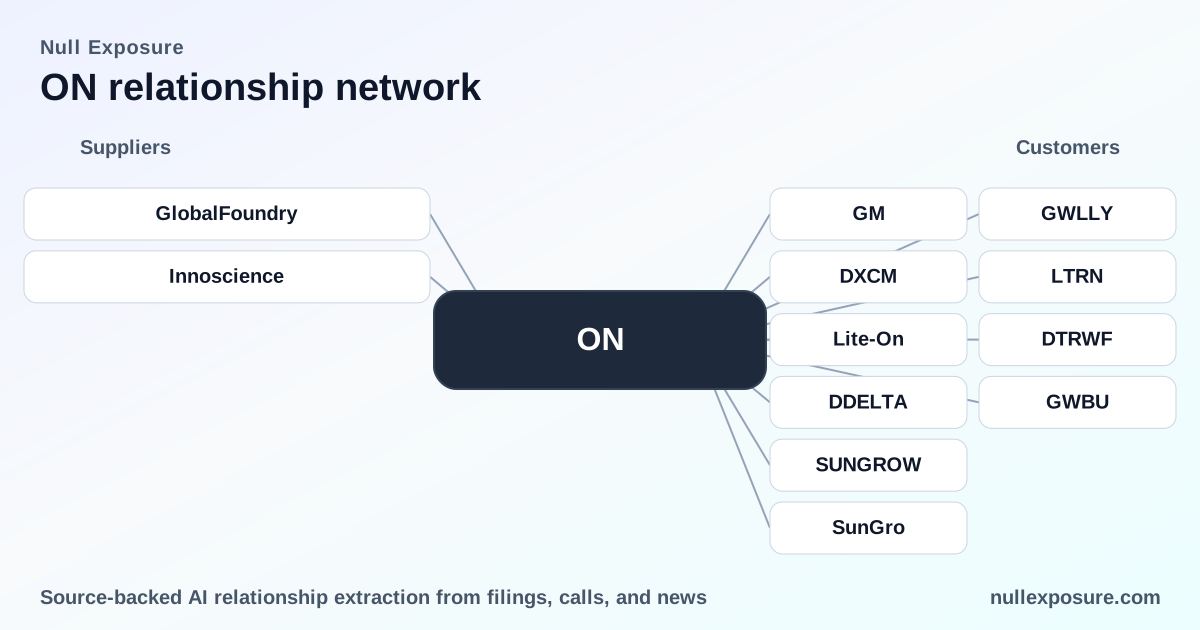
ON Semiconductor: supplier posture, partner map, and what it means for investors
ON Semiconductor sells semiconductor components across automotive, industrial and consumer markets and monetizes by designing chips and outsourcing wafer fabrication, assembly and testing to third-party manufacturers; the company captures margin through product design, proprietary packaging and system-level integration while carrying meaningful, contract‑bound purchase obligations to external manufacturers. For investors evaluating supplier relationships, the critical questions are concentration, contract tenor, and the operational leverage embedded in those external manufacturing ties. For deeper supplier intelligence and structured counterparty analysis, visit https://nullexposure.com/.
Why supplier relationships are a strategic lever for ON
ON operates a hybrid model: in-house design plus outsourced manufacturing. That model drives faster scale without commensurate capital investment in fabs, but it introduces supplier concentration and commitment risk that flows directly to gross margins and product delivery. Company disclosures show that third‑party manufacturers accounted for about 34% of ON’s total manufacturing input costs in 2025, and the firm reports multi‑year purchase commitments that total hundreds of millions of dollars, signaling both scale and lock‑in. These dynamics convert supplier performance into a direct earnings lever for ON and a focus area for credit and equity investors.
For more context on supplier exposures and counterparty risk screening, explore https://nullexposure.com/.
What management said on recent calls — two named partners
Management identified two partners tied to switching elements in product assemblies: Innoscience and GlobalFoundry. The remark was made in the Q4 2025 / FY2026 earnings call transcript and positions these companies as sources for specific switching components in ON’s supply chain.
GlobalFoundry
Management stated that GlobalFoundry is a partner for switching elements used in ON’s products. According to an earnings call transcript published by InsiderMonkey on March 10, 2026, ON will be “doing the switches or the switching element” with GlobalFoundry. (Source: InsiderMonkey Q4 2025 / FY2026 earnings call transcript, March 10, 2026 — https://www.insidermonkey.com/blog/on-semiconductor-corporation-nasdaqon-q4-2025-earnings-call-transcript-1692578/)
Innoscience
Management named Innoscience alongside GlobalFoundry as an engagement partner for switches, indicating a multi‑supplier approach to discrete switching technology. The same InsiderMonkey transcript (March 10, 2026) quotes management: “we have an engagement or a partnership with Innoscience.” (Source: InsiderMonkey Q4 2025 / FY2026 earnings call transcript, March 10, 2026 — https://www.insidermonkey.com/blog/on-semiconductor-corporation-nasdaqon-q4-2025-earnings-call-transcript-1692578/)
Constraints and company‑level signals that shape supplier risk
The company’s disclosures provide direct signals about how supplier relationships are structured and the financial stakes involved:
-
Long‑term contracting posture. ON discloses that agreements with manufacturers often require forecasts and purchase commitments, and that longer‑term commitments are sometimes required early in relationships. This indicates contractual rigidity and forward‑looking obligation that reduces ON’s ability to rapidly reprice or reallocate capacity. (Company disclosure, FY2025 filing.)
-
Material concentration. Third‑party manufacturers contributed approximately 34% of ON’s total manufacturing input costs in 2025, demonstrating that suppliers are economically significant and concentration risk is real. This level of input concentration elevates the impact of any supplier disruption on gross margins. (Company disclosure, FY2025 filing.)
-
Role profile: manufacturer and service provider. ON explicitly uses third‑party contractors for wafer fabrication and for assembly/testing, and it contracts external vendors for capital expenditures and IT services; that establishes suppliers as both production-critical manufacturers and essential service providers. (Company disclosure, FY2025 filing.)
-
Sizeable committed spend. The company reports non‑cancelable future purchase obligations totaling $605.7 million across 2026–thereafter (with $354.3m in 2026 alone), which signals a high minimum annual spend and reduced short‑term flexibilty. This spend schedule places ON solidly in the $100m+ spend band, creating near‑term cash flow and operational commitments to counterparties. (Company disclosure schedule of future minimum purchase obligations, as of December 31, 2025.)
These constraints are company‑level signals and are not attributed to any single supplier unless disclosed by ON.
Investment implications: concentration, bargaining power, and margin sensitivity
-
Concentration risk is real and quantifiable. A third‑party manufacturing cost share at the ~34% level makes supplier outages or pricing pressure a direct threat to gross profit. Investors should treat supplier performance as an operational risk factor, not a peripheral procurement note.
-
Contract structure limits short‑term flexibility. Long‑term purchase commitments and large non‑cancelable obligations constrain ON’s ability to rapidly downsize capex or reallocate spend, increasing downside in cyclical demand contractions.
-
Bargaining power is asymmetric. Outsourcing fabrication reduces capital intensity for ON, but when suppliers are both high‑volume manufacturers and scarce capacity providers, counterparty leverage shifts against ON; this can compress margins if capacity tightness persists.
-
Earnings sensitivity is elevated. Given ON’s operating margin profile and EV/EBITDA multiple (Operating Margin TTM ~19.1%, EV/EBITDA ~27.1 per company data), supply disruptions or adverse repricing have direct and concentrated P&L implications.
Practical due diligence steps for operators and investors
- Request contract term summaries focusing on minimum purchase obligations, penalty clauses, and lead times to quantify how much demand must flow through named partners each year.
- Map capacity and geographic concentration for key suppliers to assess single‑point‑of‑failure exposure.
- Confirm dual‑sourcing and inventory strategies for critical switching components to evaluate how ON mitigates supplier concentration.
- Monitor customer ordering trends against the non‑cancelable obligations schedule to model downside scenarios for working capital and margin compression.
For an actionable supplier risk playbook and continuous counterparty monitoring, visit https://nullexposure.com/.
Bottom line
ON’s business model — design plus outsourced manufacturing — delivers capital efficiency and scale but crystallizes supplier risk into a material earnings lever. GlobalFoundry and Innoscience are named partners for switching technology, and company disclosures show multi‑year, material commitments and a manufacturer‑centric supplier base that investors must treat as strategic counterparties. Active due diligence on contract terms, capacity allocation and backup sourcing is essential to underwrite ON’s margin and operational continuity.