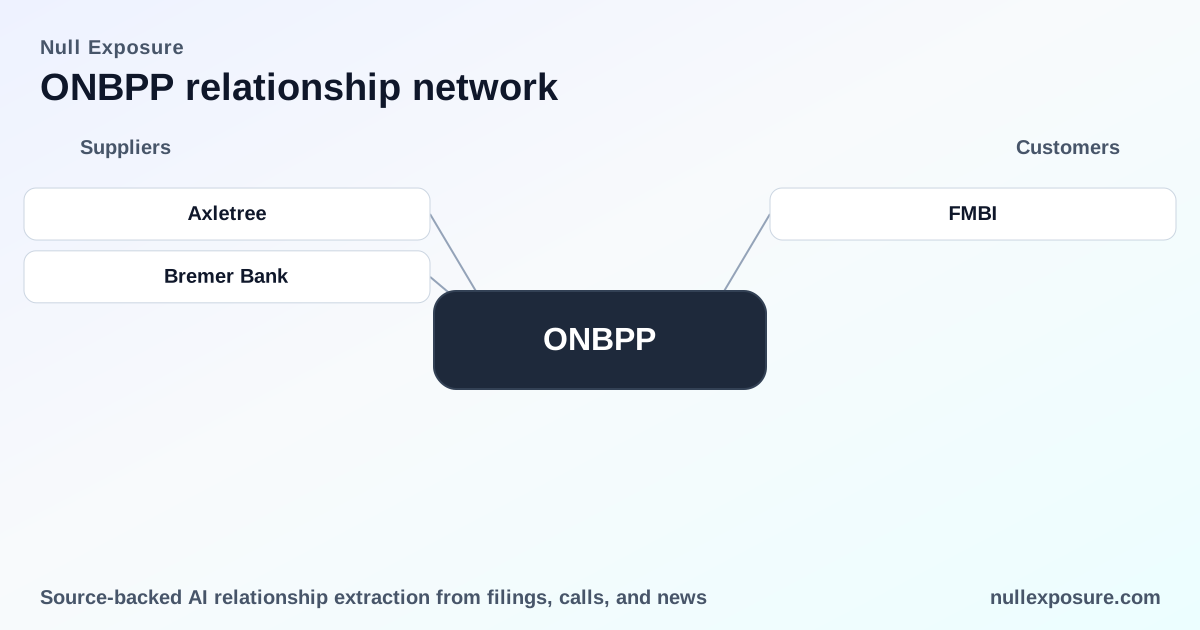
Old National Bancorp (ONBPP): Supplier relationships and what they mean for investors
Old National Bancorp monetizes through traditional regional banking operations—deposit gathering, commercial and consumer lending, and fee-based wealth and mortgage services—while its depositary shares give investors fractional exposure to Series A preferred stock and a claimed steady yield. Investors should view supplier and counterparty relationships as extensions of the bank’s funding and operating model: partners can shift capital availability, systems risk, and service continuity, which directly affect earnings stability and balance-sheet capacity. For more supplier-focused intelligence, visit https://nullexposure.com/.
Quick read: the commercial logic behind these supplier links
Old National augments organic lending and servicing through strategic partnerships and vendor implementations that either expand balance-sheet capacity or strengthen infrastructure. These supplier relationships are not peripheral; they intersect funding sources (which drive leverage and liquidity) and core processing (which drives operational efficiency and compliance). That combination influences both earnings momentum and operational risk.
The two supplier relationships that show up in public reporting
Axletree — Symmetree implementation
Old National announced the completion of a partnership through the implementation of Symmetree by Axletree CI, a platform rollout intended to improve a component of the bank’s infrastructure. According to MarketScreener coverage dated March 10, 2026, this is positioned as a completed deployment that supports Old National’s digital or data-processing stack. (MarketScreener, March 10, 2026: https://www.marketscreener.com/news/old-national-bancorp-to-present-at-the-rbc-capital-markets-financial-institutions-conference-ce7e5fdbdd8cf02d)
Bremer Bank — balance-sheet and capital support
A recently closed partnership with Bremer Bank was completed ahead of schedule and has materially expanded Old National’s balance sheet and capital position, supporting current earnings momentum and future loan growth, per a Simply Wall St news item dated March 10, 2026. This indicates a funding or portfolio-transfer relationship that directly affects capital deployment. (Simply Wall St, March 10, 2026: https://simplywall.st/stocks/us/banks/nasdaq-onb/old-national-bancorp/news/old-national-bancorp-onb-valuation-check-after-recent-share)
What the disclosed constraints reveal about ONB’s operating profile
The company-level constraints extracted from public materials paint a coherent picture of how Old National operates with counterparties and service providers.
-
Contracting posture: predominantly long-term but operationally periodic. The bank reports long-term liabilities such as FHLB advances maturing across 2025–2044 with fixed and variable coupons, signaling enduring funding relationships and multi-year debt commitments that underpin lending capacity. Concurrently, most contracts settle on monthly, quarterly, or semiannual cycles, reflecting shorter operational cadence for payments and vendor settlements.
-
Counterparty mix includes government facilities. Old National explicitly notes access amounts from the Federal Reserve discount window and the Federal Home Loan Bank. Government facilities function as contingent liquidity backstops, reducing tail liquidity risk but also reflecting reliance on system-level backstops during stress.
-
Vendors are material service providers. The bank identifies third-party vendors responsible for key data processing and information services, suggesting outsourced critical infrastructure rather than fully in-house execution. That creates concentration and continuity considerations around vendor performance and contract terms.
-
Spend and balance-sheet concentration are meaningful. The firm reported other borrowings of $329.7 million as of December 31, 2024—an indicator that single-category finance commitments exceed $100 million, which elevates supplier/counterparty criticality and the economic impact of any disruption.
Taken together, these constraints point to an operating model that combines long-maturity funding with externalized service execution and material single-counterparty exposures, which investors should treat as levers that amplify both upside and operational risk.
How these relationships change the risk/reward profile
Old National’s supplier relationships are strategically complementary: one partner improves operational capability (Axletree), the other increases lending capacity (Bremer). Each has distinct portfolio impacts.
-
Upside: The Bremer arrangement directly increases capital and lending runway, supporting loan growth and earnings leverage; Axletree’s Symmetree rollout could improve processing efficiency, compliance, or decisioning speed, reducing expense or credit friction. Both arrangements are positive for scaled growth and margin resilience.
-
Risk: Outsourced infrastructure expands concentration and operational risk; significant borrowing lines and long-dated advances raise interest-rate and refinancing exposures, and government facilities, while cushioning, do not remove systemic counterparty risk. Investors should treat vendor continuity, contract length, and counterparty credit as active monitoring items.
For targeted supplier intelligence, see https://nullexposure.com/ — the platform aggregates these relationship signals into investor-ready analyses.
Practical due diligence checklist for investors and operators
When evaluating ONBPP exposure, focus on the following:
- Confirm the commercial terms and duration for the Bremer financing link and whether assets or loans were transferred or guaranteed.
- Assess service-level agreements, failover plans, and data controls tied to Axletree’s Symmetree implementation.
- Review the bank’s maturity ladder for FHLB and other long-term advances and test sensitivity to interest-rate movements.
- Monitor single-supplier spend thresholds and concentration limits given the >$100 million borrowings signal.
These items convert the qualitative relationship signals into quantitative exposures investors can model.
Final takeaways and next steps
Old National is strengthening both its balance-sheet capacity and its infrastructure through targeted supplier relationships, blending capital partnerships with outsourced processing upgrades. That combination supports near-term loan growth while introducing vendor and long-dated funding exposures that require active oversight.
Explore more supplier-centric intelligence at https://nullexposure.com/ to track counterparties, contract maturities, and operational concentration for ONBPP and peer regional banks.
For investors prioritizing stable income with exposure to regional banking, Old National’s partner set is constructive but demands focused monitoring of vendor continuity and funding maturity risk—areas that will determine whether the company’s current momentum translates to durable returns. Learn how supplier signals feed valuation and risk models at https://nullexposure.com/.