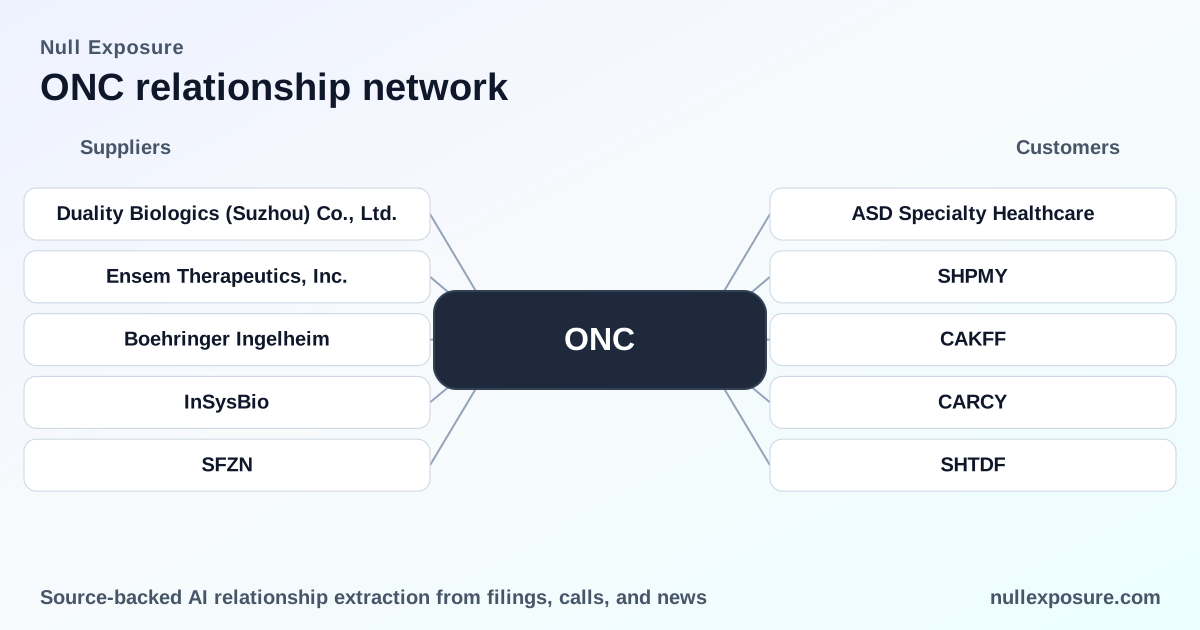
ONC supplier footprint: what investors need to know now
ONC operates as an oncology developer and commercial-stage drug company that generates revenue through product sales, licensing of drug candidates, and partnerships for manufacturing and clinical development. The company monetizes by advancing clinical candidates into commercialization while outsourcing portions of production and development to third‑party manufacturers and service providers; this creates revenue upside from approved products and recurring cost commitments tied to contract manufacturers and collaborators. For a concise supplier risk scan, see the full mapping at https://nullexposure.com/.
A concise investor thesis up front
ONC’s model blends asset-centric biotech commercialization with a reliance on contract manufacturing and translational modeling partners. Revenue is generated from product sales and licensing/collaboration economics, while margins and execution risk are conditional on third‑party manufacturing capacity and clinical development support. The FY2024 disclosures and subsequent press coverage show a mix of long‑lead manufacturing commitments and tactical service partnerships—both drivers of near-term operational leverage and potential supply-side fragility. Explore the supplier evidence base at https://nullexposure.com/.
The supplier posture: what contracts and constraints reveal
The company’s filings and disclosure excerpts portray a hybrid contracting posture:
- Contracts are largely cancellable or short‑term in style: the company notes that many agreements “are generally cancellable at any time…with prior written notice,” which reduces long-run lock‑in but increases exposure to supplier churn.
- ONC functions as a buyer with purchase commitments totaling $131.9 million as of December 31, 2024, including a $32.5 million minimum for CMOs and $99.4 million of binding purchase order obligations tied to Amgen, indicating material, committed spend on manufacturing and inventory (FY2024 10‑K).
- The company relies on a limited set of third‑party CMOs and CROs for drug substance/product production and trial services, which raises concentration and criticality risk for specific manufacturing nodes.
- Spend signals are mixed: disclosures show both smaller recurring commitments (hundreds of thousands to low millions) and large, multi‑million-dollar commitments, meaning supplier risk is unevenly distributed across partners.
Collectively, these constraints point to a company that has moved substantial operating risk off‑balance‑sheet to vendors while retaining buyer exposure through purchase commitments and critical manufacturing dependencies.
Supplier relationships, in plain English
Below are every supplier relationship flagged in the available sources, with a short plain‑English summary and source reference.
Duality Biologics (Suzhou) Co., Ltd. — ONC holds a license for BG‑C9074 from Duality Biologics, indicating a licensing-in arrangement for a clinical asset rather than a pure manufacturing contract. This is documented in ONC’s FY2024 10‑K filing. (FY2024 10‑K)
Ensem Therapeutics, Inc. — BG‑68501 is licensed from Ensem Therapeutics, showing ONC’s approach of licensing external discoveries to broaden its pipeline and retain development control. This licensing disclosure is in the company’s FY2024 10‑K. (FY2024 10‑K)
Boehringer Ingelheim — ONC co‑developed and licensed genetically modified cell lines from Boehringer Ingelheim that serve as core raw materials at ONC’s Guangzhou manufacturing site, highlighting a strategic manufacturing and intellectual‑property dependency for biologic production. This relationship is described in the FY2024 10‑K. (FY2024 10‑K)
InSysBio — Multiple news reports in early 2026 describe ONC extending a collaboration with InSysBio to apply mechanistic translational modeling to clinical programs and dose selection, including cytokine release syndrome risk management; this is a service‑oriented partnership focused on trial design and safety modeling rather than manufacturing. (Sahm Capital report, Jan–Feb 2026)
Siegfried (SFZN) — Regulatory filings and a Q1 2025 business update indicate approval to add Siegfried’s Swiss facility as an alternate drug substance manufacturer by the European Medicines Agency, underlining a strategic redundancy step in ONC’s manufacturing network. (BioSpace press release, Q1 2025)
Strategic implications and risk framing
The combined relationship map and constraint signals produce several clear implications for investors:
- Concentration risk is material. The company explicitly relies on a limited number of CMOs/CROs for commercial and clinical supply, which amplifies disruption exposure if a single node (facility, cell line owner, or contract partner) experiences capacity or regulatory problems.
- Purchase commitments create locked‑in cash exposure. The $131.9 million in purchase commitments (FY2024) — including binding orders tied to Amgen and minimum CMO commitments — converts supplier relationships into near‑term cash obligations, which reduces financial optionality even where contracts are cancellable on notice.
- Operational criticality sits at the intersection of IP and manufacturing. Licensing of core cell lines and manufacturing know‑how (e.g., from Boehringer Ingelheim) creates operational dependencies that are not readily substitutable without technical transfer work.
- Maturity of supplier relationships is mixed. Regulatory approval of an alternate manufacturer (Siegfried) signals proactive de‑risking, while continued reliance on translational modeling partners (InSysBio) reflects an advanced R&D posture where sophisticated services are becoming integral to trial success.
Across these points, the headline risk is that supply and service relationships are both commercially significant and technically specialized, which compresses the margin for supplier failure.
If you want a quick supplier risk scorecard and alert feed tailored to ONC’s partner set, run a targeted scan at https://nullexposure.com/.
Actionable investor takeaways
- Monitor material purchase‑commit disclosures and any changes to binding orders (Amgen tie‑outs) in quarterly filings; these commitments are cash‑allocative and nontrivial (FY2024 figures).
- Track regulatory approvals and site qualifications (e.g., Siegfried’s EMA acceptance) as leading indicators of manufacturing resilience and revenue optionality.
- Watch collaborations that materially affect clinical program execution (InSysBio modeling extensions) because they directly influence trial timelines and dose‑selection risk.
For portfolio teams that need continuous supplier surveillance and contract‑level signals for ONC, see our coverage and alerting options at https://nullexposure.com/.
Conclusion: how to read the supplier signal
ONC’s supplier map shows a company that is operationally sophisticated but supplier‑dependent: licensing deals enlarge the pipeline, while manufacturing and advanced modeling partnerships create both execution leverage and concentration risk. Investors should treat disclosed purchase commitments and key technical licensors as first‑order variables when modeling revenue timing and margin sustainability. For a detailed supplier dossier and ongoing monitoring of ONC counterparties, visit https://nullexposure.com/.