Onfolio Holdings (ONFOW) — supplier relationships, constraints, and investor implications
Onfolio acquires controlling stakes in small online businesses and operates them as a consolidated portfolio, generating cash flow through optimized operations and incremental acquisitions; the company monetizes by extracting profit from acquired properties and scaling low-capex digital assets while funding growth through capital raises and placement agents. Revenue comes from operating portfolio businesses; capital markets activity (equity or debt raises) underpins acquisition cadence and liquidity. If you want a concise map of supplier exposure and operational constraints, start here and learn more at the NullExposure homepage: https://nullexposure.com/.
The quick read for investors
Onfolio runs a roll-up model focused on mature small web businesses—low capex, high dependence on software and cloud providers, and acquisition-sized transactions typically in the low millions. Operational spend is split between acquisition outlays ($1m–$10m band) and modest recurring facilities and admin costs (sub-$100k annual office/storage spend). Financing partners play a direct role in enabling deal flow.
How Onfolio’s operating model shapes supplier relationships
Onfolio’s supplier footprint is consistent with an operator focused on digital asset consolidation rather than heavy manufacturing or retail:
- Contracting posture: The company contracts with a broad set of small-business vendors and cloud/service providers rather than a few large suppliers, reflecting a transactional procurement pattern—acquisitions deliver the largest single payments while ongoing supplier spend is modest and distributed.
- Concentration: Acquisition payouts create episodic concentration risk (single deals in the $1m–$10m range), while ongoing vendor spend is dispersed across many low-dollar items.
- Criticality: Software applications, IT systems, and cloud infrastructure are material to operations; loss of those services would disrupt the core revenue engine.
- Maturity: The business model is an early- to mid-stage roll-up: businesses acquired are small but cash-generative, and financing relationships are structural to scaling.
These conclusions come from Onfolio’s public disclosures and transaction excerpts: the company explicitly notes dependence on software/cloud providers and describes acquisition purchase prices in the low‑millions, while listing modest office and storage lease costs in its filing disclosures.
Every supplier relationship found in the record
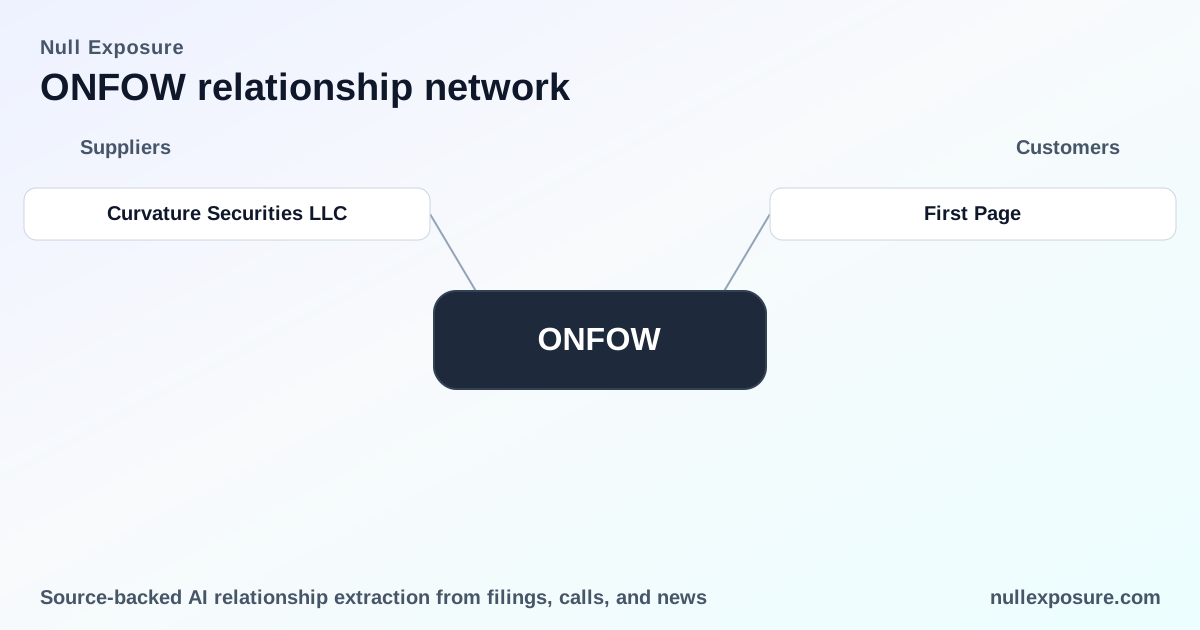
Curvature Securities LLC — Curvature acted as exclusive placement agent for Onfolio’s financing program tied to a potential up-to-$300 million facility, signaling active capital markets engagement to fund acquisitions and working capital. A Futunn news post reported Curvature’s placement agent role in March 2026 (news.futunn.com, March 10, 2026).
(There are no other supplier or intermediary relationships surfaced in the supplier-scope results provided.)
What the disclosure constraints tell us about operational risk
The extracted constraint excerpts provide direct company-level signals that are actionable for investors and operators:
- Small-business focus is explicit. Onfolio states it acquires and actively manages small online businesses with stable cash flows and existing management teams—this is a company-level strategic posture that drives supplier selection and integration playbooks.
- Software and cloud dependencies are material. The firm discloses dependence on software applications, IT systems, infrastructure, and cloud service providers to run acquired businesses—this elevates vendor resilience and contract terms to first-order risks.
- Service-provider relationships are core, not peripheral. The disclosure frames these providers as service partners necessary for daily operations, which implies priority vendor management and continuity planning.
- Acquisition spend sits in the $1m–$10m band. The company’s filings show an aggregate purchase price example of $2,160,000 for an asset purchase (ES Business Assets), which indicates point-in-time cash outflows at that scale and the need for financing capacity.
- Ongoing facilities and administrative spend is small. Office lease and storage line items (roughly $400/month for a small executive-center office; $75/month for a coworking space; $172/month for storage) demonstrate a low fixed-cost backbone for headquarters and administrative functions.
These signals are company-level, not tied to a specific vendor except where the company names a financing intermediary.
Investment implications — what to watch and how to act
- Operational resilience equals software vendor oversight. Given the materiality of IT and cloud services, investors should evaluate contract length, termination clauses, and multi-region redundancy for key platforms. Insist that management disclose dependency concentration (which cloud providers and critical SaaS vendors) in investor materials.
- Financing relationships matter for growth execution. Curvature Securities’ exclusive placement agent role for an up-to-$300M financing program is strategically significant: access to committed placement capacity will determine Onfolio’s ability to pursue acquisitions at the stated $1m–$10m scale. Review any commitment letters or placement agreements where available.
- Acquisition economics are central to valuation. With acquisitions in the low millions and modest overhead, marginal acquisition returns drive equity value. Monitor gross profit trends and profit margin improvements at the acquired businesses rather than headline revenue growth alone.
- Counterparty and spend monitoring should be ongoing. Small recurring operational spend creates many low-dollar contracts; however, a single large acquisition or platform vendor outage could be value disruptive. Demand periodic supplier concentration reporting from management.
If you want a tailored supplier-risk brief on Onfolio or comparable roll-up strategies, visit NullExposure for deeper supplier-level intelligence: https://nullexposure.com/.
Practical next steps for operators and investors
- Ask management for a vendor criticality map that lists top cloud/SaaS providers, contract terms, and continuity plans.
- Request transparency around any financing commitments or exclusivity terms with placement agents like Curvature to assess deal execution risk.
- Model acquisition cadence against committed financing capacity and a sensitivity where placement capacity is reduced.
For a deeper, structured review of Onfolio’s supplier posture and to subscribe to ongoing monitoring, go to NullExposure: https://nullexposure.com/.
Bottom line
Onfolio is a digital-asset roll-up with material dependence on software and cloud service providers, acquisition-sized cash outflows in the $1m–$10m range, and active capital markets partnerships that enable scale (for example, Curvature Securities LLC as an exclusive placement agent for a financing program). For investors, the critical monitoring points are vendor concentration and contract resilience, acquisition returns, and the stability of financing arrangements that underpin growth.