Onity Group (ONIT): How supplier ties shape the mortgage-originator playbook
Onity Group originates and services residential mortgage loans and monetizes through origination fees, servicing fees and periodic sales of mortgage servicing rights (MSRs) to recycle capital and de-risk duration exposure. The company’s operating model combines an active correspondent seller network, dependency on third‑party servicing technology, and financing relationships to fund loans through the cycle — a structure that creates both scalable revenue lines and concentrated operational dependencies. For a deeper look at counterparties and contract risk, visit https://nullexposure.com/.
A single strategic move that reshapes capital and risk
Onity’s most consequential recent action for suppliers and investors was the repositioning of its reverse mortgage exposure. Onity executed a sale and strategic partnership with Finance of America / Finance of America Reverse to transfer MSRs and adjust its participation in the HECM market, a transaction the company expects will free up roughly $100 million in capital and simplify the reverse mortgage franchise. According to Onity’s 2025 Q4 earnings call, the sale of MSRs to Finance of America Reverse was explicitly cited as a near-term capital catalyst and part of a strategic repositioning (2025Q4 earnings call).
This transaction changes Onity’s counterparty footprint for servicer and investor flows and reduces balance-sheet duration tied to reverse mortgages. For investors and prospective partners, the practical consequence is reduced capital drag and a more modular servicing profile, with Finance of America entities becoming visible downstream buyers and partners.
Who Onity is working with now — the relationships you need to know
Below I list every supplier/counterparty relationship surfaced in the company’s recent disclosures and conference remarks, with plain-English summaries and source references.
-
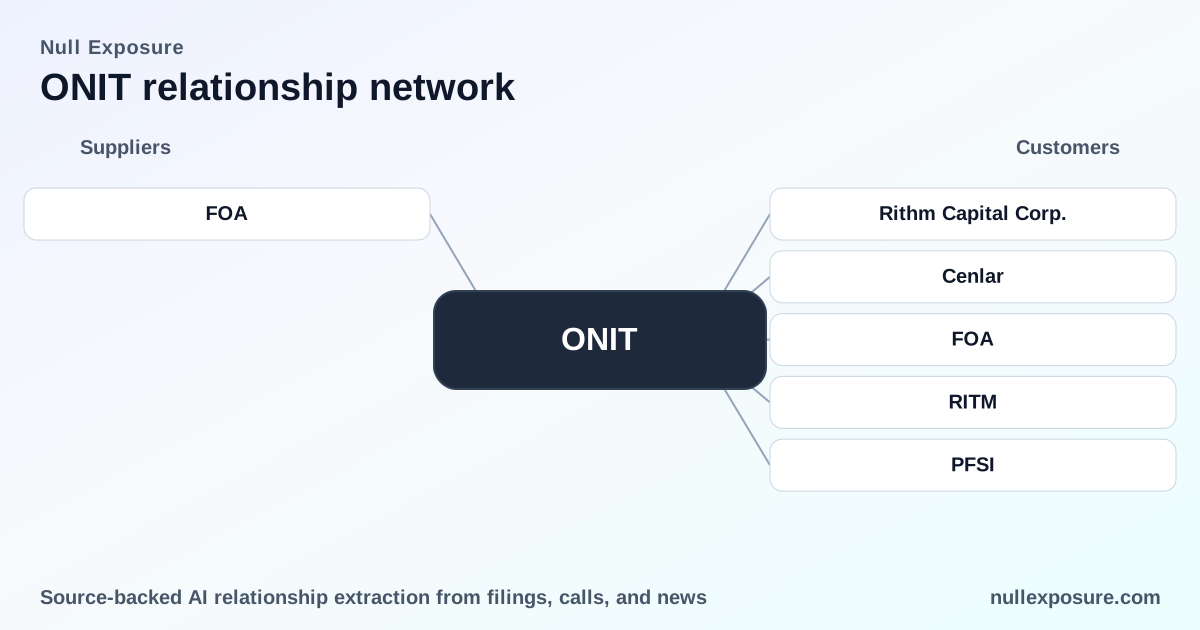
Finance of America (FOA): Onity disclosed the sale of reverse MSRs to Finance of America as part of a broader repositioning, noting that the transaction will free roughly $100 million of capital for the company. This was discussed on the company’s 2025 Q4 earnings call (onit-2025q4-earnings-call, 2025Q4).
-
Finance of America Reverse (FOA): Onity described a strategic partnership with Finance of America Reverse intended to simplify and reposition its participation in the reverse mortgage market, indicating an ongoing operational and commercial relationship beyond a one‑time MSR sale. The partnership and strategic intent were described on the 2025 Q4 earnings call (onit-2025q4-earnings-call, 2025Q4).
Each of the above relationships was surfaced in the 2025 Q4 earnings call; the Finance of America entities are both buyer/partner in the reverse mortgage adjustment and therefore crucial counterparties for Onity’s capital recycling plan.
What the public disclosures say about Onity’s supplier posture
Several excerpts from Onity’s disclosures and remarks give a clear view of how the company contracts and where operational risks sit:
-
Large correspondent seller network, active relationships: Onity reported 716 approved correspondent sellers as of December 31, 2024, with modest net additions year-over-year. This signals a broad wholesale origination footprint and an active contracting posture with originating partners (company disclosure as of 12/31/2024).
-
Dependence on specialized service providers: Onity explicitly states dependence on Black Knight and other vendors for servicing systems, business process outsourcing and other tech services. The company is operating under a seven‑year agreement with Black Knight for the MSP servicing system that expires in 2026, and Onity characterized the system as critical to compliant servicing operations (company disclosures; service-provider excerpt).
-
Financing counterparty reliance: Onity depends on banks and other financing sources to fund loans and manage liquidity, a standard but meaningful structural dependency for an originator/servicer (company disclosure).
Taken together, these statements create a crisp profile: broad origination reach through correspondent sellers, high criticality on a limited set of platform providers (notably Black Knight), and continued reliance on external funding.
How these constraints translate into investment and operational risks
Translate the disclosure facts into investor-relevant constraints and you get actionable signals:
-
Contracting posture: Active and operationally integrated — Onity runs a live servicing book and an extensive correspondent network (716 sellers), indicating ongoing contract management and real-time waterfall flows that require robust counterparty controls.
-
Concentration: The seller count suggests breadth in origination counterparties, reducing single‑counterparty concentration at the front end; however, technology concentration is material — a single outsourced servicing platform (Black Knight MSP) is foundational to operations and compliance.
-
Criticality: Technology and financing relationships are mission‑critical. The Black Knight MSP contract and financing sources underpin daily operations and capital deployment; disruption would be immediately consequential to loss mitigation, borrower communication, and cash flows.
-
Maturity: Relationships are active and contractual — the Black Knight agreement has a defined term (expires 2026) and the Finance of America relationships reflect strategic, transactional maturity where Onity has transitioned exposure through MSR sales and partnership structures rather than ad hoc trades.
These are company‑level signals drawn directly from the firm’s public statements and earnings remarks; they outline where management has concentrated counterparty risk and where the firm has taken steps to de‑risk balance‑sheet duration.
If you evaluate counterparties for credit, operations or integration, these are the priorities: quantify operational replacement cost for the MSP, stress test financing rollovers, and confirm detail on the MSR sale mechanics with Finance of America. For verification and next-step diligence, see https://nullexposure.com/.
Investment implications — what investors and partners should act on now
-
Capital recycling improves flexibility: The MSR sale and partnership free capital — roughly $100 million per management commentary — improving liquidity and potentially supporting growth or deleveraging. That is a positive read for short‑term solvency and nimble balance‑sheet management.
-
Operational vendor risk is binary: Dependency on a single servicing platform and outsourced vendors is a binary operational risk; contract expiration in 2026 for the Black Knight MSP requires active negotiation or a tested migration plan to prevent service disruption.
-
Counterparty credit matters: The Finance of America entities are now primary downstream counterparts for reverse MSRs; investors should evaluate FOA’s credit and servicing behavior since Onity has shifted exposure away from on‑balance MSR ownership into a partnership model.
-
Funding continuity is essential: Given Onity’s reliance on banks and external financiers, persistent access to capital markets or committed warehouse lines remains a gating factor for growth and earnings stability.
For tailored due diligence on these supplier relationships and contract risks, visit https://nullexposure.com/ for resources and further analysis.
Bottom line — a clearer, but not risk‑free, supplier map
Onity has actively reshaped its supplier and counterparty footprint: it broadened origination reach through a large correspondent base, materially reduced reverse‑mortgage balance‑sheet duration via MSR sale(s) to Finance of America/Finance of America Reverse, and nonetheless retains material dependency on a limited set of service providers and financing partners. For investors and operators, the task is straightforward: confirm the operational redundancy plan for the Black Knight MSP, validate the economics and covenants of the MSR sale/partnership, and stress the firm’s financing sources under adverse scenarios.
To review these supplier ties in depth and compare counterparties across mortgage originators, start your research at https://nullexposure.com/.