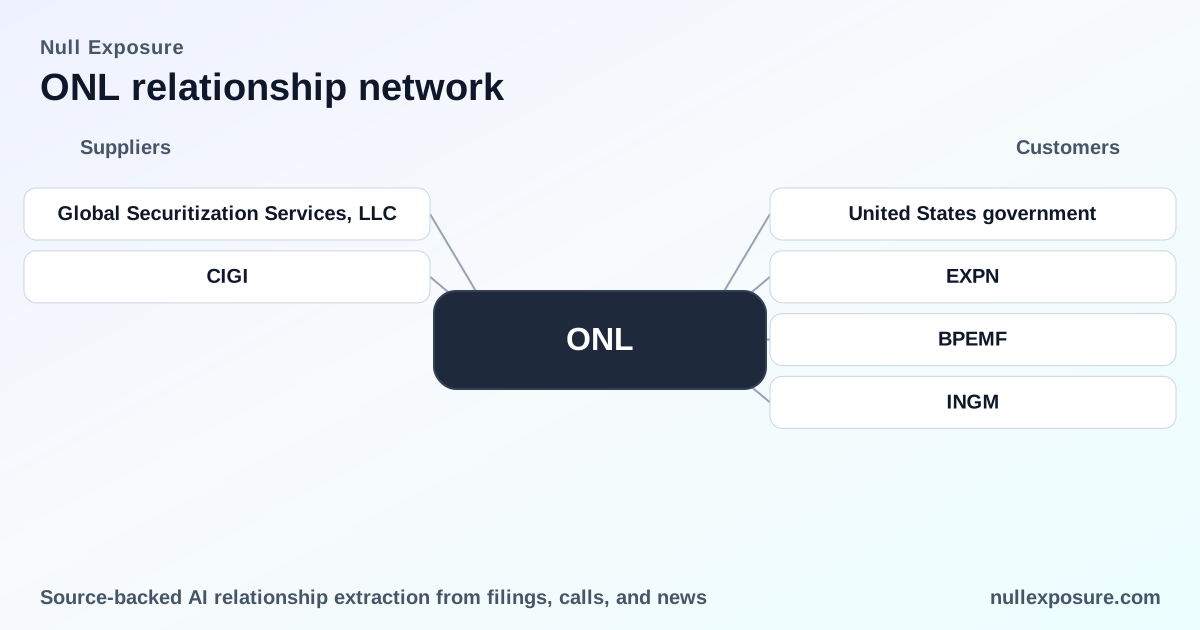
Orion Office REIT (ONL) — supplier relationships and what they signal for investors
Orion Office REIT operates and monetizes as a traditional office-focused real estate investment trust: it acquires office and commercial assets, stabilizes and leases them to tenants, and realizes value through rental income plus selective dispositions. Revenue is driven by property-level rents and asset sales; capital deployment is visible through acquisitions sourced from securitization entities and brokered transactions. For investors gauging supplier and counterparty exposure, the pattern of counterparties — securitization firms on one hand and major brokerage houses on the other — is the most relevant operational signal. Learn more on the homepage: https://nullexposure.com/.
A quick read on ONL’s operating profile
As of the latest reported quarter (2025-12-31), Orion Office REIT shows a compact but active balance sheet: market capitalization of $130.1M, revenue of $135.8M, EBITDA of $48.5M, and negative diluted EPS of -$2.42. The company pays a modest dividend ($0.08 per share; yield ~3.45%) while trading at a low price-to-book (0.20) and a high EV/EBITDA (~26.4) — a combination that signals investor skepticism about earnings durability relative to book value.
Company-level sourcing and procurement posture should be read in that context. With modest scale and constrained public market valuation, ONL's capital deployment is selective and transactional, relying on third-party counterparties to supply deal flow and brokerage services rather than an internal origination engine.
Key operating-model signals (company-level):
- Contracting posture: Transactional and opportunistic — ONL acquires assets from financial sellers and uses third-party brokers for deal execution.
- Concentration: Asset-level concentration risk is elevated by acquisition scale relative to market cap; each large purchase moves the balance sheet materially.
- Criticality: Third-party brokers and securitization sellers are mission-critical for sourcing and executing acquisitions and dispositions.
- Maturity: A small-cap REIT profile with negative EPS suggests a mid-stage operating maturity where capital markets access and asset performance will determine strategic flexibility.
Deal-level relationships identified in public sources
Below are the public supplier/counterparty relationships surfaced for ONL; each relationship is followed by a concise summary and the reporting source.
Global Securitization Services, LLC — seller of a San Ramon warehouse (FY2025)
Orion Office REIT acquired a 96,882 square foot warehouse in San Ramon from Global Securitization Services, LLC for $34.6 million, indicating ONL’s willingness to purchase non-core or industrial-logistics assets from structured finance sellers when valuations and strategic fit align. According to Simply Wall St reporting in March 2026, this was recorded as an FY2025 transaction and reflects ONL’s use of capital to add discrete assets off securitized balance sheets. (Source: Simply Wall St, March 10, 2026.)
Colliers — broker representing a seller in a suburban-office transaction (FY2023)
National brokerage Colliers provided sell-side representation in a suburban office deal involving Orion-related assets, with brokers John Homsher and Alissa Adler named as the seller representatives; this underscores ONL’s reliance on established brokerage networks for sourcing and closing property-level transactions. TheRealDeal covered that transaction in December 2023, highlighting the role of major brokerages in ONL’s deal flow. (Source: TheRealDeal, December 20, 2023.)
What the supplier mix tells investors about execution risk and strategy
The two counterparties above tell a coherent story about ONL’s execution model:
-
Securitization sellers as acquisition channels: Buying assets from securitization vehicles like Global Securitization Services signals ONL’s strategy of picking opportunities where structured sellers are motivated to transact — a fast way to deploy capital but one that can introduce asset variability and due-diligence complexity. This is consistent with transactional, opportunistic capital deployment rather than high-volume internal origination.
-
Dependence on large broker networks: Use of market-leading brokerages such as Colliers indicates ONL relies on external distribution and marketing channels for deal sourcing and asset disposition, which reduces fixed overhead but concentrates operational criticality in these third parties.
These supplier patterns align with the company’s macro metrics: low market cap and negative EPS, which imply limited internal sourcing scale and a need to preserve capital flexibility. The combination of a small public valuation and purchases of multi-million-dollar assets means that each counterparty engagement carries material balance-sheet implications.
If you are tracking ONL relationships closely, monitor the frequency and size of acquisitions from securitization sellers and the roster of brokers involved; changes in those patterns will be early indicators of a shift from opportunistic to more systematic growth.
For a centralized view of ONL supplier coverage and faster monitoring, visit https://nullexposure.com/.
Risk considerations tied to supplier relationships
- Counterparty concentration risk: A pattern of sourcing multiple assets from a narrow set of sellers concentrates exposure to the underwriting standards of those sellers. ONL’s purchase of a $34.6M asset from a securitization firm is sizeable relative to its market cap and warrants scrutiny.
- Execution and repricing risk: Reliance on brokers for deal flow can accelerate transactions but also transfer repricing power to intermediaries in tighter markets.
- Asset heterogeneity: Buying opportunistically from structured sellers can introduce non-core asset types (e.g., industrial warehouses) that require different operational expertise and tenant strategies.
Investors should treat each material acquisition as a potential inflection point for portfolio composition and earnings volatility.
How to monitor and act on supplier signals
- Track recurring counterparties in property-level press and filings: repeated appearances by a seller or brokerage indicate a structural sourcing relationship.
- Watch subsequent asset performance and leasing outcomes for properties acquired from securitization entities; underperformance is the quickest tell that acquisition quality differs from historical portfolio norms.
- Read quarterly reports and footnotes for mentions of broker fees, transaction costs, and related-party arrangements that quantify the operational cost of relying on external sourcing.
If you want regular updates on counterparty patterns and property-level transaction tracking for REITs like Orion, check https://nullexposure.com/ for vendor analysis and supplier monitoring.
Final takeaway
Orion Office REIT operates with a transactional, opportunistic supplier posture: it sources assets from securitization sellers and relies on large brokers to execute deals, a model that conserves internal capex but concentrates sourcing and execution risk in a few third parties. Given ONL’s small market cap, negative EPS, and low price-to-book, these supplier relationships are material to capital deployment and portfolio performance. Active monitoring of counterparties and deal-level outcomes will be decisive for assessing ONL’s trajectory. For consolidated supplier intelligence and ongoing updates, visit https://nullexposure.com/.