Ooma Inc.: Supplier Relationships, Contract Profile, and What Investors Should Price In
Ooma is a mixed hardware-and-subscription communications company that monetizes through recurring service revenue for business and consumer voice-over-IP solutions, complemented by periodic hardware sales (notably the Ooma AirDial device) and B2B channel arrangements. Revenue of $273.6 million (TTM) and gross profit of $167.3 million indicate a subscription-heavy margin profile, while a modest operating margin and a market cap near $384 million constrain optionality for large M&A or capex shocks. The company funds working capital and strategic deals with a secured revolving credit facility and targeted term financings.
If you’re evaluating partner risk and supplier concentration, start with the supplier map and contract posture outlined below — then decide whether Ooma’s carrier and supply-chain dependencies are priced into the stock. Visit https://nullexposure.com/ for full supplier intelligence and analytical services.
How Ooma’s supplier network drives the business
Ooma’s commercial model is dependent on recurring relationships with carriers, data-center and cloud providers, contract manufacturers, and a credit provider for financial flexibility. Those relationships determine go-to-market reach (carrier aggregators), product availability (contract manufacturers in Asia), and service resilience (co-location and cloud providers in North America). The company’s public metrics — trailing EPS of $0.23, a profit margin of 2.36%, and a Forward PE of 10.8 — show a business that is scaling revenue but with modest near-term profitability, making supplier terms and commitments material to cash flow and execution.
Key operational signatures to note: long-term minimum purchase commitments and operating leases; mid-range supplier spend bands; geographic split between North American data centers and Asian contract manufacturing; and a three-year secured credit facility that underpins liquidity. Visit https://nullexposure.com/ to see how these signatures compare across similar communications suppliers.
Contracting posture and maturity (company-level signals)
- Long-term commitments are embedded in the model. Ooma disclosed non-cancelable service commitments and operating leases stretching multiple years, establishing predictable vendor spend but reducing flexibility. These contractual obligations are consistent with a subscription-hardware combined model requiring inventory and steady telecom capacity.
- Shorter-term pockets exist alongside multi-year deals. The company also records shorter annual minimums for certain cloud services, indicating a mix of flexible cloud consumption and fixed telecom commitments.
- Financial maturity is supported by a secured credit facility. A three-year Credit Agreement provides a $30 million revolving facility and was used as the funding vehicle for acquisitions and working capital, which lowers refinancing risk for current obligations.
- Spend concentration sits in the low tens of millions. Evidence of single-counterparty commitments and aggregate non-cancelable purchase obligations places Ooma in the $10m–$100m spend band overall, with specific supplier categories in the $1m–$10m range (inventory and manufacturing commitments).
Supply chain geography and role exposures (company-level signals)
- Manufacturing concentrated in Vietnam and other Asian countries. The company outsources device production offshore, which creates supply-chain and logistics exposure but gives cost advantages and scale for hardware rollouts.
- Core hosting and service delivery anchored in North America. Ooma leases co-location space in San Jose, Dallas and Ashburn and uses Equinix facilities for critical cloud and routing infrastructure, which centralizes operational risk in a small number of data-center locales.
- Service providers fill critical operational functions. Telecommunication providers and cloud vendors supply capacity that is effectively embedded in Ooma’s delivered product — non-cancelable minimums increase the criticality of these suppliers.
Supplier relationships investors should track (explicit summaries)
-
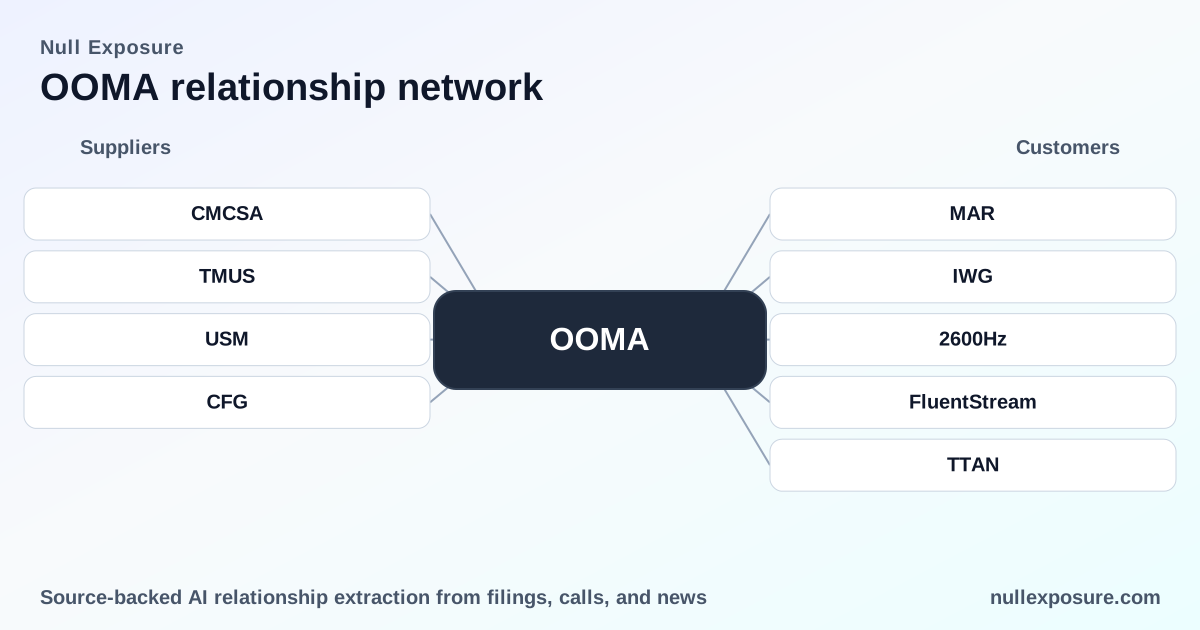
Comcast — Ooma referenced Comcast as a partner that launched Ooma AirDial on schedule during its Q1 2026 earnings call, signaling a go-to-market deployment with a major cable operator that expands distribution and validates the AirDial product roll-out. (Ooma Q1 2026 earnings call, March 7, 2026)
-
T‑Mobile — Management listed T‑Mobile as one of its largest carrier relationships, alongside other national carriers and aggregators, indicating continued distribution and traffic partnerships that feed recurring service revenue. (Ooma Q1 2026 earnings call, March 7, 2026)
-
US Cellular — Ooma named US Cellular among its largest relationships, which reinforces the company’s multi-carrier distribution strategy for both consumer and business services. (Ooma Q1 2026 earnings call, March 7, 2026)
-
Citizens Bank, N.A. — A CityBiz report covering Ooma’s acquisition activity noted that the purchase price was funded by a new term loan facility with Citizens Bank, N.A., reflecting Citizens’ role as the lender on a transaction that affects leverage and liquidity. (CityBiz, March 2026)
Why these relationships matter for valuation
- Carrier and aggregator ties (T‑Mobile, Comcast, US Cellular) drive subscriber growth and ARPU stability. Carrier partnerships accelerate distribution at scale but embed dependency on a handful of large telco contracts; any commercial renegotiation can swing near-term revenue growth given the company’s modest profit margins.
- Manufacturing and logistics concentration means hardware cycles are susceptible to geopolitical disruption and freight cost inflation. Ooma’s inventory purchase commitments in the low millions underline the operational leverage to device roll-outs.
- Financing through Citizens Bank indicates access to committed capital for M&A and working capital; the Credit Agreement reduces immediate liquidity risk but creates covenant and covenant-monitoring obligations that investors must monitor through filings.
Investment implications — checklist for operators and allocators
- Monitor carrier contract renewals and product integration milestones (AirDial rollouts with Comcast and others). Positive execution expands distribution and reduces unit economics risk.
- Track inventory and manufacturing lead times out of Vietnam and Asia, especially if hardware launches accelerate. Supply disruptions would have direct margin and revenue timing consequences.
- Watch the credit facility utilization and covenant compliance tied to Citizens Bank; leverage capacity is a strategic asset for tuck-ins but elevates refinancing sensitivity if growth stalls.
- Analyst sentiment skews mildly positive (six buys, one hold) while valuation exhibits a wide gap between trailing PE (60.6x) and forward PE (10.8x), signaling expectations for accelerating profitability priced into future earnings.
Visit https://nullexposure.com/ for a bespoke supplier-risk heatmap and to compare Ooma’s counterparty footprint against peers.
Bottom line
Ooma’s supplier architecture is a hybrid of predictable long-term telecom commitments and flexible cloud consumption, backed by an offshored manufacturing model and a committed credit facility. For investors, the crucial variables are carrier relationship continuity, disciplined inventory management, and covenant visibility under the Citizens Bank financing. Where Ooma trades relative to peers will hinge on execution of carrier partnerships and the company’s ability to convert revenue growth into material operating leverage. For ongoing monitoring of these supplier signals, visit https://nullexposure.com/ to subscribe to alerts and deep-dive reports.