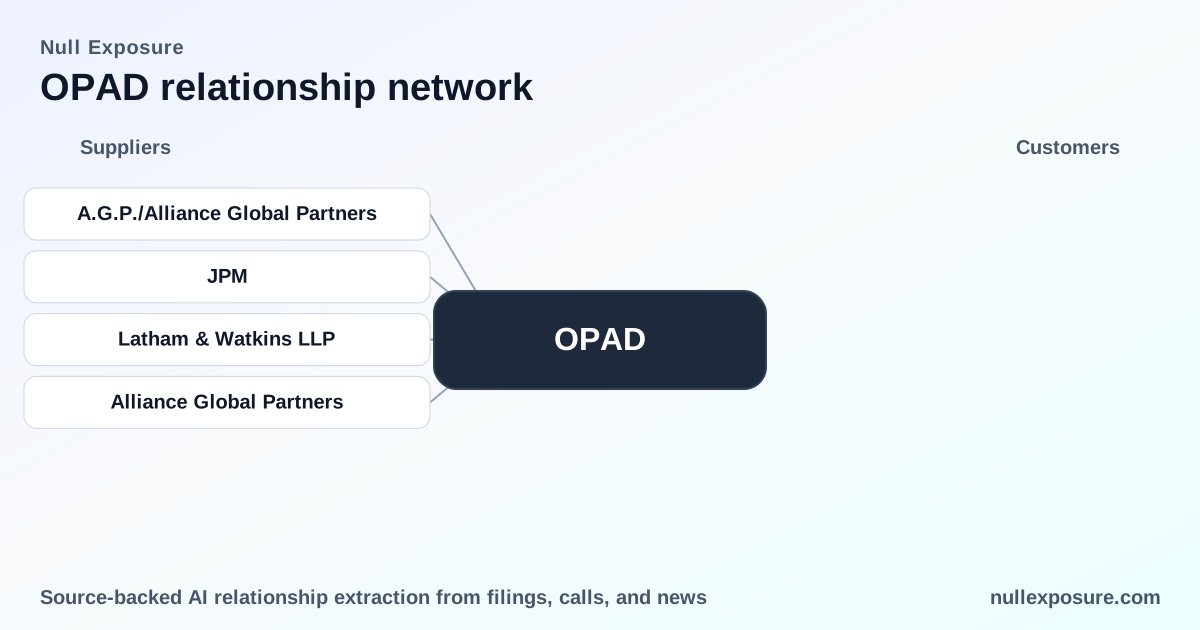
Offerpad Solutions (OPAD): Supplier relationships that move the balance sheet
Offerpad Solutions operates as a technology-enabled homebuyer and home-seller platform that monetizes by buying, renovating, and reselling residential real estate, plus ancillary services (title/escrow, financing facilitation and agent referral fees). Revenue comes from property sales, fee-based services around the transaction, and occasionally financing and placement arrangements tied to capital markets activity. For investors and operators, the supplier footprint — placement agents, legal and advisory firms, title vendors and lending counterparties — drives both execution risk and short-term funding economics. Learn more about portfolio supplier exposures at https://nullexposure.com/.
How Offerpad’s supplier posture shows through its contracts and cash flows
Offerpad’s operating model is capital- and service-intensive: the company purchases inventory, renovates homes through contractors, and lists properties for resale. That cycle creates a short-term contracting posture for many cash and credit relationships — inventory funding and renovation costs are intended to recycle within a 12‑month turn. The company discloses that borrowings to buy and renovate homes are classified as current liabilities because repayment is expected when inventory sells, which makes supplier and lender timing critical to liquidity.
- Short-term funding dependency: working capital and warehouse/credit facilities are core to operations; expiration or non-renewal of these facilities materially alters liquidity and sourcing costs.
- Service-provider mix: Offerpad runs a hybrid operating model — in-house title and escrow capabilities paired with national third-party providers, renovator contractors, MLS data partners and consulting firms — creating moderate vendor concentration in payments and operational reliance.
- Maturity and criticality: many supplier relationships are operationally critical (title, MLS, contractors) and economically significant (financing, placement agents).
Explore supplier-centric signals and curated relationship intelligence at https://nullexposure.com/.
Public relationships you need to track (each one covered)
Below are the supplier and advisor relationships surfaced in recent disclosures and press coverage, with a plain-English summary and source note for each.
A.G.P. / Alliance Global Partners
Offerpad appointed A.G.P./Alliance Global Partners as an exclusive placement agent and agreed to a 5.0% cash fee plus reimbursement of expenses, including legal fees capped at $50,000 — an arrangement that directly affects the cost of capital when Offerpad accesses equity or other market placements. Source: TradingView reporting on Offerpad’s material agreements (March 10, 2026).
J.P. Morgan Securities LLC
J.P. Morgan served as exclusive financial advisor to Offerpad during its SPAC merger process, providing transaction advisory and capital markets counsel that shaped the company’s path to being publicly traded. That relationship signals reliance on major bulge‑bracket advisory capacity for strategic capital transactions. Source: PR Newswire announcement regarding Offerpad’s plans to become publicly traded (2026).
Latham & Watkins LLP
Latham & Watkins acted as legal counsel to Offerpad in the same corporate transaction, delivering regulatory, transactional and securities law services that underpin Offerpad’s public listing and capital-raising activities. Effective legal stewardship reduces execution risk in capital events. Source: PR Newswire announcement regarding Offerpad’s SPAC merger plans (2026).
Alliance Global Partners (news commentary)
Commentary in market outlets noted that Alliance Global Partners’ role as a placement agent represents a strategic juncture for Offerpad, providing investor reassurance and distribution capability at the point of capital raise. This coverage reinforces the practical importance of placement agents to Offerpad’s access to fresh equity or structured financings. Source: TimothySykes news item summarizing Alliance Global Partners’ role (2025).
What the supplier mix implies for risk, concentration and contract maturity
Offerpad’s disclosures and external reporting together sketch a supplier profile with several investor-relevant implications:
- Concentration of short-term funding: The company classifies borrowings tied to inventory as current liabilities because they are repaid as homes sell, signaling cyclical liquidity tied to turnover and home‑sale velocity. That contracting posture raises sensitivity to housing market slowdowns and interest-rate driven capital costs.
- Operational criticality of title and MLS providers: Offerpad both operates title/escrow services and sources third-party title insurance and MLS data; payments to a large title provider (First American) were material in recent years, indicating a recurrent, high-dollar service relationship that supports transaction throughput. According to company disclosures, Offerpad paid First American millions across 2022–2024 and a board interlock exists with First American’s CEO, which increases both operational linkage and potential governance considerations.
- Contract maturity signals: the company disclosed the expiry of a warehouse lending facility in April 2024, which was not renewed, a concrete example of how facility rollover can shift funding cost and availability. Conversely, Offerpad reported an active senior secured facility and two mezzanine facilities with affiliates of LL Capital Partners as of December 31, 2024 — a mixed picture of terminated and active credit relationships that materially affects near-term liquidity and renegotiation risk.
These are company-level signals derived from disclosure language about borrowings, service providers and facility status; they are not assigned to a specific named supplier unless the disclosure explicitly names that counterparty.
Practical takeaways for investors and vendor managers
- Prioritize maturity and fee visibility: placement-agent fees (a disclosed 5% cash fee in the recent engagement) and legal/advisory retainers are concentrated, event-driven costs that inflate capital raises; understand fee cliffs before underwriting new financings.
- Stress test inventory turn and refinance scenarios: because inventory-linked debt is typically repaid within 12 months, slower home sales or higher capex per property directly squeeze liquidity and increase reliance on placement agents or mezzanine lenders.
- Monitor title and data-provider exposures: material payments to title vendors and a board interlock with a major title provider create both operational dependency and potential governance questions; contractors for renovations represent a second-order operational concentration.
If you want a single place to watch developments across Offerpad’s supplier relationships and finance agreements, visit https://nullexposure.com/ for ongoing monitoring and supplier risk briefings.
Final recommendation and next steps
Offerpad’s supplier landscape shows a classic iBuyer profile: short‑cycle funding, concentrated operational vendors, and episodic capital-market engagements that determine the company’s cash-cost of operations. For investors, underwrite scenarios where sales velocity compresses or where placement fees and advisory costs rise during capital raises. For operators and procurement teams, lock down multi‑vendor sourcing for title, scalable contractor networks, and clear renewal timelines for credit facilities.
For deeper supplier signal feeds and relationship analytics tuned to capital-market events, see https://nullexposure.com/ — it’s the most efficient starting point for tracking counterparty changes and funding agreements that move Offerpad’s fundamentals.