OPAL Fuels: Supplier Relationships and Strategic Constraints — What Investors Should Know
OPAL Fuels transforms organic waste streams into renewable natural gas (RNG) and renewable electricity, monetizing through long-term gas rights and site lease agreements, project-level sales of RNG and power, and joint-venture project stakes and offtakes. The company's operating model is project-centric: it develops, constructs and operates biogas conversion facilities and secures long-term feedstock and offtake contracts to lock in cash flows while using project finance and commercial debt to support capex. For a concise vendor-risk snapshot and continuous coverage, visit https://nullexposure.com/.
Why supplier and counterparty relationships drive OPAL's valuation
OPAL's business is value-engineered around feedstock access, operating scale and contract tenure. Long-duration gas rights and site leases (typically 20 years or more) convert landfill and manure hosts into predictable revenue streams; project economics then depend on construction execution, plant uptime and the credit quality of offtakers or JV partners. OPAL also monetizes through direct sales of RNG, renewable electricity, and through joint ventures that allocate construction and operating risk to partners while preserving revenue participation. Key financial context: Revenue TTM $329.2M, Market Cap ~$473M, EV/EBITDA ~16.4 — a growth company with operating leverage exposed to project commissioning and contract delivery.
Constraints that shape OPAL’s supplier posture and operational risk
The company-level disclosures provide clear, strategic constraints that govern supplier relationships and overall risk:
- Contracting posture: OPAL signs long-term gas rights and site leases typically of 20 years or longer, which structurally reduces commodity exposure and increases revenue visibility but concentrates counterparty and site-host risk across long tenors. This is documented in the company's disclosures describing standard agreement terms.
- Role and delivery model: OPAL functions predominantly as an operator and service provider, contracting licensed subcontractors for construction and carrying operational obligations for running projects, while also acting as a seller of RNG and renewable power. Filings note reliance on subcontractors for construction and letters of credit issued in support of project financing and PPA interconnections.
- Maturity and scale: As of December 31, 2024, the company owned and operated 26 projects, including 11 RNG and 15 renewable power projects, signaling a portfolio at commercial scale rather than pure development-stage exposure.
- Financial protections and project finance practices: The use of letters of credit in favor of lenders, utilities and independent system operators signals exposure to project-level credit support and a financing posture that relies on third-party credit instruments.
These company-level signals frame how suppliers, lenders and JV partners evaluate contract terms and pricing when working with OPAL. For a systematic supplier-risk evaluation, check https://nullexposure.com/.
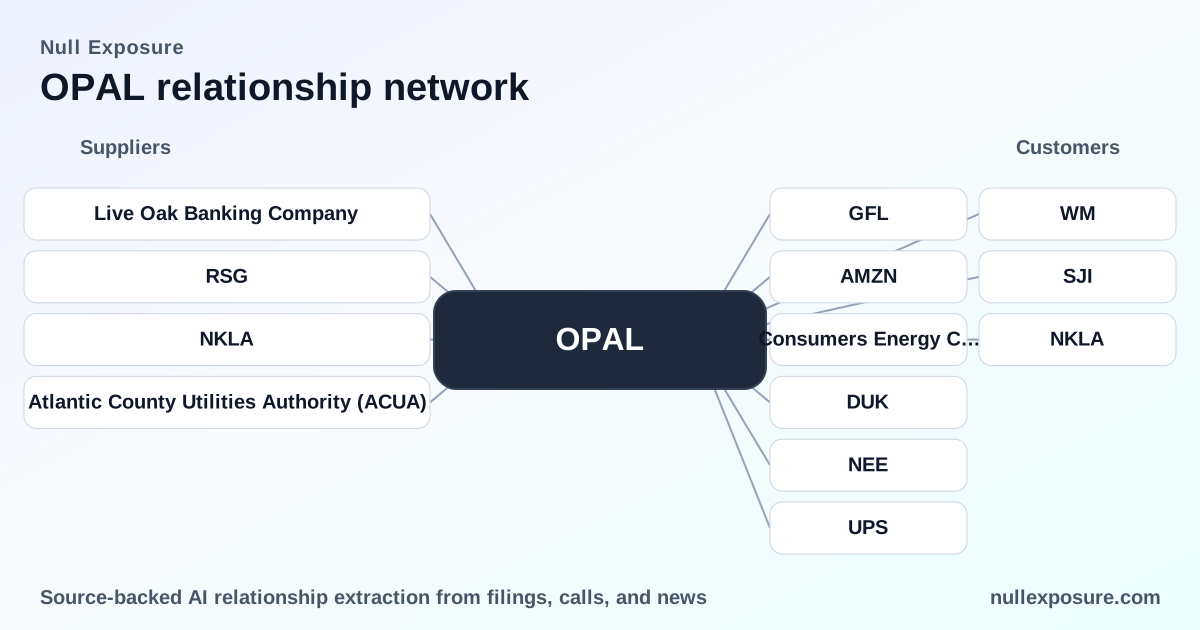
Relationship roll-call: what each counterparty delivers to OPAL
Live Oak Banking Company — project debt for Sunoma
OPAL disclosed in its FY2024 10‑K that Sunoma, an indirect wholly-owned subsidiary, entered into a debt agreement with Live Oak Banking Company for an aggregate principal amount quoted as $20,000. This is a direct lender relationship supporting project-level financing documented in the company’s FY2024 filing. (Source: OPAL 2024 Form 10‑K)
Republic Services, Inc. — joint venture for NC landfill RNG
OPAL announced a joint venture with an affiliate of Republic Services to convert an existing renewable electricity facility at Republic’s Charlotte Motor Speedway Landfill into an RNG plant with an initial annual design capacity of approximately 1.4 million MMBtu, and executed a new long-term gas rights agreement for the site. This JV demonstrates strategic alignment with a large waste-management host that supplies feedstock and site access while OPAL brings conversion and operating expertise (reported March 2026). (Source: CityBiz / OPAL press release, March 2026)
Nikola Corp. — hydrogen fueling network collaboration
In a collaboration first publicized in 2021, OPAL combined its experience developing, constructing and operating heavy-duty fueling stations with Nikola’s proposed fuel‑cell electric vehicle leasing and hydrogen-supply offering to deliver an integrated fueling solution. The arrangement illustrates OPAL’s capability to extend beyond RNG into broader low-carbon fueling infrastructure and station operations. (Source: Transport Topics / TTNews coverage, original announcement 2021)
Atlantic County Utilities Authority (ACUA) — New Jersey landfill RNG facility
OPAL operates an RNG facility located at ACUA’s solid-waste landfill in New Jersey that captures and processes landfill gas into RNG, a site-host relationship that converts municipal landfill emissions into saleable fuel. This reflects the company’s ongoing municipal-host strategy for feedstock access and project placement (reported March 2026). (Source: Yahoo Finance coverage of OPAL announcement, March 2026)
What investors and operators should extract from the relationship map
- Contract length is a structural strength and a governance lever. The typical 20‑year gas rights and lease profile gives OPAL predictable revenue legs that support project financing, but also concentrates counterparty exposure to landfill and host credits.
- JV partnerships with large waste managers de‑risk feedstock and site access. The Republic Services JV is a model for scaling capacity with a large host that supplies gas rights and eases permitting and operations integration.
- Diversification into fueling infrastructure broadens optionality. The Nikola collaboration shows that OPAL leverages its fueling-operations competency to enter hydrogen and heavy-duty fueling markets adjacent to RNG.
- Project-level finance and LC usage imply execution and liquidity risk corridors. Lending relationships and letters of credit are routine for capital-intensive projects but require active treasury management to avoid liquidity stress during construction or commissioning.
Key metrics to monitor on a rolling basis: project commissioning timelines, uptime/availability on operated plants, counterparty credit of site hosts and offtakers, and the company’s LC and debt utilization relative to liquidity.
Final takeaways and action steps for investors and operators
OPAL has built a repeatable project model anchored by long-term site agreements, a growing project portfolio (26 projects), and selective joint ventures with large waste managers; these features create predictable revenue while transferring some execution risk to subcontractors and partners. For investors, track commissioning schedules and JV pipeline conversions; for operators and suppliers, price and contract terms should reflect long-tenor counterparties and the company’s history of issuing LCs and using project finance structures.
If you evaluate counterparties or need continuous monitoring tools for counterparties like OPAL, visit https://nullexposure.com/ for running intelligence and supplier-risk analytics.
Actionable next steps: prioritize verification of long-term gas-rights documentation, review JV governance terms for revenue splits and decision rights, and validate liquidity buffers that cover letters of credit and construction-phase shortfalls. For a tailored supplier-risk briefing on OPAL or comparable players, begin at https://nullexposure.com/.