OppFi (OPFI): supplier relationships that shape funding, cards, and operational risk
OppFi operates a data-driven consumer lending platform that originates and services loans to underbanked consumers, then monetizes through interest income, fees, and ancillary product sponsorships (cards and partnerships). The company leverages third-party banks to sponsor payment rails and card issuance, strategic capital providers for lending capacity, and fintech partners for card processing and program management—creating a supplier footprint that materially affects funding cost, product distribution, and operational resiliency. For an organized supplier view and relationship signals, visit https://nullexposure.com/.
How these partners form OppFi’s operating backbone
OppFi’s business model is platform-centric with outsourced execution: the front-end customer acquisition, credit decisioning, and servicing sit on OppFi’s stack while critical rails—card issuing, payment processing (ACH), cloud infrastructure, and warehouse/funding lines—live with third parties. The company-level evidence shows a persistent reliance on service providers for data center and cloud services, bank access to ACH collections, and third-party security risk assessments, signaling a contracting posture that favors strategic outsourcing with controls for supplier risk management (company filings and risk disclosures). This posture reduces fixed cost and speeds product launches but concentrates operational risk in a small number of external suppliers.
The counterparties you need to track (and what they do for OppFi)
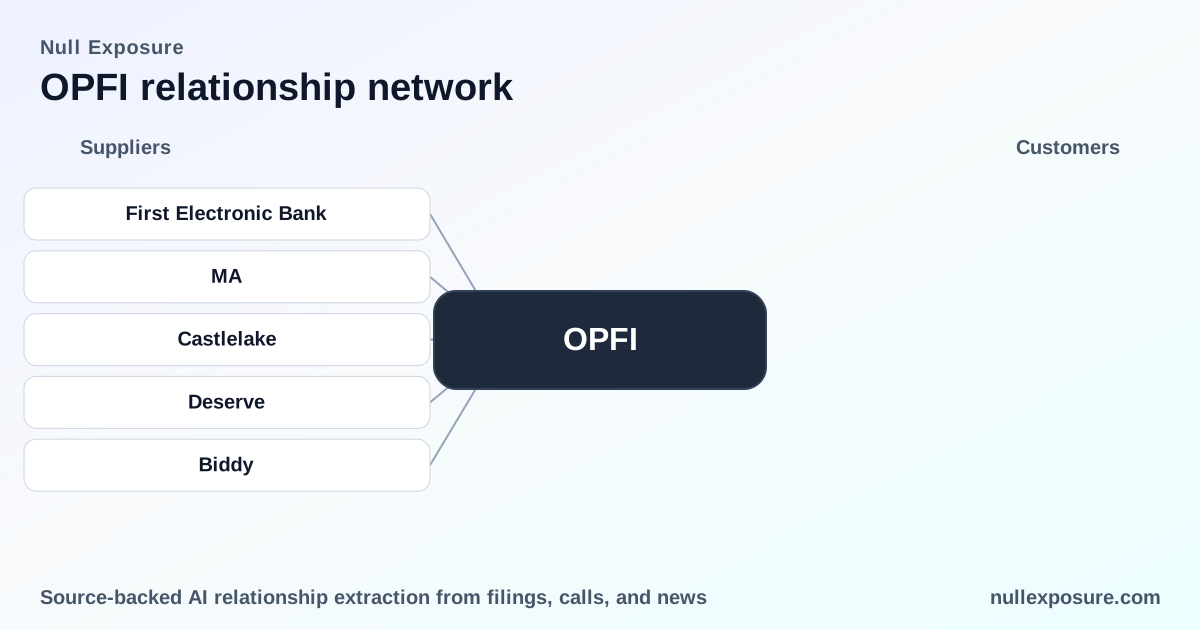
Below are the named supplier relationships surfaced in public sources; each entry is a compact investor-facing description with a direct source.
-
First Electronic Bank — First Electronic Bank is the issuing bank for the OppFi Card, taking on the bank sponsor role that enables FDIC-insured issuance and card performance oversight. According to a PR Newswire press release tied to the OppFi Card launch (FY2021), First Electronic Bank is the issuer and Member FDIC (source: PR Newswire, 2026-03-10 — https://www.prnewswire.com/news-releases/oppfi-teams-up-with-mastercard-first-electronic-bank-and-deserve-to-introduce-oppfi-card-301263758.html).
-
Mastercard — Mastercard is the exclusive card network for the OppFi Card, providing the network rails and acceptance footprint necessary for cardholder functionality and merchant acceptance. The PR Newswire release identifies Mastercard as the exclusive card network (FY2021), which is relevant for acceptance and interchange economics (source: PR Newswire, 2026-03-10 — https://www.prnewswire.com/news-releases/oppfi-teams-up-with-mastercard-first-electronic-bank-and-deserve-to-introduce-oppfi-card-301263758.html).
-
Deserve — Deserve is the card-platform partner powering the OppFi Card solution alongside the issuing bank, supplying card program management and processing capabilities that complement OppFi’s customer-facing product (FY2021). The PR Newswire announcement lists Deserve as a powering partner for the card product (source: PR Newswire, 2026-03-10 — https://www.prnewswire.com/news-releases/oppfi-teams-up-with-mastercard-first-electronic-bank-and-deserve-to-introduce-oppfi-card-301263758.html).
-
Castlelake — Castlelake is a capital provider and credit facility counterparty; OppFi renewed its credit agreement with Castlelake, which the company cites as improving operating leverage, pricing, and capacity, directly affecting funding cost and lending capacity (FY2025). This detail emerged in an earnings call transcript reported by The Globe and Mail / Motley Fool (source: The Globe and Mail / Motley Fool transcript, Q3 2025 — https://www.theglobeandmail.com/investing/markets/markets-news/Motley%20Fool/35763200/oppfi-opfi-q3-2025-earnings-call-transcript/).
-
Biddy — Biddy generated $1.4 million in equity income for OppFi in 2025, indicating a minority-equity or income-producing relationship rather than a pure vendor contract; this is a non-core but positive income line that supports reported earnings (FY2025). This figure comes from the Q3 2025 earnings discussion transcribed by The Globe and Mail / Motley Fool (source: The Globe and Mail / Motley Fool transcript, Q3 2025 — https://www.theglobeandmail.com/investing/markets/markets-news/Motley%20Fool/35763200/oppfi-opfi-q3-2025-earnings-call-transcript/).
What the supplier mix implies for risk, concentration, and execution
OppFi’s supplier roster reveals three structural dynamics investors and operators must monitor:
-
Funding and credit concentration: The renewed Castlelake facility is a positive for capacity and pricing, but it increases exposure to a small number of capital providers for warehouse and credit capacity. Track maturity schedules, covenants, and any step-downs in capacity that could affect origination growth.
-
Payment and product rails are outsourced and therefore critical: Card issuance and network dependence (First Electronic Bank, Deserve, Mastercard) mean OppFi’s consumer-facing product distribution relies on third-party banks and platform partners rather than in-house charter capabilities. This reduces regulatory complexity but creates operational dependency on partner contracts and network terms.
-
Operational and cybersecurity posture is outsourced but governed: Company disclosures show reliance on third-party data centers and cloud storage, with security risk assessments for select suppliers and controls in place—this is a company-level signal that OppFi manages supplier risk but remains exposed to supplier resiliency and cyber incidents.
For more detailed supplier scoring and monitoring for OppFi, see an investor-grade supplier report at https://nullexposure.com/.
Practical monitoring checklist for investors and operators
- Monitor Castlelake facility covenants, pricing resets, and capacity limits on a rolling basis.
- Watch card program metrics (activation, spend, delinquencies) tied to First Electronic Bank / Deserve / Mastercard relationships; network or processor issues will move consumer metrics quickly.
- Review third-party audit and security attestations for cloud and data center vendors given the explicit controls language in filings.
- Track non-operational equity relationships like Biddy for one-off income items that support reported earnings but are not core revenue drivers.
Bottom line: the supplier story is strategic, not incidental
OppFi’s supplier relationships are mission-critical to product delivery and funding economics: bank sponsors and card partners enable product distribution, while capital providers like Castlelake determine growth capacity and cost of capital. The company’s explicit reliance on third-party infrastructure and bank access to ACH is a deliberate contracting posture that reduces fixed costs and regulatory friction but concentrates operational and counterparty risk. Investors should prioritize covenant and partner-service metrics; operators should focus on SLAs, security attestations, and contingency planning.
For an actionable supplier map and ongoing monitoring of OPFI counterparties, visit https://nullexposure.com/. If you want a custom supplier risk profile for a portfolio or transaction, start at https://nullexposure.com/ and request a tailored briefing.