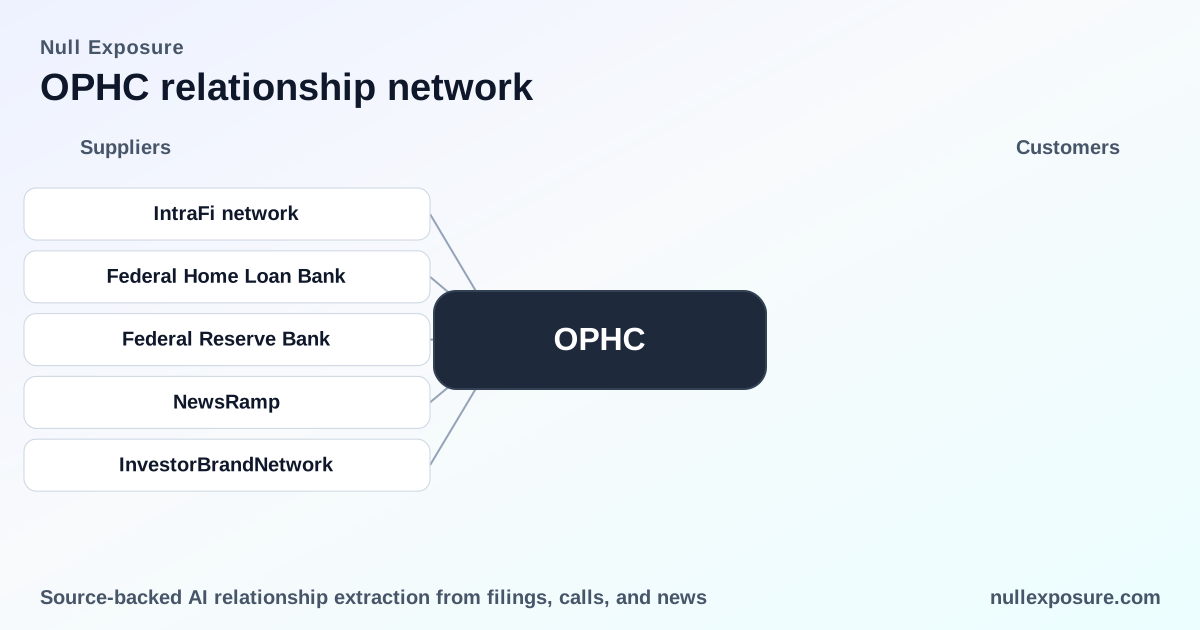
OPHC supplier relationships: what OptimumBank’s vendor map tells investors
Thesis: OptimumBank Holdings, Inc. (OPHC) runs a regional commercial and consumer bank model focused on Florida markets, monetizing through net interest income on loan originations and deposit spreads while supplementing liquidity with wholesale borrowing; its supplier strategy reflects that operating model—outsourcing critical data processing while relying on established liquidity partners and third‑party distribution services. Investors should read supplier relationships as operational levers: funding capacity, deposit insurance engineering, and outsourced technology are direct drivers of margin stability and execution risk.
For a practical view of counterparties and implications, visit https://nullexposure.com/.
How OptimumBank makes money and why suppliers matter
OptimumBank generates revenue primarily from lending and deposit margins, with reported Revenue TTM of $47.3 million and a strong operating margin profile. The bank manages balance‑sheet liquidity not only through core deposits but also via brokered deposits and wholesale advances, and it outsources much of its back‑office processing—both choices have material impact on capital flexibility and operational resilience. Supplier relationships therefore map directly to funding capacity (Federal Home Loan Bank, Federal Reserve access), deposit safety engineering (IntraFi), and the operational backbone (outsourced data processing).
Visit https://nullexposure.com/ for deeper supplier intelligence.
A concise tour of every supplier relationship in the record
IntraFi Network — deposit insurance augmentation (FY2026)
OptimumBank uses the IntraFi network to expand FDIC insurance coverage for deposits via brokered deposit arrangements, which increases the practical capacity to attract larger or brokered deposit balances. This is documented in the company’s SEC 10‑K coverage summarized by TradingView in March 2026. (TradingView coverage of OPHC SEC 10‑K, FY2026.)
Federal Home Loan Bank — committed wholesale liquidity (FY2026 / FY2025)
OPHC had $50.0 million of Federal Home Loan Bank (FHLB) advances outstanding at December 31, 2025 and reported additional borrowing availability of $231.9 million, establishing the FHLB as a primary committed liquidity partner. Management disclosed both the outstanding $50 million advance and the broader borrowing capacity in filings and press summaries spanning FY2025–FY2026. (Company reporting summarized on Yahoo Finance and TradingView, FY2025–FY2026; GlobeNewswire financial release Nov 2025.)
Federal Reserve Bank — supplementary advance channel (FY2025)
Company reporting groups Federal Reserve Bank advances together with FHLB advances in liquidity tables, indicating that OPHC maintains the Federal Reserve as a supplementary source of short‑term advances when eligible collateral and access conditions are met. The inclusion is explicit in the company’s FY2025 financial release published on GlobeNewswire. (GlobeNewswire press release, November 12, 2025.)
NewsRamp — distribution/press services used in investor outreach (FY2025)
A December 2025 media piece about an insider buying used NewsRamp for registration, verification and distribution services, indicating OPHC or related public relations activity leverages third‑party news distribution channels for investor communications. (CityBuzz article referencing NewsRamp, December 9, 2025.)
InvestorBrandNetwork — content distribution partner referenced in media (FY2025)
The same December 2025 article discloses reliance on InvestorBrandNetwork for distributed content, signaling usage of paid investor news networks to amplify corporate announcements. (CityBuzz article referencing InvestorBrandNetwork, December 9, 2025.)
What these relationships tell investors about OPHC’s operating posture
- Funding flexibility is a clear priority. The combination of FHLB advances, Federal Reserve advance capability, and brokered deposits routed through IntraFi demonstrates a deliberate approach to scale deposits and manage liquidity without diluting lending activity. That structure supports the bank’s revenue generation model by enabling asset growth while limiting reliance on uninsured local deposits.
- Operational execution is outsourced at scale. Company disclosures state that OptimumBank outsources most of its data processing services, including automated general ledger, deposit accounting, and loan subsystems. This is a company‑level signal of a contracting posture that prefers vendor specialization over in‑house development. (Company filing language summarized in SEC commentary, FY2026.)
- Cost behavior confirms vendor dependency. Management highlights increases in salaries, employee benefits, and data processing and other operating costs, which indicates vendor services are a material and variable line item affecting operating expense and margin levers. Treat this as an ongoing cost and concentration metric rather than a one‑off. (Company expense discussion, FY2025 filings.)
How to read risk and maturity from these signals
- Concentration and criticality: Outsourcing "most" data processing implies a small number of critical vendors; that elevates operational concentration risk even as it can improve scalability and control costs.
- Maturity of relationships: Use of regulated liquidity providers (FHLB, Federal Reserve) is a maturity signal—these are institutional, contractually governed relationships that provide predictable capacity. In contrast, distribution partners (NewsRamp, InvestorBrandNetwork) are tactical and non‑critical for banking operations.
- Contracting posture: The bank’s posture is vendor‑centric for technology and institutional for liquidity—this hybrid approach is common for regional banks seeking balance-sheet growth without heavy IT capital investment.
Explore supplier profiles and risk matrices at https://nullexposure.com/ to quantify counterparty exposures and contract terms.
Risk checklist and investment takeaways
- Positive: Strong access to FHLB advances and a clear mechanism (IntraFi) for scaled deposit insurance increase the bank’s ability to fund growth without compressing retail margins. This supports the bank’s current return on equity and low beta profile.
- Watch: Outsourced data processing is operationally efficient but creates vendor concentration; any vendor outage or cost shock would hit both expense and service delivery. Disclose vendor continuity plans and SLAs as part of due diligence.
- Funding cadence: The $50 million outstanding FHLB advance and $231.9 million of available borrowing suggest room to execute growth scenarios; monitor utilization trends and collateral eligibility changes that would affect availability.
For a structured supplier risk assessment or to commission a counterparty deep dive, begin at https://nullexposure.com/.
Final takeaway: OptimumBank’s supplier map aligns with a growth‑oriented regional bank that trades on liquidity access and outsourced operational scale. Investors should evaluate FHLB and Federal Reserve access as funding insurance and treat data‑processing suppliers as operational risks that require contract and continuity scrutiny.