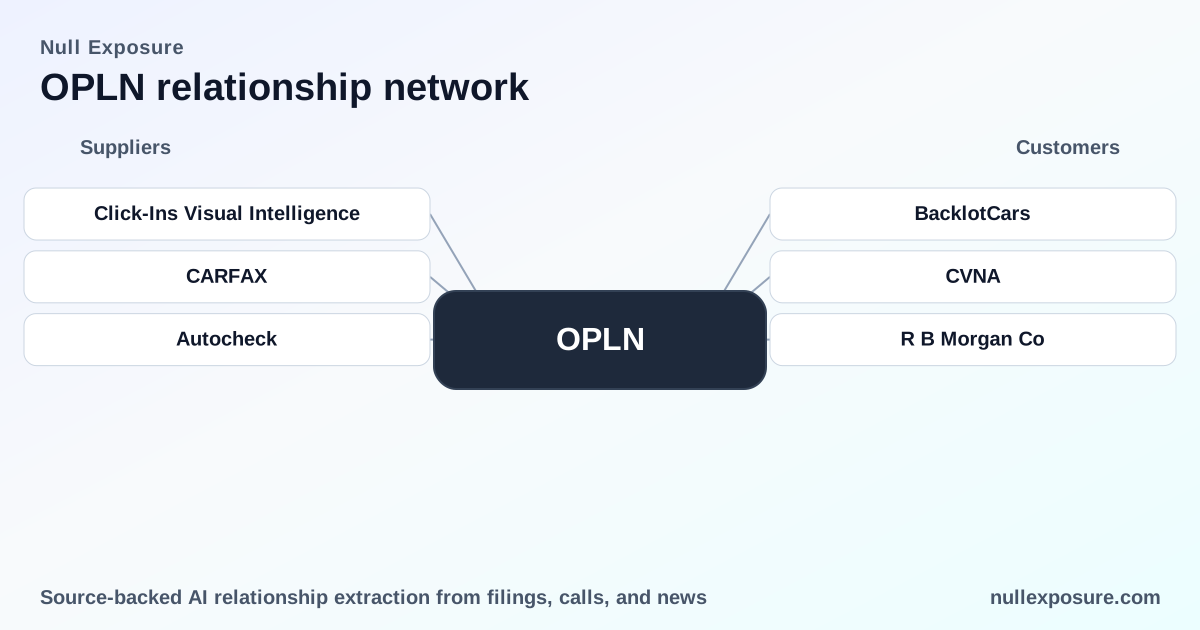
OPENLANE (OPLN): Marketplace company building operational control across the used-vehicle lifecycle
OPENLANE operates a global digital marketplace that connects dealers and fleet sellers with wholesale buyers and service providers, monetizing primarily through transaction fees, ancillary services (inspections, condition reports, reconditioning and logistics), and value-added automation tied to vehicle lifecycle events. Revenue scales with transaction volume while margin expansion depends on productized services — particularly inspection automation, vehicle history integration, and in-house/outsourced transport — that convert fixed platform costs into recurring fee streams. For further supplier and counterparty intelligence, visit https://nullexposure.com/.
Company snapshot and commercial posture OPENLANE is a marketplace at scale: roughly $1.93B in trailing revenue and a market capitalization near $2.9B in the latest public data. The business combines high-frequency transactional flows with increasing emphasis on software-driven services (inspection AI, automated title and history checks, transport logistics). That hybrid model creates a dual revenue profile — transactional marketplace fees plus predictable revenue from embedded services — but also imposes operational complexity where supplier relationships directly affect service quality and cost.
- Key operating readouts: Revenue (TTM) ~$1.93B, Gross profit (TTM) ~$893M, EBITDA ~$414M. These figures reflect a business where scale drives profitability but operational partners are the levers of unit economics.
How OPENLANE sources and coordinates service delivery OPENLANE combines proprietary platform capabilities with external suppliers to deliver end-to-end vehicle disposition services. Public disclosures and press material show emphasis on three functional layers where suppliers matter: inspection/condition reporting, vehicle history and verification, and transportation/logistics. A company-level constraint signals that OPENLANE provides transportation using both owned equipment and third-party licensed and insured carriers, reflecting a mixed contracting posture that balances control and capacity. This vertical integration reduces reliance on pure third-party carriage but also concentrates operational risk in logistics execution and regulatory compliance.
For investor diligence: track integration depth (APIs and automation), counterparty concentration, and the economics of converting ancillary services into recurring revenue. Learn more about supplier risk and exposure mapping at https://nullexposure.com/.
Supplier relationships in the public record The following summarizes every supplier relationship surfaced in the available results, with direct source references and plain-English implications.
Click-Ins Visual Intelligence — AI-powered inspection partnership
OPENLANE launched “Visual Boost AI” developed in partnership with Click-Ins Visual Intelligence to expand mobile-based damage detection and vehicle inspection capabilities. According to OPENLANE’s corporate press release (March 2026), this integration productizes on-site photo-based inspection and automates damage scoring to speed turn-ins and reduce reconditioning uncertainty. Source: OPENLANE corporate press release, March 2026.
CARFAX — automated vehicle-history integration for turn-ins
Investor-day material cites automation around “VHR CARFAX” for the turn-in process, indicating OPENLANE is integrating CARFAX vehicle-history reports into its vehicle handoff workflows to accelerate verification and reduce manual checks. MarketScreener coverage of OPENLANE’s investor day (FY2026) lists CARFAX automation as a targeted operational improvement. Source: MarketScreener reporting on OPENLANE investor day, March 2026.
Autocheck — post-sale maturity and monitoring tools
Investor-day slides reference “Post-S6le Autocheck Maturity Manager,” signaling a post-sale vehicle-history and maturity-management function driven by Autocheck data to manage buyer assurance and warranty/return exposures. This implies OPENLANE is leveraging Autocheck for post-transaction monitoring and to limit post-sale dispute risk. Source: MarketScreener reporting on OPENLANE investor day, March 2026.
Operating-model constraints and what they signal for counterparties Publicly disclosed constraints include a service-provider posture: OPENLANE explicitly states it provides transportation services using both owned equipment and licensed third-party carriers. Presenting that as a company-level signal yields several actionable conclusions:
- Contracting posture: Mixed model — partial vertical integration in logistics (owned assets) paired with third-party carriers where capacity is variable. This reduces pure supplier dependency but increases fixed-cost and asset management responsibilities.
- Concentration: The visible partner list is small in the public excerpt, but the operational model requires a broader ecosystem (inspections, history providers, carriers). Single-provider concentration risk exists for key services such as vehicle history and inspection if integrations are narrow.
- Criticality: Inspection and vehicle-history integrations, along with transport, are operationally critical — failures increase reconditioning costs, delay turn-ins, and elevate buyer dispute rates.
- Maturity: The firm is productizing services (AI inspection, automated history checks, post-sale maturity management), indicating transition from bespoke integrations to scalable, automated supplier relationships that can improve margins if executed.
Financial and operational implications for investors
- Revenue leverage: Automation partnerships (Click-Ins, CARFAX, Autocheck) directly target faster throughput, lower reconditioning spend, and fewer post-sale claims, improving unit economics without linear increases in traffic.
- Margin sensitivity: Transport ownership adds fixed cost but preserves margin on logistics; third-party carrier dependence exposes margins to capacity shocks and freight pricing.
- Operational risk: Integration depth matters. Fully embedded automation reduces manual labor but increases vendor lock-in and integration complexity; monitoring of SLAs, error rates, and fallback processes is essential.
- Regulatory/data risk: Reliance on history providers implicates data accuracy and compliance; contracts and indemnities with CARFAX/Autocheck are material to loss exposure.
Practical takeaways for operator diligence
- Prioritize verification of SLA metrics and data quality for inspection and history providers; inspect the end-to-end latency improvements and error rates that partnerships claim.
- Evaluate transport economics: asset utilization, carrier mix, and contingency plans for capacity shortages. A mixed-owned/third-party model signals intentional control but requires capital and operating discipline.
- Treat post-sale monitoring (Autocheck maturity functions) as a risk-mitigation expense that can reduce gross loss if properly enforced.
If you are sourcing counterparty intelligence or mapping supplier concentration for portfolio companies, get a structured view of OPENLANE’s supplier integrations and contractual risk at https://nullexposure.com/.
Conclusion — where to focus next OPENLANE’s strategy is clear: convert transactional marketplace flow into predictable, higher-margin services by embedding inspection AI and automated history checks while retaining select logistics capability. That strategy improves per-unit margins but concentrates execution risk in supplier integrations and transport operations. Investors and operators should prioritize validation of claimed automation benefits, supplier redundancy, and transport economics in any diligence process.
For a deeper supplier-risk profile and to monitor changes in OPENLANE’s partner integrations, visit https://nullexposure.com/ for continuous coverage and supplier relationship analytics.