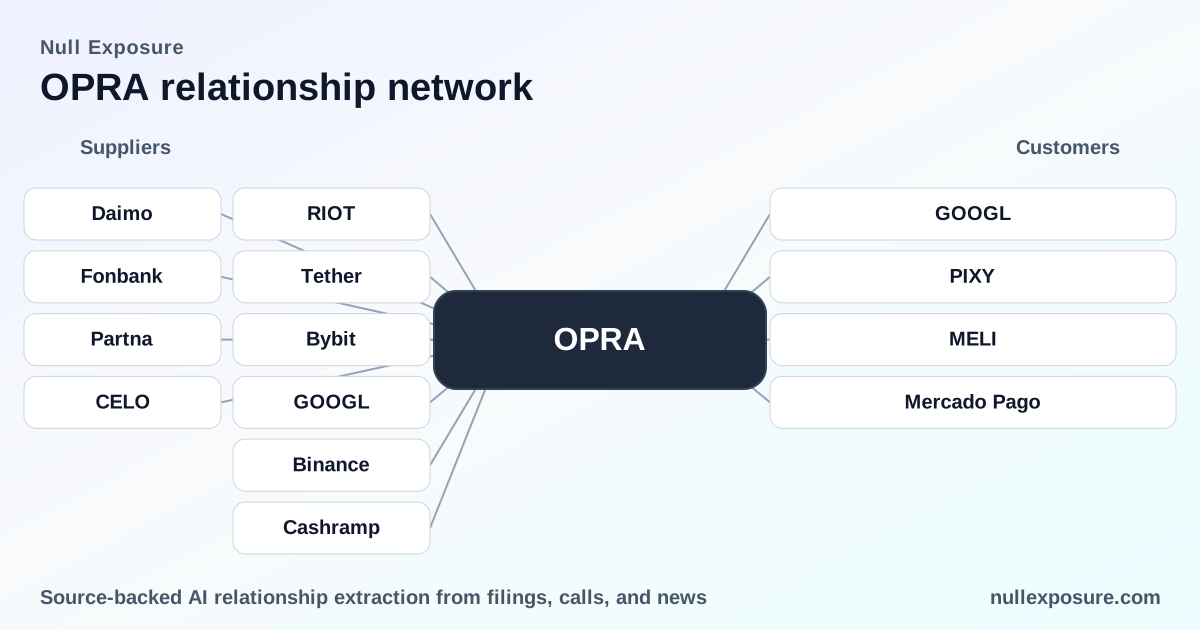
Opera Ltd (OPRA): Supplier relationships reshaping a browser company into a fintech gateway
Opera runs a dual consumer and platform business: it distributes web browsers (mobile and PC) to hundreds of millions of users and monetizes that reach through advertising, search and content partnerships, and increasingly through embedded financial services (MiniPay). Revenue growth today is driven by strategic supplier and partner integrations that convert browser distribution into payment rails and AI-enhanced engagement. For investors evaluating Opera as a supplier counterparty or strategic partner, the balance of major technology vendors, stablecoin issuers, and local cash-in partners defines both upside and concentration risk. Learn more about supplier exposure and implications at https://nullexposure.com/.
How these partnerships drive Opera’s economics
Opera’s core monetization remains advertising and default search agreements, but the company has explicitly expanded its wallet and payments product (MiniPay) and layered AI features into its desktop products to lift engagement and monetization per user. The supplier mix in the market commentary below highlights three revenue levers: (1) embedded fintech flows that capture transaction and conversion economics, (2) AI model licensing and integrations that increase time-on-platform and ad inventory yield, and (3) local distribution partners that enable fiat on/off ramps for emerging-market users. These supplier relationships convert user reach into direct-financial and indirect-ad revenue.
Relationship roll call — who Opera is working with, and why it matters
Opera’s disclosed supplier interactions in recent reporting and press coverage include a mix of global technology platforms, stablecoin and crypto liquidity providers, and regional cash-in partners. Each relationship below is summarized in plain English with source context.
Riot
Opera cited “close relationships with Riot” as enabling broader activity in select markets, indicating collaborative regional or ecosystem work that supports user engagement and market expansion. According to an earnings call transcript reported by InsiderMonkey in March 2026, Opera highlighted Riot as a partner that helps them “do more in those markets.” (InsiderMonkey, Q4 2025 earnings call transcript, Mar 2026)
Tether
Opera expanded support for Tether’s USDT and Tether Gold inside MiniPay, turning the browser wallet into a conduit for stablecoin-based payments and digital-gold access for emerging markets. This collaboration was widely reported in February 2026 and cited by multiple news wires as central to Opera’s fintech push. (Finviz / SahmCapital / Coinspeaker, Feb 2, 2026)
Bybit
Bybit is listed among local partners through which MiniPay users have added cash, evidencing exchange and liquidity-provider integration that feeds Opera’s wallet inflows. News coverage notes more than $49 million in cash added to MiniPay through partners including Bybit. (Finviz / Barchart coverage of MiniPay expansion, Feb 2026)
Opera integrated Google’s Gemini AI models into its desktop browsers (Opera One, Opera GX, Opera Neon) to power upgraded AI features and drive higher engagement among its PC user base; Opera also described a long-term partnership with Google for delivering integrated services. Multiple earnings-related reports in March 2026 attribute the new AI functionality to Google’s models. (Aijourn and SimplyWall.St reporting on Opera Q4 2025 results, Mar 2026)
Binance
Binance is named alongside other partners as a channel through which users convert local cash into MiniPay balances, tying a major crypto exchange to Opera’s wallet liquidity and user onboarding. Media wires reported Binance as one of several cash-in partners that have connected local economies to global liquidity. (Barchart / Finviz reporting on MiniPay partners, Feb 2026)
Cashramp
Cashramp appears in coverage as a partner enabling direct cash top-ups to MiniPay wallets, representing a payment-service-provider role in Opera’s emerging-market distribution footprint. Reports list Cashramp among local partners supporting the $49M+ cash inflows. (SahmCapital / Barchart, Feb 2026)
Daimo
Daimo is referenced as another local partner that facilitates user deposits into MiniPay, contributing to the wallet’s on-ramp network and regional payments reach. Coverage of the MiniPay rollout includes Daimo in the partner list. (SahmCapital / Finviz, Feb 2026)
Fonbank
Fonbank is included in Opera’s roster of local cash partners credited with enabling significant local currency inflows to MiniPay, suggesting Opera’s strategy to stitch regional banking channels into its wallet product. (Barchart / Finviz reporting on MiniPay, Feb 2026)
Partna
Partna is listed among the network of local partners that have driven cash additions to MiniPay, underscoring the fragmented, partner-driven approach to on-ramps in emerging markets. (Finviz / SahmCapital coverage, Feb 2026)
Celo
MiniPay is built on the Celo blockchain, making Opera’s wallet a non-custodial product that leverages Celo’s mobile-first, low-fee infrastructure for emerging-market payments. This technical foundation was noted in reporting on the MiniPay expansion. (Finviz reporting on MiniPay and Celo, Feb 2026)
What the supplier mix reveals about Opera’s operating model
The relationships above are consistent with a company transitioning from pure distribution to platform economics. Several company-level signals are observable:
- Contracting posture: Opera is executing transactional and partnership agreements rather than deep vertical integration; the supplier list is broad and modular, indicating an assembly approach to services.
- Concentration: While Opera diversifies partners across payments, exchanges, and AI, a small number of large suppliers (notably search and a major AI provider) represent non-trivial operational leverage for user experience and monetization.
- Criticality: Suppliers that provide liquidity and on-ramp services, as well as external AI models, are functionally critical to MiniPay’s value proposition and desktop engagement features.
- Maturity: The supplier ecosystem includes both established players (Google, major exchanges) and younger blockchain and local-finance partners, reflecting a hybrid maturity profile — mature advertising/search revenue remains the backbone while newer fintech channels are still scaling.
These signals imply Opera can scale fast through partner-led expansion but retains dependency on third-party models and liquidity providers for core product differentiation. For a supplier counterparty, that means Opera is an opportunistic, partner-friendly integrator that routes user flows through external rails.
Investment implications and risks
- Upside: The MiniPay rollouts and Tether support convert browser reach into transaction revenue and unlock new monetization vectors in high-growth emerging markets; AI integrations increase desktop monetization potential through engagement uplift. These factors supported Opera’s revenue guidance beat in recent reporting and explain positive market reactions documented in February–March 2026. (Coinspeaker, Finviz coverage, Feb–Mar 2026)
- Risks: Dependency on a few large external technology suppliers and on third-party liquidity/on-ramp partners creates execution risk. Regulatory, AML, or exchange-related disruptions affecting partner channels would directly impair wallet flows.
- Operational profile for counterparties: Opera’s approach favors flexible contract terms and modular integrations; counterparties should expect product- and market-specific agreements rather than single-enterprise deals.
If you evaluate supplier risk or partnership opportunities, build scenarios that stress on-ramp availability and the continuity of AI licensing, and quantify how much revenue attaches to wallet flows versus legacy search/ad contracts.
Explore deeper supplier intelligence and structured counterparty assessments at https://nullexposure.com/.
Bottom line and next steps
Opera is no longer just a browser company; it is a distribution-first platform monetizing through ad/search and converting attention into financial flows via MiniPay. The supplier roster — spanning major AI and search providers, stablecoin issuers, and local cash partners — accelerates growth but concentrates operational exposure on external rails. For investors and operators, the critical questions are the stability of those rails and Opera’s ability to retain premium search/ad economics while scaling transaction revenue.
For a rigorous supplier due diligence package and market-facing counterparty maps, visit https://nullexposure.com/ and request the Opera supplier dossier.