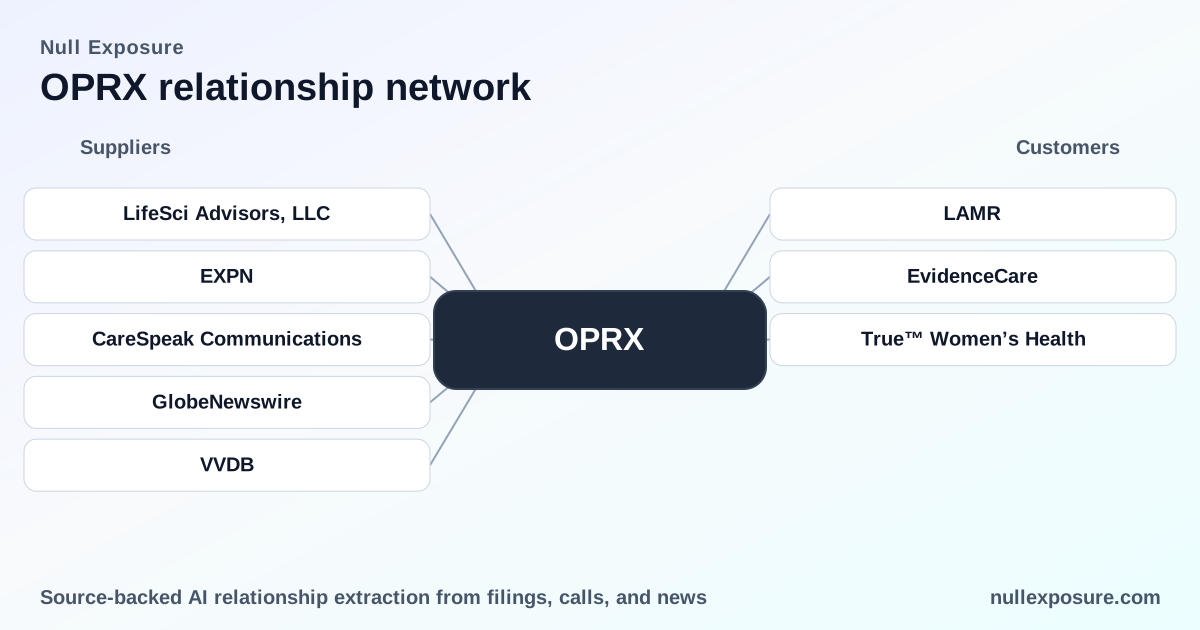
OptimizeRx (OPRX): supplier profile and partner map for investors
OptimizeRx is a digital health communications company that sells targeted messaging and patient support services to life sciences firms via electronic health record and e-prescribing channels. The business monetizes through a mix of subscription and programmatic activation fees plus revenue-sharing arrangements with channel partners, converting prescriber- and patient-facing reach into measurable activation for pharmaceutical marketers. This supplier profile distills the company’s partner relationships, contractual posture, and what those links mean for investors evaluating operational risk and commercial durability. For a deeper supplier-risk scan, visit https://nullexposure.com/.
How OptimizeRx generates cash — a concise operating thesis
OptimizeRx operates a two-sided commercial model: it sells marketing and patient engagement products to life sciences customers while relying on distribution through eRx/EHR channel partners that embed its messages into clinician workflows. Revenue is funded both by direct contracts with life sciences clients and by revenue-share arrangements with platform partners, yielding high gross margins (reported gross profit of $73.6M on $109.4M revenue TTM) but with variable cost pressure where channel payments are tied to usage. The company’s public filings and releases show a capital-light software model with measurable variable spend to sustain distribution, which controls scalability but creates exposure to partner economics.
For comparative supplier intelligence and commercial diligence, see https://nullexposure.com/.
Contracts, commitments and what they imply for suppliers
OptimizeRx’s public disclosures present a mixed contracting posture that is important for supplier and counterparty risk assessment:
- Company disclosures show long-term commitments: as of December 31, 2024, the company recorded commitments with channel partners for future minimum payments of $19.7 million scheduled across 2025–2029. This is a clear multi-year contractual footprint that drives near-term cost certainty and supplier revenue visibility.
- The company also uses usage-based revenue sharing with eRx and EHR partners: agreements provide for payments to channel partners based on revenue generated through their platforms, making a portion of the company’s cost of revenue variable and correlated with campaign volumes.
- Scale of committed outflows places OptimizeRx in a $10M–$100M spend band, with company disclosures noting $14.4 million due over the next twelve months — a non-trivial cash flow obligation that affects gross margin sensitivity.
Taken together, these signals indicate a supplier model that combines longer-dated minimum guarantees (reducing short-term churn risk) with volume-linked cost exposure (preserving scalability but introducing earnings variability). This contracting mix is mature enough to support recurring revenue while concentrating operational criticality on a small set of channel relationships.
Who OptimizeRx works with — relationship rundown
LifeSci Advisors, LLC
OptimizeRx uses LifeSci Advisors as an investor relations contact on its press releases, indicating a retained IR/communications relationship for market outreach. Source: GlobeNewswire press releases referencing LifeSci Advisors, Feb–Mar 2026 and related listings.
GlobeNewswire
GlobeNewswire is a distribution channel for OptimizeRx corporate announcements and financial-release dissemination, supporting broad media reach and regulatory disclosure obligations. Source: GlobeNewswire press release, Feb 5, 2026.
Viavid (webcast provider)
OptimizeRx used Viavid to host its investor webcast for the FY2025 results, showing the company’s selection of specialized providers for capital markets events. Source: Webcast link in company press release, Feb 5, 2026 (Viavid).
Experian
OptimizeRx announced a collaboration with Experian to integrate OptimizeRx Micro‑Neighborhood audiences into Experian’s identity graph, enabling onboarding and measurement for healthcare marketing activations. This is a strategic data- and identity-layer partnership designed to improve addressable audience activation and measurement at scale. Source: OptimizeRx–Experian press release, Jan 7, 2026.
CareSpeak Communications
OptimizeRx acquired CareSpeak Communications in 2018, integrating interactive health messaging and medication adherence capabilities into its product suite — an acquisition that expanded product breadth and signaled a capability-driven inorganic growth approach. Source: Hit Consultant report, Oct 17, 2018.
What the partner map says about operational concentration and criticality
The partner roster is functionally layered: communications/distribution (GlobeNewswire, Viavid), investor relations (LifeSci Advisors), identity/data integration (Experian), and capability expansion via acquisition (CareSpeak). The real operational dependency sits with the eRx/EHR channel partners referenced in company disclosures rather than the PR or IR vendors listed in news results, because those channel partners deliver the audience access and are the counterparties to the usage-based revenue-share framework.
Key operational takeaways:
- Contracting posture is hybrid: long-term minimum guarantees provide baseline predictability while usage-based fees align partner incentives to volume.
- Concentration risk is meaningful: the $19.7M of minimum commitments and the $14.4M due in the next 12 months imply a concentrated set of distribution relationships that materially affect cost of revenue.
- Criticality is high for channel partners but low for distributors/IR vendors: vendors like GlobeNewswire and Viavid support disclosure and investor access, but the company’s commercial outcomes are determined by EHR/eRx integrations and identity partners like Experian.
If you are structuring supplier diligence or counterparty exposure models, these characteristics require scenario stress-testing around partner renegotiation, campaign volume fluctuations, and the timing of minimum payment schedules.
For ongoing supplier intelligence and partner-risk scoring, explore more at https://nullexposure.com/.
Investment implications and concluding advice
OptimizeRx presents a high-gross-margin digital health model with contractual nuances that shape margin volatility. The company’s market capitalization (~$122M) relative to trailing revenue ($109M TTM) and an EV/EBITDA multiple (~11x) places a premium on continuing customer activation and stable partner economics. Primary risk vectors are partner economics (usage-based share) and the near-term payment ladder tied to committed minimums.
For investors and operators evaluating OPRX supplier relationships:
- Stress-test scenarios where partner revenue-shares increase with campaign scale, and model the impact of the $14.4M scheduled payments in the next 12 months.
- Treat identity integrations (Experian) as a value-driver that can improve measurement and pricing power, and treat PR/webcast vendors as executional cost centers without revenue impact.
- Monitor disclosures for any change in the size or mix of channel commitments; reductions in minimum guarantees or material renegotiations would be material.
For a structured supplier risk report and deeper partner exposure modeling, visit https://nullexposure.com/ — the homepage has tools and briefings tailored to investors assessing commercial counterparties.
Bold commercial relationships, quantifiable commitments, and a usage-linked cost model define OptimizeRx’s supplier risk profile — understand those levers before sizing exposure.