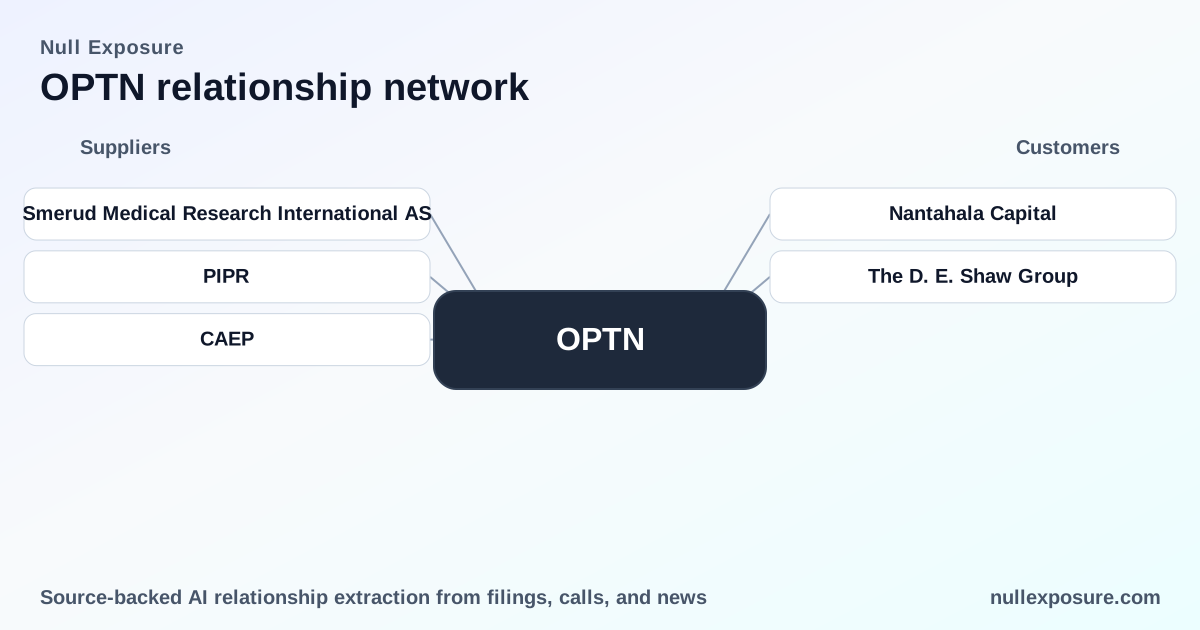
OPTN supplier relationships: what investors need to know
OptiNose (OPTN) sells prescription nasal-delivery products and monetizes through product sales, targeted direct-to-specialist commercialization, and capital markets activity to fund clinical and commercialization programs. The company contracts external clinical research organizations for trials and uses investment banks to underwrite offerings; its supplier footprint therefore blends clinical services and capital markets partners rather than heavy manufacturing dependencies. For investors, that combination drives a capital-intense revenue ramp and supplier dependencies that are procedural and time-sensitive rather than commodity-based. For deeper supplier analytics and continuous monitoring visit https://nullexposure.com/.
How OptiNose makes money and why supplier relationships matter
OptiNose generates revenue from prescription product sales and relies on a sequence of clinical, regulatory, and capital-market events to sustain growth. Clinical CROs are critical to trial execution and regulatory timelines, while underwriters and book-runners are material to liquidity and dilution outcomes when the company raises equity. Supplier relationships therefore map directly to execution risk and funding flexibility rather than to gross-margin swings tied to raw materials.
The supplier roster, one-by-one
Below are the supplier relationships surfaced in the results, each summarized in plain language with the supporting source.
Smerud Medical Research International AS — clinical trial CRO partner
Smerud Medical Research International AS is identified as a contract research organization that received fees from OptiNose for clinical trial services, with an associated individual (KTS) employed by Smerud supporting those engagements. According to a Nature publication referencing FY2017 material, this is a standard CRO relationship that supports trial operations and data collection (Nature Communications, 2017). Source: https://www.nature.com/articles/tp2017103.
Piper Sandler — lead book-running manager for a public offering
Piper Sandler acted as the lead book-running manager for OptiNose’s public offering announced in November 2021. The GlobeNewswire press release for the offering documents Piper Sandler’s role, which directly affects pricing, distribution, and investor reach when the company accessed public equity capital (GlobeNewswire, 16 Nov 2021). Source: https://www.globenewswire.com/news-release/2021/11/16/2335298/0/en/Optinose-Announces-Pricing-of-Public-Offering-of-Common-Stock.html.
Cantor — passive book-running manager on the same offering
Cantor participated as a passive book-running manager on the November 2021 equity offering, sharing underwriting duties that influence deal execution and investor allocation. The same GlobeNewswire announcement lists Cantor in this capacity and thereby confirms the firm’s role in OptiNose’s capital-raising activities (GlobeNewswire, 16 Nov 2021). Source: https://www.globenewswire.com/news-release/2021/11/16/2335298/0/en/Optinose-Announces-Pricing-of-Public-Offering-of-Common-Stock.html.
What the relationships reveal about OptiNose’s operating model
These supplier entries paint a clear operational profile for OptiNose:
- Contracting posture: The company outsources specialized functions—clinical trial execution and capital markets execution—rather than vertically integrating them. This reduces fixed-cost base but concentrates programmatic risk in a few external partners.
- Concentration signal: The CRO relationship is a classic single-service dependency during trials; while ownership of multiple CROs is common, the record here specifically names Smerud, which suggests at least one committed external partner for clinical work.
- Criticality and maturity: CRO and underwriting partners are mission-critical at different stages—CROs during trials and data submission, underwriters during capital raises. Both relationships are highly time-sensitive and directly affect cash runway and regulatory milestones.
- Supplier maturity: The listed suppliers are established service providers: an experienced research CRO and established investment banks, which implies operational reliability rather than nascent vendor risk.
There are no explicit contractual constraints or limitation clauses disclosed in the provided supplier data set. That absence is a company-level signal: the dataset does not flag supplier-specific constraints such as exclusivity, single-sourcing clauses, or time-limited performance covenants. For subscription-grade supplier tracking and to see how these signals evolve over time, visit https://nullexposure.com/.
Investment implications — how to weigh these relationships
Operational and funding outcomes for OptiNose flow directly from these partnerships. Key takeaways for investors:
- Clinical execution risk is outsourcing risk. If trials are delayed or data quality issues emerge, timing to approval and commercialization shifts, impacting cash burn and funding needs. The CRO relationship is therefore a lever on program timing.
- Capital-market relationships shape liquidity windows. The November 2021 offering shows the firm relies on active underwriters to access public capital; book-running arrangements influence pricing and dilution when the company raises equity.
- Vendor selection is conservative. The partners named are established firms, which reduces counterparty operational risk but does not eliminate program timing risk.
- Concentration requires monitoring. Single named CRO in the results and a small set of underwriters imply that a limited number of external parties could materially influence near-term execution.
Actionable checklist for investors:
- Monitor trial milestones and CRO progress updates as leading indicators of commercialization timing.
- Watch notices of future equity raises and the composition of underwriters to assess funding access and potential dilution.
- Track press releases and filings for any expansion of the supplier base or transitions away from single-source CRO dependency.
Place your supplier diligence on a disciplined cadence and compare peers’ supplier diversification to quantify execution risk.
Final takeaways and next steps
OptiNose’s supplier relationships are classic for a clinical-stage, commercializing specialty pharmaceutical company: outsourced trial execution and reliance on underwriters for capital support. These relationships matter because they directly control trial timelines and liquidity windows—two variables that determine valuation inflection points.
For investors and operators wanting systematic monitoring of these supplier dynamics, start with a supplier-concentration review and a capital-market readiness check. To get ongoing alerts and structured supplier intelligence, visit https://nullexposure.com/ and subscribe for continuous coverage.
If you would like a concise supplier-risk memo tailored to your holdings or a peer-compared supplier concentration dashboard, explore our services at https://nullexposure.com/.