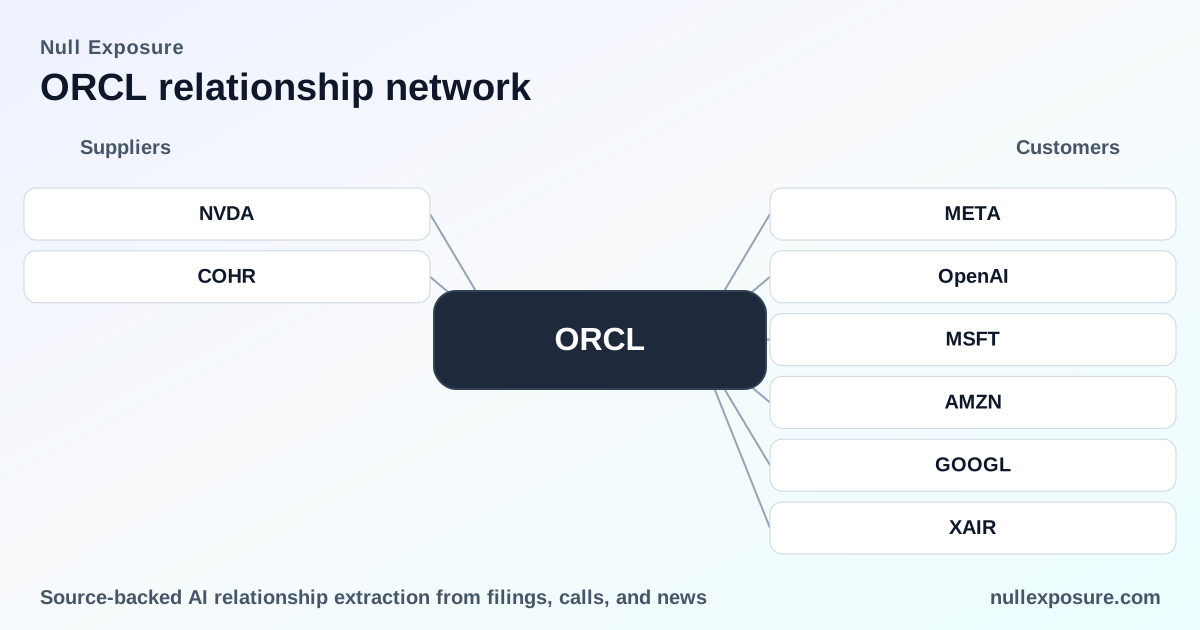
Oracle (ORCL) — supplier relationships that matter to investors
Oracle monetizes through software licensing, cloud subscriptions, engineered hardware and professional services, with recurring revenue from enterprise databases and an expanding share of infrastructure and application cloud revenue. The company’s go-to-market now blends high-margin software contracts with capitalized cloud infrastructure investments, and supplier relationships for chips and AI models shape both cost structure and the product roadmap for cloud customers.
Explore supplier risk and concentration with NullExposure: https://nullexposure.com/
Why suppliers are strategic for Oracle's business model
Oracle’s transition from on-premise software to cloud services has converted many formerly discretionary supplier relationships into operationally critical ones. When Oracle contracts for high-performance AI accelerators and partners to embed models into its SaaS stack, those agreements directly affect gross margins, service differentiation, and speed-to-market for enterprise buyers. The company still earns substantial recurring cash from licenses and subscriptions—Revenue TTM roughly $64.1 billion and Operating Margin TTM ~32.7%—but supplier-driven capex and external IP partnerships influence unit economics and competitive positioning.
Oracle’s supplier posture combines large-scale procurement power with an outsourced delivery model for some components; this creates a mix of negotiating leverage and persistent dependency on external vendors.
Visit NullExposure for detailed supplier intelligence: https://nullexposure.com/
What the news mentions actually recorded
Recent media coverage in March 2026 emphasized two supplier relationships that are material to Oracle’s cloud and AI strategy:
-
Multiple news posts reported that Oracle is spending heavily on Nvidia chips to power cloud AI workloads and infrastructure. According to several InsiderMonkey articles dated March 10, 2026, Larry Ellison through Oracle is deploying “billions” on Nvidia accelerators to underpin generative AI capability across Oracle Cloud (InsiderMonkey, March 10, 2026).
-
The same coverage documents a strategic partnership with Cohere to embed generative AI across Oracle’s cloud and applications, signaling Oracle is integrating third‑party foundation models into its platform and product stack (InsiderMonkey, March 10, 2026).
Relationship-by-relationship: what investors need to know
Nvidia (NVDA)
Oracle is committing substantial capital to procure Nvidia accelerators to support its cloud AI services and to provision customer workloads with GPU-backed instances; this elevates Nvidia from a component supplier to a strategic infrastructure partner for Oracle’s AI push. Source: InsiderMonkey reporting, March 10, 2026.
Cohere (COHR)
Oracle has executed a partnership to embed Cohere’s generative AI capabilities across Oracle Cloud and applications, positioning Cohere as a model partner that complements Oracle’s software and cloud delivery. Source: InsiderMonkey reporting, March 10, 2026.
(These two relationships are the set of supplier links surfaced in the March 2026 coverage.)
Company-level constraints and what they reveal about operating risk
Oracle’s disclosures and public excerpts supply two clear signals about how it organizes supplier relationships:
-
The company states that it outsources manufacturing, assembly and delivery for the substantial majority of its hardware products, indicating Oracle leverages external manufacturers for engineered systems and cloud hardware rather than vertically integrating production. This is a company-level signal about procurement posture and supply-chain maturity.
-
Oracle also reports that its cloud operations are delivered through global data centers, substantially all leased through colocation suppliers, revealing a co-location-centric approach that relies on colo partners for footprint and availability rather than sole reliance on wholly owned hyperscale data centers.
These constraints imply several operational realities: supplier concentration for hardware and colo services, predictable procurement cycles for repeatable infrastructure buys, and an operational model that trades fixed-asset capital deployment for flexible third‑party capacity. For investors, that combination increases exposure to supplier delivery risk (components and colo capacity) while preserving capital-light expansion and geographic reach.
Investment implications — executable checklist for investors and operators
-
Supply concentration risk: Heavy investment in Nvidia GPUs concentrates Oracle’s hardware dependency; if GPU supply tightens, Oracle’s ability to provision AI instances could be constrained.
-
Margin impact and capex cadence: Large GPU procurements raise near-term capital intensity but support higher-value cloud services that can command premium pricing; monitor gross margin mix and cloud infrastructure spend in quarterly filings.
-
Strategic upside from model partnerships: Embedding Cohere models into Oracle’s apps accelerates feature delivery and reduces time-to-value for customers, strengthening SaaS renewals and upsell funnels.
-
Operational resilience from outsourcing: Outsourced manufacturing and colocation leasing reduce fixed-asset risk but transfer operational continuity risk to suppliers; supplier SLAs and diversification strategy are key due diligence items.
-
Macro and competitive dynamics: GPU pricing and availability, plus competitive moves by other cloud providers (including their own chip strategies), directly affect Oracle’s cost and differentiation.
Oracle’s scale—market capitalization near $448 billion and strong operating margins—gives it negotiating leverage, but large concentrated buys and model partnerships convert supplier relationships into strategic dependencies.
For deeper supplier intelligence and relationship mapping, see NullExposure: https://nullexposure.com/
Final assessment and recommended next steps
Oracle’s supplier activity in early 2026 signals an aggressive push to industrialize generative AI within its cloud and application stack. Nvidia supplies the compute foundation; Cohere supplies model capability — together they materially shape Oracle’s cloud product road map and cost profile. At the company level, outsourcing manufacturing and leasing colocation capacity show a deliberate operating model that favors flexibility over upstream ownership, with attendant supplier‑concentration risks.
Actionable next steps for investors and operators:
- Monitor Oracle’s quarterly filings and cloud spend disclosures for GPU purchase schedules and partner contract announcements.
- Track service-level agreements and diversification among colo suppliers to gauge availability risk.
- Evaluate contract structures with model partners for exclusivity, revenue sharing, and data governance provisions.
For tailored supplier risk reports and ongoing monitoring of Oracle’s ecosystem, visit NullExposure and request a supplier intelligence brief: https://nullexposure.com/