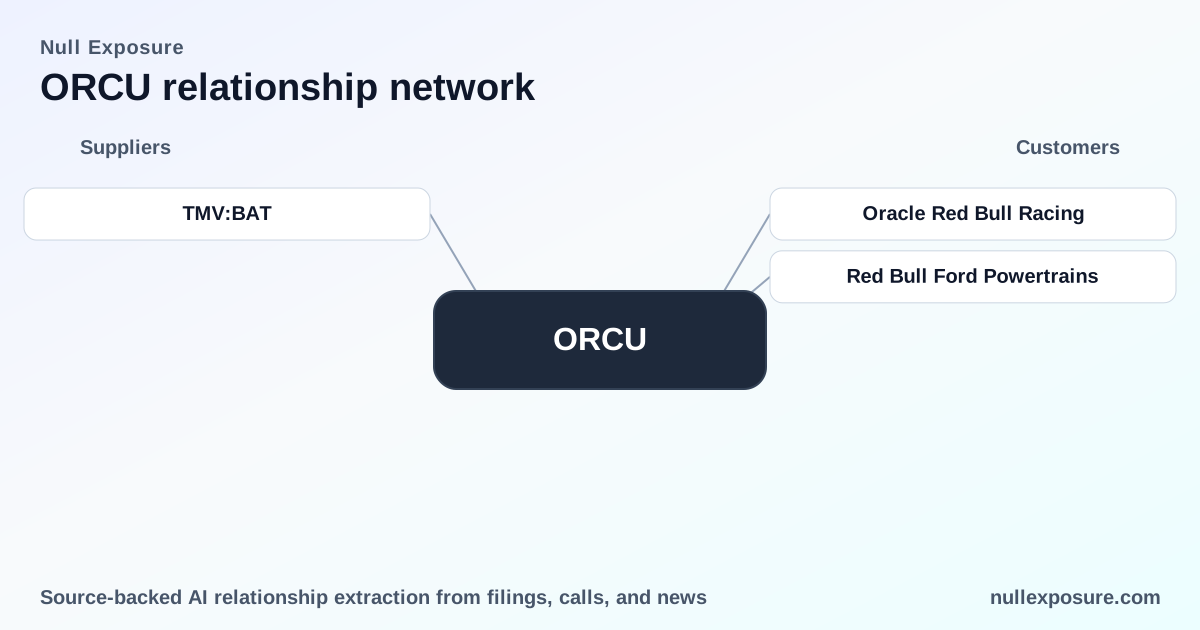
ORCU as a Supplier: What investors and operators should price into due diligence
ORCU is a leveraged equity ETF product offered by Direxion that monetizes through management and financing fees embedded in a daily-reset leveraged structure and by generating trading and securities-lending revenue for the issuer. For investors and counterparties evaluating a supplier relationship with ORCU, the relevant question is not only market performance but the operating plumbing—derivatives counterparties, market-maker liquidity, rebalancing mechanics, and fee capture—that drives both revenue and counterparty risk.
Explore how ORCU’s supplier relationships behave in practice and where concentrated exposure can create operational fragility: https://nullexposure.com/
How ORCU operates in plain language
ORCU is a 2x leveraged ETF product that achieves its exposure by using swaps, futures and/or other derivative instruments and by daily rebalancing the fund’s leverage. The issuer captures revenue primarily through the expense ratio and the difference between the financing cost of leverage and what investors pay, while ongoing trading and securities-lending activity produce incremental income. Because the product resets daily, short-horizon performance and liquidity provision are central to both capitalization and counterparty exposures.
This operating model creates an ecosystem of suppliers—prime brokers, derivatives counterparties, custodians, and market makers—whose reliability and cost schedules directly affect ORCU’s economics and risk profile. For more tailored monitoring of these dynamics visit https://nullexposure.com/
Recorded supplier relationship: Direxion (ETF sponsor and manager)
A news report from ETF Trends on March 10, 2026 cited ETF Database data showing directional ETF flows and short-term performance: the Direxion Daily ORCL Bear 1X ETF (ORCS) gained 4.7% while the Direxion Daily ORCL Bull 2X ETF (ORCU) dropped 9.6% on that day, highlighting the concentrated volatility faced by levered products and the sensitivity of investor flows to short-term moves. (ETF Trends, March 10, 2026; article referenced ETF Database data: https://www.etftrends.com/leveraged-inverse-content-hub/oracle-etfs-face-market-test-amid-data-center-volatility/)
Direxion, as sponsor and portfolio manager, is the primary counterparty for fund governance, operations, and distribution. That relationship is the core supplier link: Direxion designs the product, sets the expense and financing terms, and manages daily rebalancing, which determines both revenue capture and operational risk for counterparties and holders. (ETF Trends coverage, March 2026.)
Company-level signals and operating constraints investors should factor in
Because no explicit constraints were reported in the review set, present signals describe the product-level business model and its implications:
-
Contracting posture: Short-duration counterparties dominate. Leveraged ETFs rely on daily rebalancing and short-term derivatives and therefore operate with counterparty agreements that are transactional and frequently renewed; this increases sensitivity to short-term credit and liquidity conditions.
-
Concentration: Revenue and operational risk concentrate at the fund level around a single issuer/legal vehicle and a small set of counterparties and market makers. Product-level concentration means an adverse event at a primary counterparty or within the issuer’s operational stack materially affects the product’s availability and economics.
-
Criticality: For market participants using ORCU as a hedging or tactical exposure, the fund is functionally critical for short-term liquidity and leverage provision; the sponsor’s ability to manage intraday and end-of-day rebalancing is therefore a critical supplier capability.
-
Maturity: The leveraged ETF model is operationally mature—market conventions for daily reset funds are well established—yet the product’s market sensitivity to headline moves and to concentrated flows remains elevated.
These company-level signals should be integrated into counterparty assessments and liquidity stress tests rather than treated as isolated statistics.
What the Direxion relationship tells investors about risk and revenue
The ETF Trends report on ORCU’s large intraday move is an operational data point with three practical takeaways:
-
Volatility translates directly into investor flows and fee volatility. A near double-digit intraday move, like the 9.6% drop reported, drives trading volumes and can widen spreads, increasing revenue for liquidity providers but also heightening execution risk for investors. (ETF Trends, March 10, 2026.)
-
Sponsor execution matters. Direxion’s role in rebalancing and communicating position adjustments governs whether the product remains tradable during stress; sponsors that execute predictably protect value for counterparties and clients.
-
Counterparty exposure is dynamic. Large moves concentrate exposures in derivatives and funding lines; counterparties must price that tail risk into margin and financing terms.
Practical due-diligence checklist for counterparties and operators
Use these points to translate the product signals into actionable diligence:
- Verify the counterparty network supporting derivative execution and financing; model short-term renewal risk under stressed conditions.
- Stress test daily rebalancing mechanics and the sponsor’s operational playbook for extreme moves to confirm continuity of market-making and clearing.
- Monitor liquidity metrics and bid-ask spreads in real time and tie them to fee accruals to quantify revenue sensitivity to volatility.
- Validate distribution and custody arrangements to ensure rapid access to collateral and to understand legal protections in a counterparty default.
A disciplined diligence program that maps contractual recourse and operational fallback will materially reduce surprise exposures. For more portfolio-level supplier intelligence, visit https://nullexposure.com/
Closing recommendation: price the supplier ecosystem, not just the ticker
ORCU is a leveraged product whose profitability and resilience are derived from a compact supplier ecosystem centered on the sponsor, derivatives counterparties, and market makers. Investors and operating counterparties must evaluate the sponsor (Direxion), the short-duration contracting posture, concentration of exposures, and the product’s operational maturity when setting exposure limits or structuring financing.
If your firm needs continuous monitoring of issuer and supplier relationships for leveraged and specialty funds, start with a focused supplier-mapping exercise and ongoing event feeds linked to sponsor performance and liquidity signals. Learn more or request a tailored review at https://nullexposure.com/