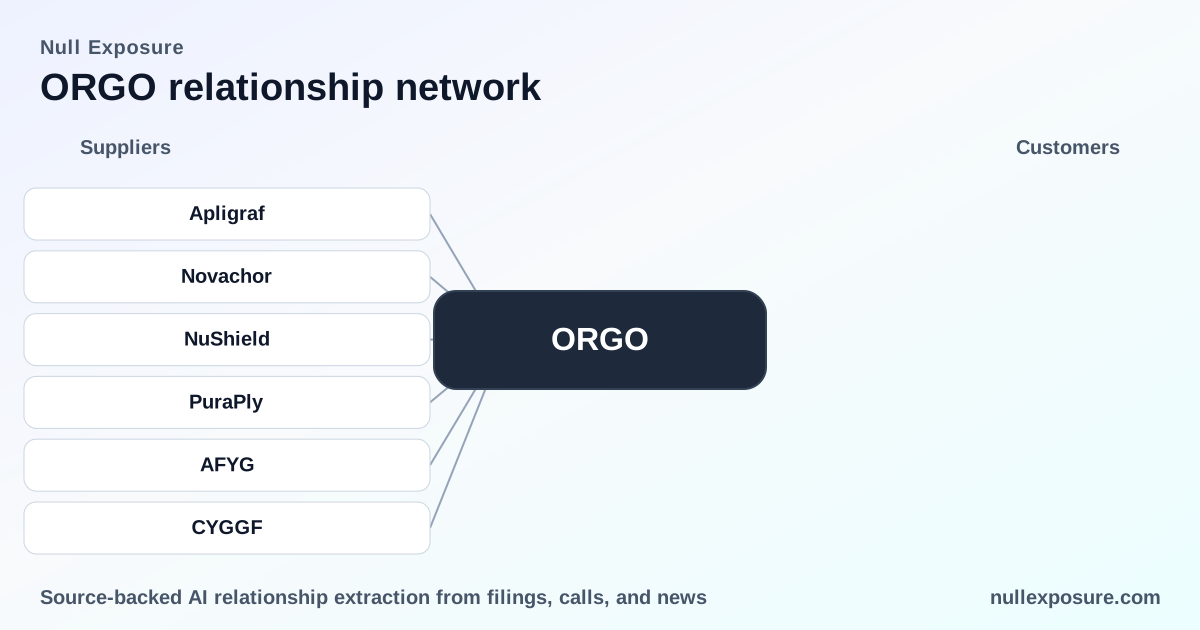
Organogenesis (ORGO) — Supplier Map and Commercial Risks for Investors
Organogenesis is a regenerative‑medicine manufacturer that sells advanced wound‑care and surgical products; it monetizes through product sales, licensing of certain trademarks and rights, and royalty arrangements tied to product revenues. Revenue is concentrated in a narrow set of biologics and placental‑derived products that are either manufactured in‑house or sourced from a limited group of third‑party suppliers, creating a supplier dependency profile that directly affects production continuity and margins. For an investor or operator assessing counterparty exposure, this supplier list and the company’s contracting posture are primary risk levers. Learn more about supplier intelligence at https://nullexposure.com/.
How Organogenesis runs the business and where suppliers fit
Organogenesis manufactures its primary non‑placental products internally while relying on third‑party manufacturers for placental‑based products and licensed goods. The company combines direct manufacturing, licensing arrangements and third‑party production to scale product reach while keeping capital intensity manageable. The FY2024 Form 10‑K frames supplier risk as a core operational constraint: the company explicitly identifies a short list of suppliers whose loss could materially impact sales, and it records multi‑year licensing and manufacturing arrangements that affect both cost structure and product availability.
- Contracting posture: The company recognizes multi‑year licensing fees amortized over contract terms (an example shows a three‑year initial term), indicating longer‑dated contractual commitments for at least some intellectual property and supply relationships.
- Concentration and criticality: The Form 10‑K lists a limited group of suppliers for key product lines, signaling high supplier concentration and operational criticality for those counterparties.
- Maturity and role mix: Public filings indicate both license relationships (historical university license) and active third‑party manufacturers; the company operates as both manufacturer and licensee depending on the product.
- Spend signal: Organogenesis discloses legally binding commitments totaling $26,303 as of December 31, 2024; an automated classification places supplier spend in a $10M–$100M band as a company‑level signal, which investors should reconcile with raw filings when modeling cash commitments.
For procurement teams and investors focused on execution risks, these characteristics translate to a playbook: prioritize continuity planning with named suppliers, verify multi‑year contract terms and exclusivity, and stress‑test manufacturing switch costs.
Learn how to convert supplier intelligence into actionable risk limits: https://nullexposure.com/.
The supplier roster — what the filing actually lists
Below I cover every supplier named in Organogenesis’ FY2024 10‑K and summarize what the company discloses about each relationship.
Apligraf
Apligraf is named among a limited group of suppliers and manufacturers whose loss could materially impact product sales, indicating its role is significant for Organogenesis’ product mix. According to Organogenesis’ FY2024 Form 10‑K, Apligraf is explicitly listed as one of the suppliers on which the company depends.
Novachor
Novachor appears on the same limited‑supplier list in the FY2024 10‑K, meaning Organogenesis treats it as a material supplier for one or more product lines; loss or disruption could create product development costs or delivery delays. The company’s 10‑K (FY2024) includes Novachor in the supplier group citation.
NuShield
NuShield is likewise identified in the FY2024 10‑K among the small set of suppliers and manufacturers that are material to Organogenesis’ operations, exposing the company to supplier concentration risk if alternative sources are not qualified. This listing comes from Organogenesis’ FY2024 Form 10‑K.
PuraPly
PuraPly Antimicrobial products are singled out in the FY2024 filing as part of the limited supplier group; Organogenesis states that losing any significant supplier could materially impact sales of its products, which includes PuraPly. This is documented in the company’s FY2024 10‑K.
Affinity (AFYG)
Affinity is identified by name in the FY2024 10‑K’s supplier list and is associated with third‑party manufacturing or licensed product rights that Organogenesis relies on; the 10‑K flags the group (including Affinity) as potentially material if interrupted. The FY2024 Form 10‑K lists Affinity (AFYG) among the limited suppliers.
CYGNUS (CYGGF)
CYGNUS is also reported in the FY2024 10‑K as part of the constrained supplier set; the company groups CYGNUS with other named providers that are material to product supply and revenue. Organogenesis’ FY2024 Form 10‑K includes CYGNUS (CYGGF) in its supplier disclosure.
(Each relationship above is taken from Organogenesis’ FY2024 Form 10‑K, which enumerates the limited group of suppliers the company depends upon.)
What investors and operators should watch next
- Concentration risk is explicit. The 10‑K’s language—listing a compact set of suppliers—means a single counterparty shock could produce material revenue disruption. Model downside scenarios that assume multi‑week to multi‑month outages for any named supplier.
- Contract tenors matter. The company records upfront licensing fees amortized over a three‑year initial contract in at least one instance, signaling multi‑year contractual commitments for IP and supplier relationships that affect near‑term cash flow and expense recognition.
- Mixed role set increases coordination risk. Organogenesis functions as manufacturer for some products and uses third‑party manufacturers for others, while also operating as a licensee under historical university arrangements and engaging service providers such as GPOs and outsourced security operations. This hybrid posture increases orchestration needs across procurement, quality and compliance teams.
- Reported commitments vs. classified spend. The filing shows legally binding commitments of $26,303 as of December 31, 2024; automated classification grouped company supplier spend into a $10M–$100M band as a company‑level signal — investors should reconcile absolute commitments in filings with any external spend banding used in model assumptions.
If you manage supplier risk or build exposure models, validate contract lengths and termination provisions with each named supplier and stress test revenue under supply interruption scenarios. For operational playbooks and counterparty monitoring, visit https://nullexposure.com/ for tools and coverage.
Bottom line for the investor
Organogenesis operates a highly concentrated supplier model for key biologic and placental product lines, supported by a mix of in‑house manufacturing, third‑party manufacturers, licensing arrangements and service providers. Supplier continuity is therefore a primary operational risk with direct revenue and development cost implications. Investors valuing ORGO should explicitly price supplier disruption scenarios into downside cases, confirm the maturity and exclusivity of named contracts, and track any shifts in the roster or commitment schedules reported in subsequent filings.
For continuous supplier intelligence and to convert these disclosures into investment signals, go to https://nullexposure.com/.