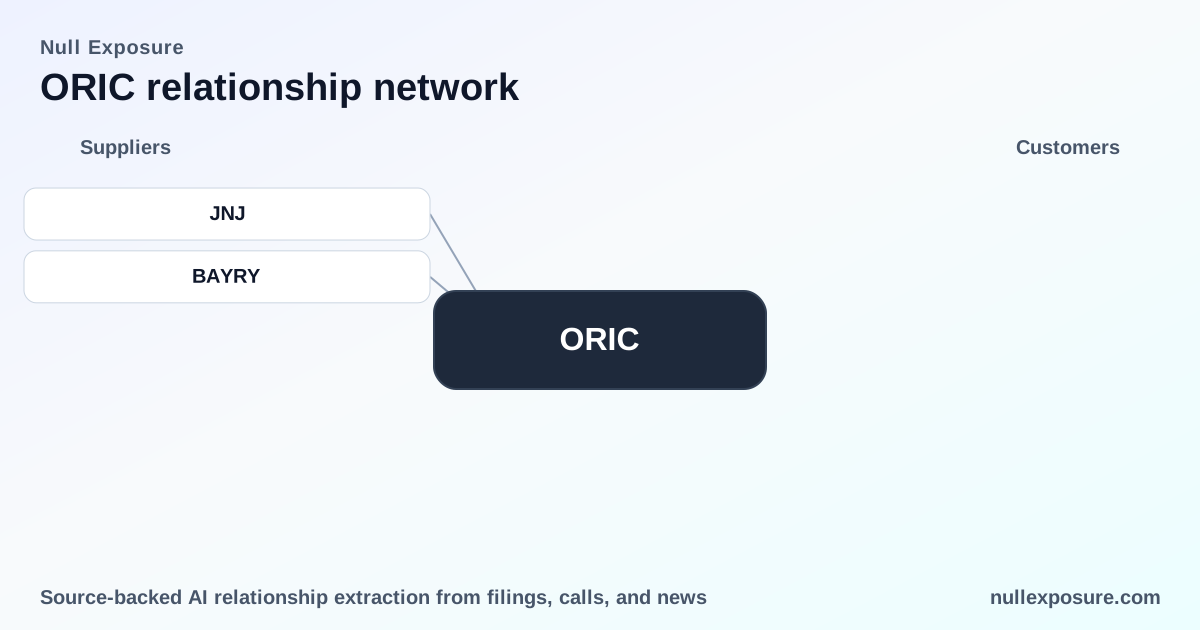
ORIC Pharmaceuticals: Supplier and collaboration map that drives near-term clinical value
Oric Pharmaceuticals is a clinical-stage oncology developer that builds value through targeted drug discovery, licensing and collaboration agreements, and eventual product sales upon approval. The company is pre-revenue and funds development through capital markets and partner collaborations; its commercial upside depends on successful late‑stage trials and external supply arrangements that enable combination studies and future manufacturing scale. For investors evaluating ORIC as a supplier partner or counterparty, the critical signals are a heavy outsourcing posture, single-source manufacturing concentration, and a growing slate of strategic collaborations with large pharma to de‑risk clinical development and share supply obligations. Learn more about supplier risk and counterparty exposures at https://nullexposure.com/.
What ORIC’s external relationships look like in plain English
ORIC’s public disclosures and press coverage list a small set of strategic collaborators used to run combination studies and secure drug supply. Below are the relationships surfaced in recent company communications and market reporting.
Johnson & Johnson — clinical collaboration and supply for enozertinib combination
ORIC announced a clinical trial collaboration and a supply agreement with Johnson & Johnson to evaluate enozertinib in combination with amivantamab (SC amivantamab) for first‑line NSCLC patients with EGFR exon 20 mutations. This is a protocol‑level collaboration that also includes a supply element to enable the combination study. According to ORIC press materials (GlobeNewswire, Jan 12, 2026 and Feb 23, 2026), the arrangement covers trial execution and supply logistics for the combination program; trading press coverage of ORIC’s filings reiterates the same collaboration (TradingView, Mar 2026).
Source: ORIC press releases and operational highlights (GlobeNewswire, Jan–Feb 2026) and trading press note on ORIC filings (TradingView, Mar 2026).
Bayer — collaboration to evaluate combinations with Rinzimetostat and Enozertinib
ORIC has entered into clinical trial collaboration terms with Bayer to evaluate its epigenetic and EGFR‑targeted assets in combination with Bayer therapies. Reporting on ORIC’s SEC disclosures and related news highlights Bayer as a collaborator for combination studies with Rinzimetostat and enozertinib, positioning the company to test synergistic regimens alongside large pharma partners (TradingView, Mar 2026).
Source: Coverage of ORIC’s filings and program collaborations (TradingView, Mar 2026).
The operating constraints that define ORIC’s supplier posture
ORIC’s public disclosures and filing excerpts make its supplier and outsourcing model explicit. These are company‑level signals that shape operational risk and contracting strategy:
-
Outsource‑first model and high third‑party dependency. ORIC relies extensively on third‑party CROs, CMOs, clinical sites and central labs for discovery, development, clinical manufacture and trials. External costs are the largest variable in R&D spend and are central to program timelines. ORIC’s filings state that it cannot independently conduct its clinical trials and requires multiple outside service providers.
-
Single‑source manufacturing concentration. For each product candidate ORIC currently relies on a single third‑party manufacturer with no immediate alternatives in place. That creates acute supply risk: production delays or quality issues at a CMO can push trial enrollment, regulatory milestones and program value.
-
Licensing and in‑licensing as a value driver. ORIC has licensed development and commercialization rights for key candidates — for example, rights to ORIC‑944 were licensed from Mirati (August 2020) and ORIC‑114 from Voronoi (October 2020), per company disclosures — which demonstrates a strategy of combining in‑licensed assets with internal development and external collaborations to broaden clinical programs.
-
Contracting posture is partner‑centric. The company enters collaboration and supply agreements with large pharma (e.g., Johnson & Johnson, Bayer) to enable combination studies and share operational burden; these contracts are strategically critical to run pivotal programs that underpin valuation.
-
Clinical‑stage maturity and financial profile. ORIC is pre‑revenue and reported negative EBITDA; the company’s market cap and balance sheet dynamics make access to partner funding, milestone payments and capital markets critical to sustain operations.
These constraints combine to produce two dominant operational facts: execution is highly dependent on a small set of third parties, and strategic collaborations are a primary mechanism to de‑risk trials and secure supply.
What investors should watch next — risk and upside checklist
-
Manufacturing concentration risk. With single CMOs tied to each candidate, a manufacturing interruption could materially delay timelines and destroy optionality for partnerships or commercialization. Monitor CMO contracts, tech transfer status, and any public quality or delay notices.
-
Contract terms and supply obligations in collaborations. Collaboration announcements often hide asymmetries: which party bears supply risk, who pays for additional manufacturing, and how IP and commercialization rights are split. Review subsequent filings and investor materials for explicit supply‑and‑cost allocations.
-
Clinical readouts and enrollment pace. The value of these supplier relationships is realized through trial progress; confirm that supply schedules align with enrollment targets and that CRO oversight is robust.
-
Balance sheet runway and milestone funding. Partnerships with large pharma can deliver non‑dilutive funding and in‑kind supply; track milestone structures and any contingent payments that support near‑term liquidity.
Midway action: if you need a consolidated supplier risk profile for ORIC to inform diligence or procurement decisions, start at https://nullexposure.com/.
Relationship implications for counterparties and operators
- For large pharma partners (JNJ, Bayer), these collaborations give access to ORIC’s targeted molecules while shifting operational risk to ORIC’s CMOs and CROs; counterparties should verify ORIC’s manufacturing redundancy and quality controls before scaling a program.
- For contract manufacturers and service providers, ORIC represents a high‑value but concentrated revenue opportunity; CMOs should negotiate terms that account for the potential volatility of clinical‑stage sponsors.
- For investors, the combination of high third‑party dependency and strategic collaborations means upside is binary: positive trial data and stable supply chain unlock valuations rapidly; manufacturing or CRO failures can compress value equally fast.
Bottom line — where to focus for investment or supplier decisions
ORIC is a classic clinical‑stage developer that leverages licensing and big‑pharma collaborations to accelerate programs while outsourcing manufacturing and trial execution. The company’s supplier map is small but strategically important: Johnson & Johnson and Bayer are active collaborators, and ORIC’s reliance on single CMOs and multiple CROs is a structural constraint that investors and counterparties must price into due diligence. For operators, the primary negotiation levers are supply redundancy, quality guardrails and milestone‑linked payments. For investors, monitor manufacturing disclosures, trial supply schedules, and the cadence of clinical milestones as the decisive drivers of near‑term value.
For an in‑depth supplier exposure assessment and monitoring playbook, visit https://nullexposure.com/.
Source recap: ORIC’s operational highlights and financial updates were released on GlobeNewswire (Jan–Feb 2026); trading coverage summarizing ORIC’s SEC disclosures appeared on TradingView (Mar 2026); company filings disclose in‑license arrangements with Mirati (Aug 2020) and Voronoi (Oct 2020) and enumerate its reliance on CROs/CMOs.