ORIQ (Origin Investment Corp I) — who they hired, how they operate, and what that means for investors
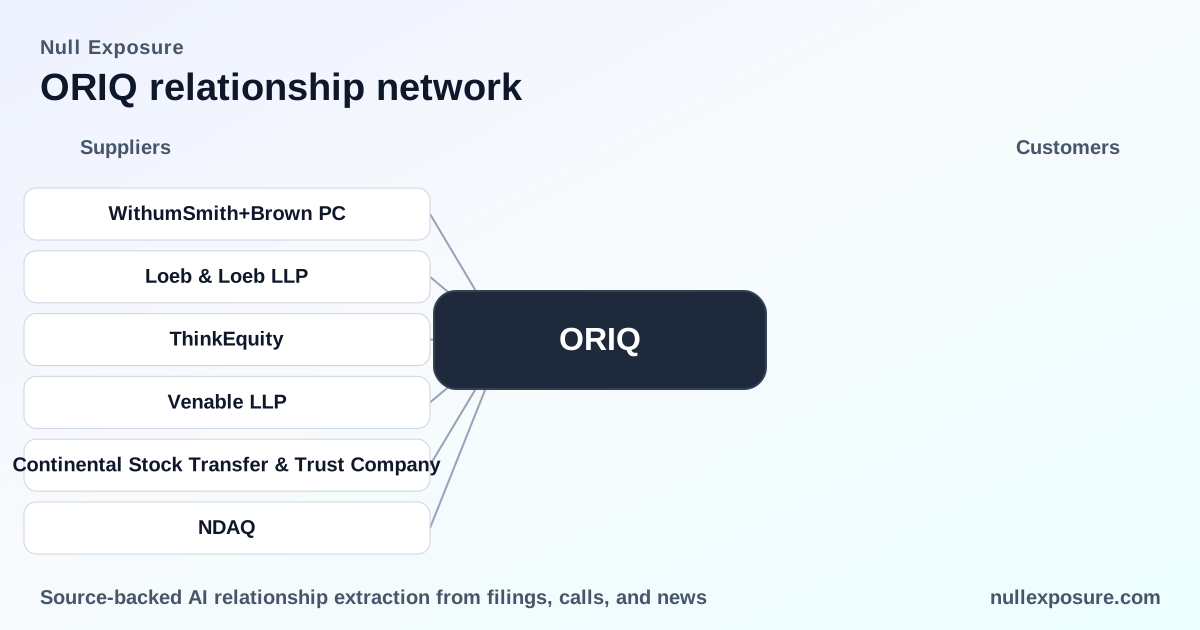
Origin Investment Corp I operates as a sponsored real estate acquisition vehicle that monetizes by raising capital through an initial public offering and deploying those proceeds into targeted property investments and operating platforms. The company’s revenue profile is currently inert—ORIQ completed a $60 million IPO of units in mid‑2025, is newly public, and its financials reflect a shell/SPAC structure focused on capital formation rather than operating cash flow. For investors and operators evaluating supplier relationships, ORIQ’s vendor roster around the IPO reveals a conservative, traditional servicing posture: external audit, issuer and underwriter counsel, a single book‑runner, a transfer agent/trustee, and public listing on Nasdaq. Learn more about how we track these supplier relationships at https://nullexposure.com/.
Quick take: operating posture and monetization in plain English
ORIQ raises capital via public markets and intends to convert that capital into real estate assets and operating value; its current earnings metrics are zero and the balance sheet consists primarily of IPO proceeds. Monetization depends on successful deal sourcing and asset management post‑closing, not on recurring operating revenues today. Institutional ownership above 73% signals a sponsor‑led institutional investor base while insiders retain meaningful stakes (about 17%), aligning incentives during the early life of the vehicle.
What the vendor list tells you about contracting, concentration and maturity
The supplier relationships disclosed around the IPO reveal several company-level operational signals you should treat as part of underwriting an investment:
- Contracting posture: ORIQ uses established external providers for audit, counsel, trustee and capital markets execution, indicating a standard outsourced model for compliance and transaction execution rather than in‑house capabilities.
- Concentration risk: The IPO relied on a single book‑running manager, ThinkEquity, which concentrates execution risk in the capital‑markets phase and can affect aftermarket liquidity and syndicate support.
- Criticality: All named suppliers are mission‑critical for listing and governance (auditor, counsel, trustee, transfer agent, exchange listing), even if they are not ongoing revenue vendors for asset management.
- Maturity signal: The corporate metrics—zero revenue, industry labelled “SHELL COMPANIES,” and recent IPO activity—indicate early maturity and a transitional operating model focused on capital deployment rather than cash flows.
No explicit contractual constraints were provided in the relationship data, which is itself a company-level signal: disclosure is currently limited to standard IPO servicing engagements rather than long‑term strategic vendor commitments.
Who’s on the payroll — the full roster and what each relationship means
Below I list every relationship captured in the public coverage around ORIQ’s IPO, with a concise plain‑English summary and a source reference for each.
WithumSmith+Brown PC — external auditor
WithumSmith+Brown PC is serving as ORIQ’s auditor for the IPO period, providing independent financial reporting and audit signoff required for SEC filings and investor due diligence. According to a SPACInsider report on the offering pricing (reported March 10, 2026), Withum is listed as the external auditor (https://www.spacinsider.com/news/headline-post/origin-investment-corp-i-oriqu-prices-60m-ipo).
Venable LLP — issuer’s counsel
Venable LLP serves as issuer counsel, managing the legal structure, disclosure documents and regulatory filings necessary for the company’s public registration and governance framework. The SPACInsider coverage of the IPO notes Venable as Issuer’s Counsel in the offering documentation (https://www.spacinsider.com/news/headline-post/origin-investment-corp-i-oriqu-prices-60m-ipo).
Loeb & Loeb LLP — underwriter’s counsel
Loeb & Loeb LLP acts as underwriter’s counsel, representing the underwriting syndicate on legal matters tied to the offering, which complements the issuer counsel role. SPACInsider’s article on the IPO lists Loeb & Loeb in this capacity (https://www.spacinsider.com/news/headline-post/origin-investment-corp-i-oriqu-prices-60m-ipo).
ThinkEquity — sole book‑running manager
ThinkEquity functioned as the sole book‑running manager for ORIQ’s $60 million IPO, underwriting and coordinating distribution to investors; the offering documentation and subsequent press releases confirm ThinkEquity’s central execution role. GlobeNewswire press releases from July 2025 and SPACInsider both identify ThinkEquity as the sole book‑running manager (https://www.globenewswire.com/news-release/2025/07/03/3110135/0/en/Origin-Investment-Corp-I-Announces-Closing-of-60-000-000-Initial-Public-Offering.html; https://www.spacinsider.com/news/headline-post/origin-investment-corp-i-oriqu-prices-60m-ipo).
Continental Stock Transfer & Trust Company — trustee / transfer agent
Continental Stock Transfer & Trust Company is acting as the trustee and transfer agent, responsible for shareholder recordkeeping and escrow/trust mechanics that preserve investor funds and unit distributions prior to and after closing. The SPACInsider IPO coverage lists Continental Stock Transfer in this trustee role (https://www.spacinsider.com/news/headline-post/origin-investment-corp-i-oriqu-prices-60m-ipo).
Nasdaq — listing venue
ORIQ’s units began trading on the Nasdaq Global Market under the ticker ORIQU on July 2, 2025, providing the public market venue and listing infrastructure that enables secondary trading and liquidity for investors. GlobeNewswire confirms the Nasdaq listing event and ticker assignment (https://www.globenewswire.com/news-release/2025/07/03/3110135/0/en/Origin-Investment-Corp-I-Announces-Closing-of-60-000-000-Initial-Public-Offering.html).
Investment implications and a targeted risk checklist
ORIQ’s vendor list is typical for a newly‑public acquisition vehicle, but it contains investible signals:
- Execution concentration: A sole book‑runner creates dependency on ThinkEquity for distribution strength and aftermarket support — underwriters influence early float dynamics and retail/institutional access.
- Governance hygiene: Engagement of established audit and legal firms (Withum, Venable, Loeb & Loeb) is a positive signal for disclosure quality and external controls.
- Liquidity and market access: Nasdaq listing gives ORIQ immediate market visibility, but trading liquidity will depend on syndicate placement and post‑IPO float.
- Operational runway: With zero operating revenue reported and a market cap of roughly $87.8 million, ORIQ’s success hinges on capital deployment and asset management capability rather than near‑term cash flow.
Key action for investors: validate sponsor track record on deal sourcing and the timeline for capital deployment before allocating capital to the equity. For operators and counterparties, understand that ORIQ’s outsourced, traditional supplier posture will favor standard engagement terms rather than bespoke long‑term partnerships. For deeper contractor and counterparty mapping, visit https://nullexposure.com/.
Conclusion — what to watch next
ORIQ is in the capital‑formation phase with a conventional IPO supply stack: auditor, issuer and underwriter counsel, a single book‑runner, a transfer agent/trustee, and Nasdaq as exchange. These relationships are essential for compliance and initial liquidity but do not guarantee asset performance; the stock’s future depends on sponsor deal flow and execution. For ongoing monitoring of ORIQ’s suppliers, contracts and concentration risks, check our supplier intelligence hub at https://nullexposure.com/.
Next steps for investors: confirm sponsor experience in the target real estate sectors, monitor filings for post‑IPO deployment activity, and track any changes to the syndicate or transfer agent arrangements that could alter governance or liquidity dynamics.