ORIQW (Origin Investment Corp I Warrant): what investors should know about supplier ties and operating signals
Origin Investment Corp I Warrant (ORIQW) is an option-style security tied to a SPAC vehicle focused on real estate mergers; value is generated through event-driven capital appreciation rather than operating cash flow, and returns depend on successful deal execution, merger economics, and secondary-market liquidity. As a warrant instrument, ORIQW’s investor economics are determined by the underlying post-merger equity price relative to the warrant strike price and the timing of that conversion opportunity. For investors evaluating counterparties and market positioning, the most material relationships are underwriting/listing partners that influence capital formation and initial liquidity. Learn more at https://nullexposure.com/.
Why underwriters and listings matter for a warrant vehicle
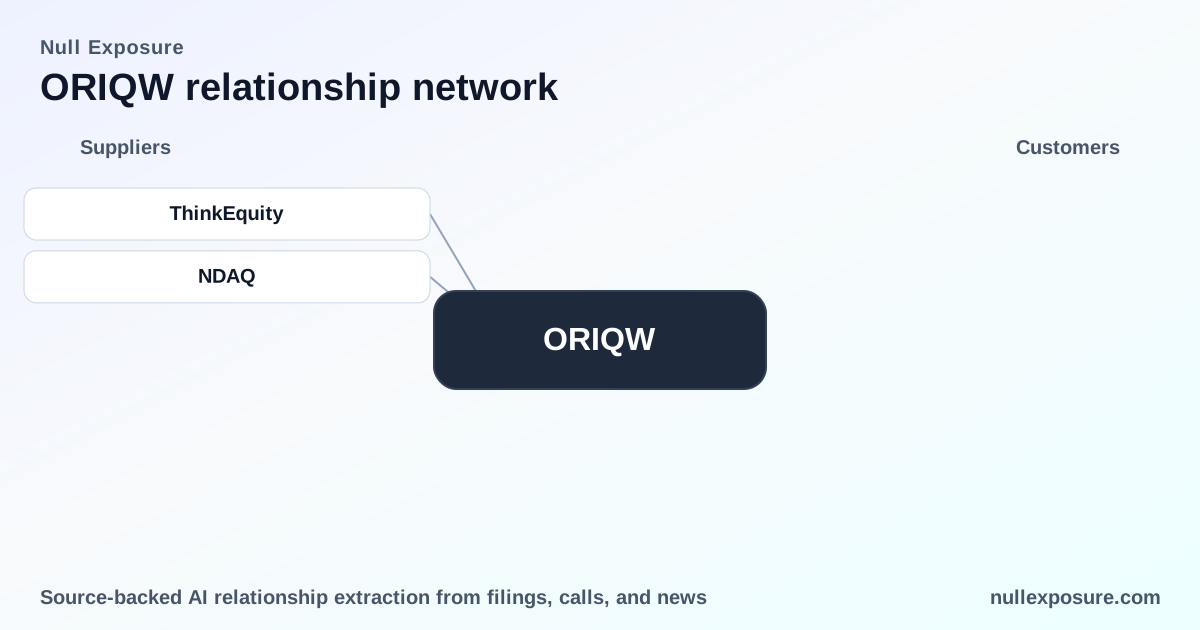
Warrants carry no standalone operating business; their price and tradability are governed by market structure and the sponsor ecosystem. Underwriters set initial supply, pricing, and the public distribution path; listing venues determine immediate liquidity and discoverability. For ORIQW, two counterparties surface in public reporting that shape those vectors: ThinkEquity as the book-running manager and the Nasdaq Global Market as the listing venue for the units that accompany the SPAC offering.
Who ORIQW is working with — concise relationship notes
ThinkEquity — sole book-running manager
ThinkEquity acted as the sole book-running manager for Origin Investment Corp’s offering, a role that positions it as the primary underwriter responsible for distribution and pricing of the public units. According to a Yahoo Finance press release covering the pricing announcement, ThinkEquity was named the sole book-runner for the transaction (https://finance.yahoo.com/news/origin-investment-corp-announces-pricing-232500631.html). Bernama also reported ThinkEquity’s role in its coverage of the offering (https://www.bernama.com/en/news.php?id=2441331).
Nasdaq Global Market — listing venue for the SPAC units
The SPAC’s units began trading on the Nasdaq Global Market under the ticker “ORIQU,” establishing the venue through which the units and related securities achieved initial market liquidity and price discovery. Bernama’s market report explicitly noted the July 2 commencement of trading on Nasdaq Global Market (https://www.bernama.com/en/news.php?id=2441331).
What those relationships signal about ORIQW’s operating posture
- Contracting posture: The presence of a single, named book-runner indicates an underwriting model organized around a lead manager rather than a multi-book-running syndicate, which concentrates execution risk but can streamline decision-making around pricing and allocation.
- Concentration: Underwriting concentration behind a sole book-runner raises concentration risk in distribution; ThinkEquity’s influence over initial supply and placement will materially shape short-term liquidity for warrants and units.
- Criticality: For warrant holders, these counterparties are critical to near-term valuation because underwriting determines float and Nasdaq listing determines access for buyers and sellers.
- Maturity: As a recently listed SPAC vehicle, the instrument is in an early lifecycle where sponsor execution of a merger is the primary value driver rather than recurring cash flows.
These are company-level signals about how ORIQW is set up and how execution risk is concentrated; they do not assign operational duties to any relationship beyond the roles named in public reports.
Risk and opportunity implications for investors
The combination of a concentrated underwriting relationship and a Nasdaq Global Market listing produces a clear profile: event-driven upside, concentrated execution risk, and market-dependent liquidity. Key considerations:
- Catalyst dependence: Warrant value is tied to the SPAC’s ability to announce and close an accretive merger in the targeted real estate space. Underwriting and listing partners determine the early market mechanics but do not change the underlying deal risk.
- Liquidity sensitivity: Initial trading on Nasdaq Global Market provides a mainstream venue for liquidity, but trading depth will reflect both investor appetite for SPAC warrants and the underwriter’s allocation strategy at IPO.
- Distribution control: With ThinkEquity as sole book-runner, allocation decisions, over-allotment behavior, and stabilization actions (if any) will be coordinated through a single manager, increasing the importance of following underwriter statements and lock-up mechanics.
Midway action: for a compact, objective view of sponsor, underwriter, and listing details, see https://nullexposure.com/ — use it as a monitoring hub for issuer relationship tracking.
Practical due diligence checklist for operators and investors
- Monitor official filings and press releases for merger announcements, warrant strike details, and conversion mechanics.
- Track trading volume and order book depth on Nasdaq to gauge immediate liquidity and price discovery.
- Watch for ThinkEquity communications or syndicate activity that affect supply dynamics, including any over-allotment or stabilization moves.
- Evaluate sponsor track record in real estate mergers to assess deal execution probability and likely valuation outcomes.
Final assessment and recommended next steps
ORIQW is an event-driven instrument where the primary operational levers are underwriting distribution and exchange liquidity rather than corporate cash generation. ThinkEquity’s role as sole book-runner concentrates execution influence, while Nasdaq Global Market listing ensures mainstream access. For investors and operators evaluating supplier relationships, the focus should be on monitoring underwriter behavior and merger progress closely.
If you want ongoing visibility into issuer-counterparty relationships and structured alerts on underwriting or listing changes, start here: https://nullexposure.com/. For bespoke analysis or institutional monitoring of SPAC-related warrants and their counterparties, contact our research team at https://nullexposure.com/ to set up tailored coverage.
Key takeaway: value for ORIQW holders is fully contingent on deal execution and market mechanics; underwriter concentration and the Nasdaq listing are the two immediate levers that will shape early valuation and liquidity (see public coverage from Yahoo Finance and Bernama linked above).