Oriental Rise Holdings (ORIS): Supplier relationships that reframe a small-cap investment platform
Oriental Rise Holdings (ORIS) operates as a public investment and platform company that monetizes through strategic partnerships, coordination services, and acquisitions in consumer-facing sectors—notably tea production and related agro-industrial projects. The firm leverages its listed status and distribution/branding capabilities to extract value from upstream producers via long-term leases, project coordination, and acquisition-led consolidation, while generating operating revenue from those activities and from financing or facilitating asset development. For investors, the immediate question is how these supplier relationships convert into recurring economics and balance-sheet scale. Learn more at https://nullexposure.com/.
How to read these supplier tie-ups: what investors should focus on
ORIS’s recent public mentions show a pattern: the company positions itself as a coordinating platform rather than an operator. That posture shapes contracting terms, risk allocation, and the speed at which partnerships translate into cash flow.
- Contracting posture: ORIS consistently offers coordination and platform services while counterparties assume investment, construction and operation responsibilities. This allocation reduces ORIS’s capex burden but increases dependence on partner execution.
- Concentration and criticality: Public disclosures identify a small number of strategic partners and a targeted vertical (tea + agro-solar integration). For a company with ORIS’s scale—market capitalization in the low six-figures—counterparty concentration is a material strategic risk because a few successful closes will disproportionately affect revenues and perceived market value.
- Maturity of relationships: The references are either non-binding letters of intent or framework cooperation agreements with long-duration commercial terms; this signals early-to-intermediate stage commercial maturity, where value is conditional on closing and implementation.
- Operational implication: Because ORIS’s model emphasizes branding, distribution and coordination, execution risk is transferred to suppliers and contractors—good for capex-light growth if partners deliver, problematic if they do not.
These company-level signals inform how board decisions, disclosures, and due diligence should be prioritized by investors and counterparties.
Relationship roll call: what the public record shows
Below are the supplier relationships referenced in ORIS’s public mentions. Each item is short, direct, and tied to its source.
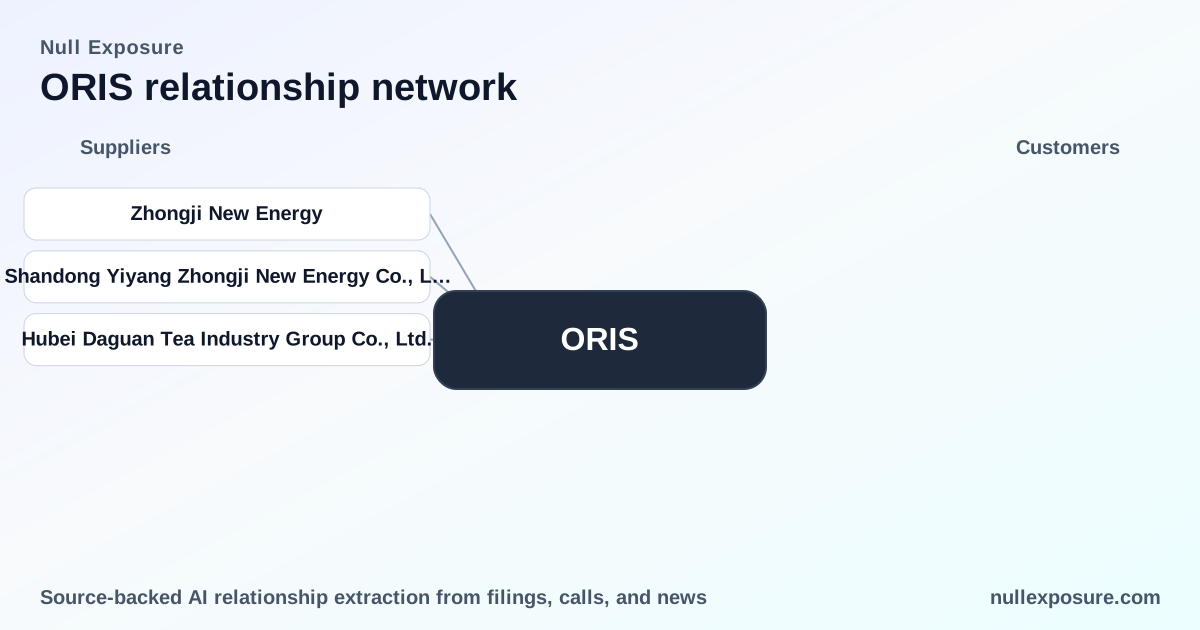
Zhongji New Energy
Oriental Rise is co-operating under a framework where Zhongji New Energy handles project investment, construction and operation while ORIS provides coordination support; the quoted cooperation contemplates a 20-year lease with a possible five-year automatic extension (FY2026). According to an Intellectia news report (March 10, 2026), that structure positions ORIS to capture long-duration commercial exposure while offloading execution risk to Zhongji (https://intellectia.ai/news/stock/oriental-rise-holdings-regains-nasdaq-compliance-with-minimum-bid-price-requirement).
Shandong Yiyang Zhongji New Energy Co., Ltd.
A separate public mention reiterates the same commercial division of labor—ORIS as coordinator, Shandong Yiyang Zhongji as investor/operator—specifically in the context of agro-solar integration at tea plantations (FY2026). Futunn covered the announcement on March 10, 2026, describing the arrangement as ORIS assisting project implementation while the Zhongji entity funds and runs the installations (https://news.futunn.com/en/post/69828443/oriental-rise-explores-agro-solar-integration-at-tea-plantations-through).
Hubei Daguan Tea Industry Group Co., Ltd.
ORIS signed a non-binding letter of intent to acquire Hubei Daguan Tea, a move presented as strategic consolidation: ORIS brings a public-company platform, capital-market access, branding and nationwide distribution to combine with Daguan’s upstream tea production assets (FY2025). The Manila Times / GlobeNewswire piece (December 31, 2025) frames the LOI as a potential value-creating transaction contingent on completion (https://www.manilatimes.net/2025/12/31/tmt-newswire/globenewswire/oriental-rise-holding-limited-signs-non-binding-letter-of-intent-to-acquire-hubei-daguan-tea-industry-group/2251209).
What these ties imply for ORIS’s economics and valuation
ORIS’s revenue base and margins—Revenue TTM ~$12.3m and Gross Profit ~$2.17m per recent public financials—are small relative to the scope of the strategic ambitions described in these relationships. The operating model implies three distinct monetization pathways:
- Coordination fees and project management revenue when ORIS supervises development and integration work.
- Lease or licensing income under long-duration arrangements (the reported 20-year lease with possible extension is a blueprint for steady, contract-backed revenue if fully executed).
- Acquisition-driven margin expansion if upstream producers like Hubei Daguan are consolidated into ORIS’s platform and commercialized through its distribution channels.
However, the translation from announcements to scale depends on closing events and partner execution—factors external to ORIS’s balance sheet. ORIS’s low institutional ownership and small free float amplify the market reaction to either successful closings or execution delays; investors should expect volatility around milestone announcements.
Learn more about platform-driven supplier risk at https://nullexposure.com/.
Catalysts, risk monitor, and what to watch next
Key catalysts:
- Formal closing on the Hubei Daguan acquisition and public disclosure of deal economics.
- Signed and financed implementation agreements with Zhongji entities and confirmation of lease payments or revenue streams.
- First operational results from agro-solar integration and distribution rollouts that prove the platform thesis.
Principal risks:
- Execution risk: partners are responsible for construction and operation; delays or underperformance reduce ORIS’s take-rate.
- Concentration risk: a small number of counterparties and sectors means single events have outsized effects.
- Liquidity and market structure: ORIS’s modest market cap and low institutional ownership create trading illiquidity and amplify price moves on news.
For quick access to ongoing relationship monitoring and deal flow updates, visit https://nullexposure.com/.
Bottom line: measured opportunity with execution-dependent upside
Oriental Rise’s public supplier relationships reveal a strategic, low-capex approach to scaling through partnerships and acquisitions—an approach that can create outsized returns if counterparties deliver and transactions close. The investment case is fundamentally execution-dependent: successful integration of Hubei Daguan and turnkey delivery from Zhongji entities would convert announcements into recurring economics; failure or delay would leave ORIS exposed to headline-driven valuation swings. Investors should prioritize verification of deal terms, counterparty financial capacity, and the timeline for revenue realization when assessing ORIS as a supplier-platform investment.