Orla Mining (ORLA): Supplier Relationships and Operational Implications for Investors
Orla Mining acquires, develops and operates gold-producing assets and monetizes through the sale of mined gold and associated by-products. The company’s economic model is asset-driven: capital deployed into mine development converts into production revenue, and profitability scales with ore grades, processing recoveries and lowering unit costs. Orla’s financials show significant scale (TTM revenue ~$772m) and healthy operating margins (39%), positioning it as an intermediate gold producer with margin leverage to ore throughput and commodity prices. For a concise portfolio-level view and supplier-focused signals, visit the NullExposure homepage: https://nullexposure.com/.
Investment thesis in one line: Orla is a production-focused gold operator whose supplier relationships — laboratory services, engineering reviewers and strategic partners — are operationally critical and contribute directly to reserve reporting, permitting and production confidence.
Why suppliers matter to Orla’s value creation
Orla runs capital- and data-intensive projects where third-party labs, independent engineering firms and joint-venture or property counter-parties influence timelines, technical risk and regulatory paths. Timely, high-quality assay results and independent technical validation are prerequisites for reserve certification, permitting and debt/equity financing, all of which feed valuation multiples and project IRRs. Orla’s margin profile and cash generation mean the company is judged more on execution risk than discovery potential; therefore counterparty performance is a measurable value driver.
Bold takeaway: supplier reliability is not ancillary — it is a direct enabler of production, reserve conversion and capital access.
What the public record shows about Orla’s supplier relationships
The available evidence documents a small set of recurring external providers used for assaying, technical review and traceability/carbon services. Below I summarize each named relationship and why it matters to investors.
-
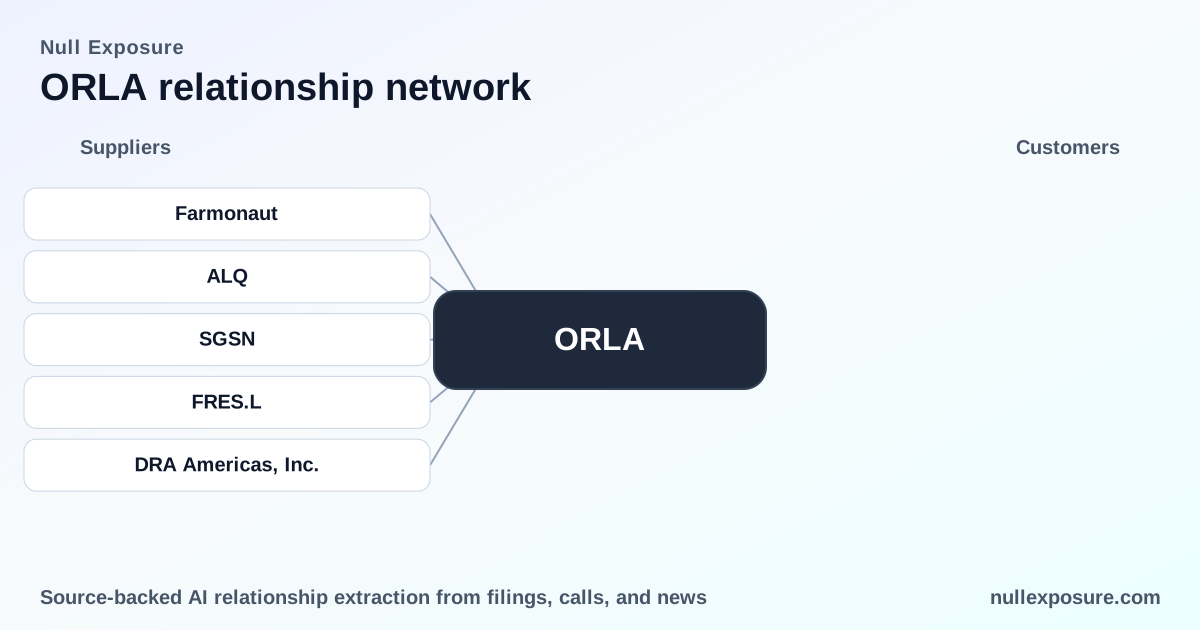
Farmonaut — Farmonaut provides carbon footprinting monitoring and resource traceability services that support Orla’s regulatory and ESG disclosures. According to a Farmonaut article (March 10, 2026), Farmonaut’s capabilities help companies like Orla reduce regulatory risk and enhance supply chain transparency, which supports market acceptance and offtake conversations. (Source: Farmonaut, 2026-03-10)
-
ALS Canada Inc. — ALS is contracted for gold assay work (fire assay fusion with AA finish) and is cited as a laboratory source for Musselwhite drill results. The Junior Mining Network press release (March 10, 2026) notes ALS’s Au‑AA23 method was used to generate drill assay data critical to resource definition. (Source: Junior Mining Network press release, 2026-03-10)
-
SGS Canada Inc. — SGS provided parallel assay services at Musselwhite, using a GE_FAA30V5 finish as reported in the company release; use of multiple ISO-recognized labs supports data integrity and investor confidence in grade reporting. (Source: Junior Mining Network press release, 2026-03-10)
-
Fresnillo plc — Fresnillo is referenced in forward‑looking assumptions tied to property agreements, including a layback agreement; that contractual relationship influences Orla’s ability to meet title and surface-access conditions at certain properties. The Junior Mining Network release calls out the layback agreement with Fresnillo as a material assumption underlying forward statements. (Source: Junior Mining Network press release, 2026-03-10)
-
DRA Americas, Inc. — DRA Americas acted as the independent qualified person on review of Musselwhite sampling and drilling procedures and concluded that the historical QA/QC met or exceeded industry standards, providing an engineering and technical quality stamp important for reserve estimation and permitting. (Source: Junior Mining Network press release, 2026-03-10)
How these relationships translate into operational constraints and company-level signals
Orla’s supplier profile signals a transactional but mature contracting posture: the firm uses established global service providers (ALS, SGS, DRA) rather than boutique providers, indicating procurement emphasis on quality, chain-of-custody and defensibility of technical data. Supplier concentration is moderate — labs and engineering reviewers are standard across the industry and Orla uses multiple providers to mitigate single‑vendor risk.
- Contracting posture: Orla contracts external, accredited laboratories and independent engineers for critical technical tasks, which is consistent with an operator that prioritizes verifiable data for investors and regulators.
- Concentration: Supplier risk is diversified across recognized international firms; no single external vendor dominates the documented relationships.
- Criticality: Assay labs and independent technical reviewers are material to Orla’s business — they underwrite reserve statements, support permitting and feed financing models.
- Maturity: The choice of global, bankable service providers reflects a mature supplier ecosystem and reduces execution risk relative to smaller operators relying on less-established vendors.
Financial context investors should weigh
Orla’s market capitalization ($4.1bn) and TTM revenue ($772m) show the company operates at scale for the junior-to-intermediate space. Operating margin (39%) and EBITDA (~$416m) provide cash-generation capacity to fund capex and supplier contracts, lowering counterparty payment risk. However, valuation multiples (trailing PE ~75.6; forward PE ~11.2) indicate the market is pricing both growth and execution optionality — supplier performance that accelerates reserve conversion and production ramp can meaningfully compress execution risk and drive re-rating.
Mid-article action: For deeper supplier analytics and relationship tracking, see the NullExposure homepage: https://nullexposure.com/.
Risk angles tied to supplier relationships
- Data integrity risk: Any breakdown in lab QA/QC would constrain reserve updates and financing. Orla mitigates this through multiple lab confirmations and independent technical reviewers like DRA.
- Contractual access risk: Agreements with property counterparties (e.g., the Fresnillo layback arrangement) are operationally critical; encumbrances or delays in those agreements translate directly into project schedule risk.
- ESG and regulatory pressure: Increasingly strict decarbonization and traceability requirements elevate the importance of carbon and chain-of-custody services (the Farmonaut relationship is relevant here).
Conclusion — what investors should watch next
Suppliers are a measurable lever on Orla’s execution outlook. High-quality assay and engineering partners reduce technical risk, support financing and underpin valuation, while property agreements with third parties are potential gating factors. Investors should monitor upcoming assay release cadence, any changes in laboratory or engineering providers, and the status of property agreements that were named in public filings.
Final call to action: To track Orla’s evolving supplier profile and its impact on project risk, review supplier-linked disclosures and corporate releases and consider the curated signals on NullExposure: https://nullexposure.com/.
Key takeaway: Orla runs a bankable supplier stack — labs, engineers and traceability vendors — that is aligned with its production-focused, asset-driven business model; supplier performance will be a direct determinant of reserve conversion and valuation upside.