O’Reilly Auto Parts: supplier relationships, financing posture, and what investors should watch
O’Reilly Auto Parts operates a national retail and distribution platform that sells aftermarket parts, tools, and accessories to professional service providers and DIY customers, monetizing through store and online sales, scale-driven gross margins, and an efficient distribution network. The company’s scale (Revenue TTM $17.78bn; Market Capitalization ~$76.36bn) funds steady operating margins and a capital-light retail footprint that depends on a broad set of suppliers and third‑party services to keep stores and distribution centers stocked and staffed. For investors evaluating supplier risk and counterparty exposures, the most relevant features are O’Reilly’s buyer contracting posture, its use of short-term supplier finance programs, and specific service-provider relationships that carry legal and operational sensitivity. Learn more background and supplier risk screening tools at https://nullexposure.com/.
How O’Reilly’s supplier model drives margins and working capital
O’Reilly buys finished parts and ancillary services for resale; those purchases are the bridge between vendor economics and the company’s retail margins. The company’s operating model shows three practical implications for supplier relationships:
- Contracting posture: buyer — O’Reilly’s commercial behavior is that of a large buyer sourcing broadly consistent product assortments across geographies, which gives it negotiating leverage but also makes its supply chain sensitive to disruptions at scale. Company disclosures note that products are sourced in a similar manner and made available to all customers through the company’s stores.
- Short-term supplier finance — the firm participates in supplier finance arrangements where it agrees to pay third-party financial institutions the stated amount of confirmed supplier invoices on the invoices’ original maturity dates, which are generally for a term of one year. That structure reduces short-term cash outflow variability for vendors but creates a one-year commitment window in O’Reilly’s payables profile.
- Mature, concentrated retail flow — with a nationwide store and distribution footprint, supplier relationships are operationally critical: an interruption in distribution-center staffing, for example, can propagate quickly to in-store availability and sales.
These characteristics combine into a predictable commercial posture: large buyer leverage, short-term payables commitments through formal supplier finance programs, and operational dependence on distribution‑center service providers.
Short-term financing: a structural constraint for suppliers
Company disclosures describe supplier finance arrangements explicitly — confirmed merchandise supplier invoices are paid to third‑party financial institutions on the original maturity dates, generally one year. That is a company-level signal that:
- Supplier payment exposures are managed through third‑party financiers rather than long-term supplier credit.
- The contracting window is short, limiting supplier lock-in but also requiring frequent renegotiation.
- O’Reilly’s working capital profile transfers payment-timing risk to the financing counterparties while preserving the company’s short-term liquidity profile.
For investors, this means counterparty risk concentrates into the financial institutions used in these programs and into the operational continuity of the supplier base within one-year horizons.
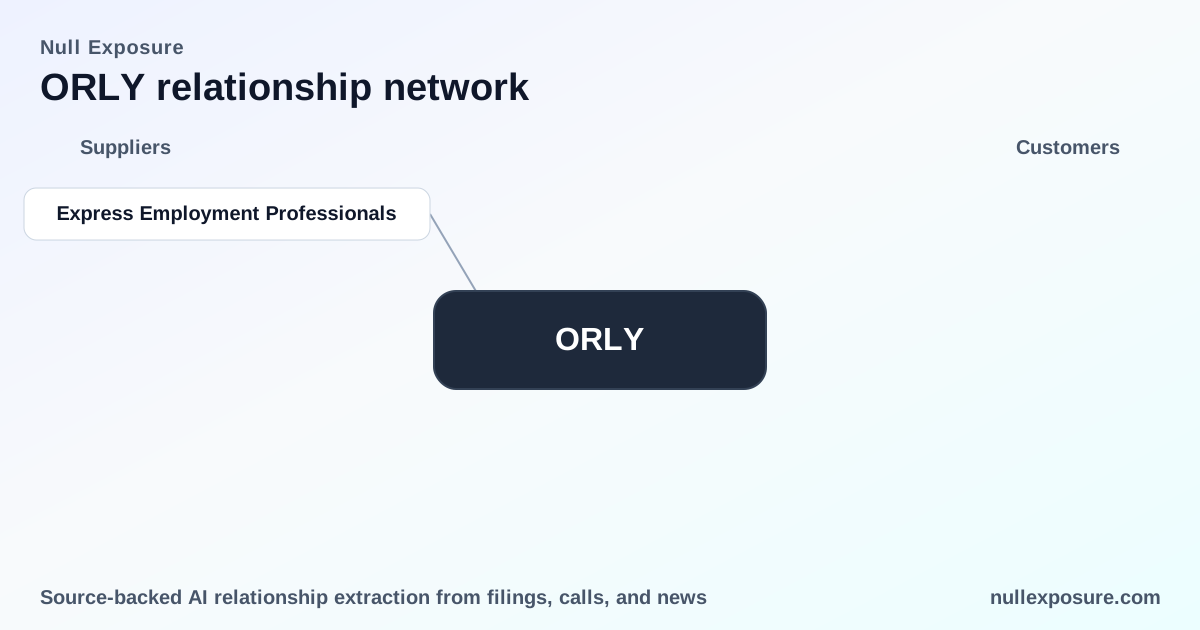
Relationship snapshot: Express Employment Professionals
Express Employment Professionals provides staffing services used in O’Reilly distribution centers. A ClassAction.org news article first reported on March 10, 2026, that a proposed settlement would cover people employed by O’Reilly Auto Enterprises and/or Express Employment Professionals as non‑exempt, hourly employees who worked at O’Reilly distribution centers in California between July 5, 2018 and May 22, 2024, alleging unpaid screenings and security checks. This litigation frames a service-provider relationship that is operationally critical and legally sensitive because staffing vendors touch distribution continuity and labor compliance. (Source: ClassAction.org news report, first seen March 10, 2026 — https://www.classaction.org/news/lawsuit-alleges-oreilly-auto-enterprises-failed-to-pay-workers-for-covid-19-screenings-security-checks)
Why the Express Employment relationship matters to investors
Staffing vendors to distribution centers are not low-stakes contractors: they influence throughput, inventory replenishment, and labor cost volatility across a national network. The ClassAction report signals three investor-relevant points:
- Cost and settlement risk — litigation tied to labor practices can produce remediation costs and retroactive pay obligations that affect operating expense or require reserve adjustments.
- Operational continuity risk — any disruption in staffing services can reduce distribution capacity and dent same-store sales if ramp-up times are prolonged.
- Reputational and compliance signal — labor-related class actions attract regulatory scrutiny and can change vendor-selection criteria, potentially increasing procurement complexity.
All three points are amplified by O’Reilly’s buyer posture and short-term supplier finance setup: the company negotiates and renews supplier agreements frequently, so compliance and contractual clarity with staffing partners are pivotal.
Practical implications and watch-list for investors
Investors assessing ORLY supplier exposure should monitor a concise set of indicators that map directly to the operating model described above:
- Litigation and regulatory developments involving staffing or distribution-center service providers, including settlement terms and any change in contractual arrangements.
- Disclosures around supplier finance counterparties and program scale, since economic risk shifts to the third‑party financial institutions that buy confirmed invoices.
- Operational metrics indicating distribution‑center throughput and inventory availability, which would flag service disruptions before they show up in sales.
- Supplier concentration trends for critical SKUs and services; although product assortments are broadly sourced, concentration in specific vendors for high-turn items or critical services raises single‑point risk.
Use these focus areas to triage signal from noise: labor and staffing litigation plus supplier finance commitments are the two levers that will most quickly alter O’Reilly’s near-term operating baseline.
Discover supplier risk dashboards and screening tools that bring these signals together at https://nullexposure.com/.
Bottom line: what investors should take away
O’Reilly is a structurally profitable retailer with scale advantages, but its supplier model has definable risk vectors: short-term supplier finance commitments concentrate payment-timing exposure into one‑year horizons, and staffing vendors for distribution centers represent an operationally critical relationship class where legal claims can translate into cost and continuity risk. The Express Employment Professionals matter is a proximate example of how labor and vendor disputes translate into investor‑relevant outcomes. Monitor litigation outcomes, supplier finance disclosures, and distribution‑center performance metrics to gauge whether these supplier-side factors will pressure margins or operational throughput.
For ongoing supplier risk research and alerts tailored to investor needs, visit https://nullexposure.com/.