Orion Group Holdings (ORN): Supplier relationships, recent deal activity, and what operators should watch
Orion Group Holdings is a project-driven construction and heavy marine contractor that monetizes through fixed-price and cost-plus contracts across infrastructure, industrial and marine markets; revenue derives from awarded contracts, equipment leasing and project services while profitability depends on tight supplier coordination and project execution. Orion’s working capital and margin profile is inherently linked to a small set of specialized suppliers for concrete and marine construction inputs, and its balance sheet flexibility is now supported by a new five‑year credit facility. For a deeper supplier-risk signal set and relationship mapping, visit https://nullexposure.com/.
Why supplier relationships are central to Orion’s economics
Orion operates as a bid-and-build contractor: projects are won on price and execution capability, then monetized over contract life through progress billings and equipment rental. That structure gives suppliers an outsized operational role—materials shortages or a single critical supplier disruption can delay milestones and convert profitable jobs into loss-making projects. Orion reported roughly $852 million in trailing revenue with slim net margins, so operational disruption amplifies earnings volatility.
The company-level constraint signal is explicit: the concrete segment purchases from a small set of suppliers and the loss of any one could impair short-term operations, which is a direct indicator of supplier concentration and operational criticality for projects. Contracting posture is transaction-oriented and project-tied (short-to-medium contract duration), supplier maturity is mixed (specialized marine and concrete suppliers), and concentration is a meaningful risk driver for near-term execution.
Recent corporate actions that change the supplier ecosystem
Orion completed an acquisition of J.E. McAmis and JEM Marine Leasing for approximately $60 million in FY2026, expanding its heavy marine, jetty and breakwater capabilities — an action that both broadens in‑house capabilities and introduces integration risk for vendor and subcontractor arrangements. Strategic M&A reduces external supplier dependence for certain marine services but increases integration workstreams and near-term cash demands. Several advisors and a legal counsel were engaged on that deal, indicating a standard M&A advisory and legal profile. (Multiple press reports, March 10, 2026).
On liquidity, Orion entered a five‑year $120 million credit agreement with UMB Bank to improve liquidity and reduce borrowing costs, which materially strengthens near-term financial flexibility to manage supplier payments and M&A integration. (Company earnings commentary and press coverage, Q4 2025 / FY2026).
For transaction details and advisory parties, see https://nullexposure.com/.
Relationship-by-relationship breakdown
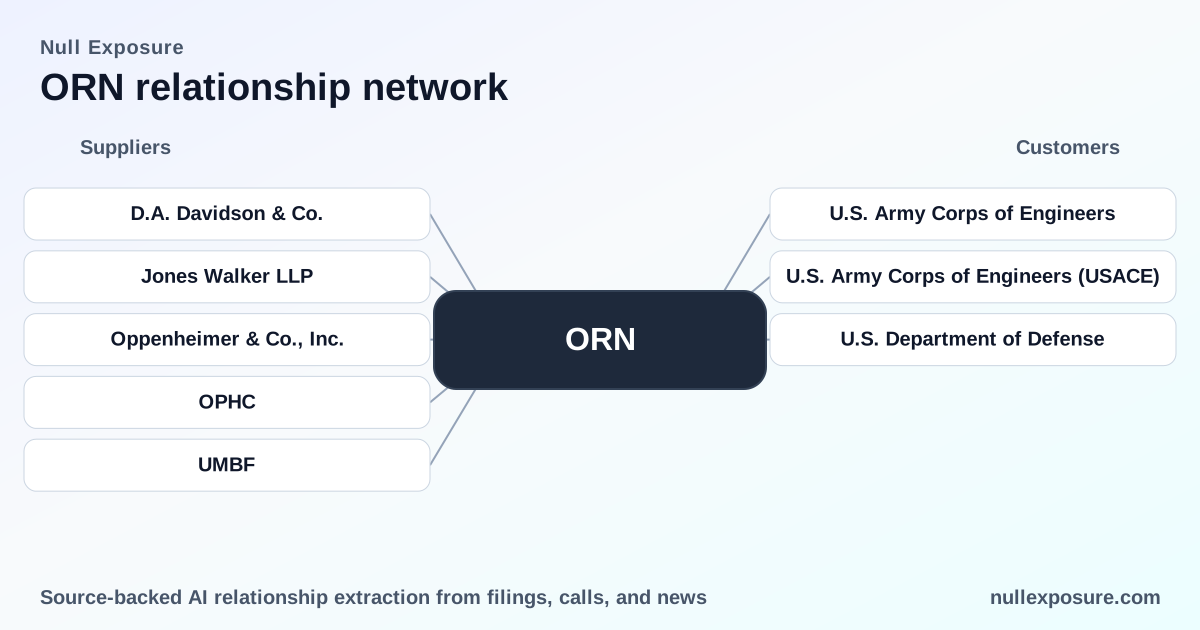
These are the external counterparties surfaced in public coverage tied to the FY2026 transactions and financing.
D.A. Davidson & Co.
D.A. Davidson served as an M&A advisor to Orion on the acquisition of J.E. McAmis and JEM Marine Leasing, providing transaction advisory services that supported deal execution. A QuiverQuant summary and the Globe and Mail press release reported D.A. Davidson’s role on March 10, 2026.
Jones Walker LLP
Jones Walker LLP acted as legal advisor to Orion on the same acquisition, handling transactional and closing mechanics typical in M&A for construction and marine assets. The engagement was reported in QuiverQuant and Globe and Mail coverage dated March 10, 2026.
Oppenheimer & Co., Inc.
Oppenheimer served alongside D.A. Davidson as an M&A advisor to Orion for the J.E. McAmis and JEM Marine Leasing purchase, supporting valuation, marketing and buyer/seller negotiation processes. The engagement is documented in multiple press pieces including WorkBoat and QuiverQuant (March 10, 2026).
UMB Bank
UMB Bank is the lender under Orion’s new five‑year, $120 million credit agreement, a financing relationship that improves Orion’s liquidity runway and reduces borrowing costs relative to prior facilities. The credit agreement and the bank’s role were disclosed in trading‑coverage and the company’s Q4 2025 earnings commentary (TradingView and InsiderMonkey, Q4 2025 / FY2026).
What these relationships imply for supplier risk and contracting posture
- Advisory and legal relationships (Oppenheimer, D.A. Davidson, Jones Walker) indicate Orion is pursuing inorganic growth to internalize specific marine capabilities, reducing external supplier exposure in those service lines while increasing short-term integration and contractual complexity. These types of engagements are standard for mid‑market strategic acquisitions and reinforce a growth-through-acquisition stance.
- The UMB Bank facility reduces immediate liquidity pressure and supports supplier payment capacity during integration and peak working-capital cycles; that improves counterparty comfort with Orion in the near term.
- Company-level supplier constraint: the explicit note on concrete supplier concentration is the single most actionable risk signal for operators and lenders — project delays tied to a single supplier will directly affect cashflow timing and potentially trigger covenant scrutiny under leveraged financing.
Operational and procurement recommendations for investors and operators
- Maintain active monitoring of supplier concentration metrics for the concrete segment and document alternate supply routes or flex‑capacity agreements; single-supplier exposure is a top execution risk.
- For lenders and risk managers, stress test covenant headroom under a 30–60 day project delay scenario given Orion’s slim profit margins and project-driven billing cadence.
- Track integration milestones for J.E. McAmis and JEM Marine Leasing closely — profitability benefits accrue only after integration of fleet, contracts and personnel; integration execution is the primary near-term value driver.
- Use the new UMB Bank facility as a buffer but require timely covenant reporting and transparency on accounts‑payable aging to validate the solvency buffer.
For an operational supplier-risk view mapped to public counterparties, visit https://nullexposure.com/ for additional monitoring and alerting tools.
Bottom line: what investors and operators should price in now
Orion’s core business is highly dependent on supplier coordination and specialized inputs; the acquisition expands in-house marine capability and reduces some external reliance, while the UMB Bank facility strengthens liquidity, but the explicit supplier concentration in the concrete segment remains a material execution risk. Investors should price in integration execution risk and monitor supplier concentration and accounts-payable dynamics closely; operators should prioritize alternate sourcing and contract terms that protect against single‑supplier failures.
To review the relationship map and receive periodic updates on Orion and its counterparties, go to https://nullexposure.com/.