Orrstown Financial Services (ORRF): Supplier relationships, funding posture and what investors should price in
Orrstown Financial Services is the holding company for Orrstown Bank and monetizes through traditional regional-bank economics: net interest income on loans funded by customer deposits and wholesale borrowings, plus fee income from trust and advisory services and wealth-management referrals. The company’s balance-sheet strategy mixes deposit funding with Federal Home Loan Bank (FHLB) advances and operating leases for branch distribution, supporting a steady dividend and a sub-10x trailing P/E on current earnings. Investors should value ORRF as a compact regional bank with explicit reliance on FHLB liquidity and third‑party wealth-channel partnerships that drive fee income. Learn more about supply-side exposures and how they influence credit and operational risk at https://nullexposure.com/.
Quick take: the supplier footprint that matters to an investor
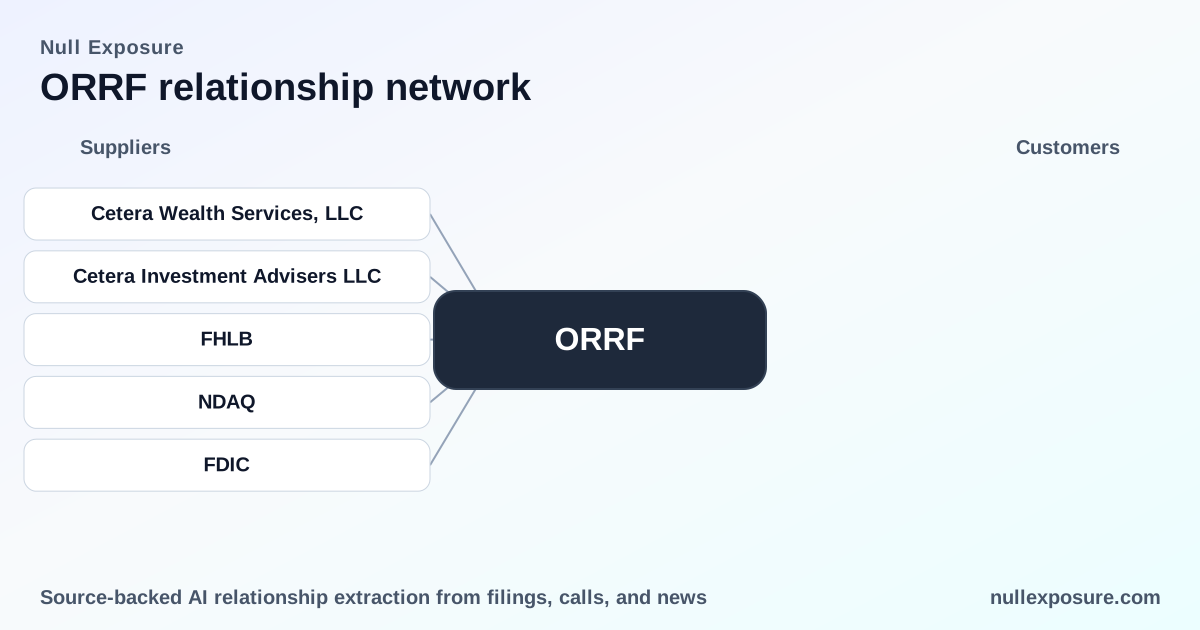
Orrstown’s public disclosures and press releases make three supplier‑class relationships central to valuation and risk analysis: (1) funding from the FHLB system, (2) wealth‑management distribution through Cetera affiliates, and (3) core regulatory protection via the FDIC and the company’s Nasdaq listing. Those ties reveal a mixed contracting posture—a combination of long‑term fixed FHLB advances and short‑term wholesale options—plus an institutional reliance on third‑party service providers for wealth and custody functions that generate fee income.
Key operating constraints and what they signal about the business model
- Long‑term funding commitment: Orrstown discloses FHLB fixed and amortizing advances with original maturities greater than one year and leases that extend up to 28 years, indicating a deliberate long‑term funding and footprint strategy consistent with a traditional regional bank balance sheet.
- Access to short‑term liquidity: The company also uses the FHLB overnight/term program, federal funds and the discount window for short‑term needs, signaling layered liquidity management rather than exclusive deposit reliance.
- Third‑party service-provider oversight: Orrstown explicitly subjects third‑party technology and solution providers to security reviews, reflecting mature vendor governance but also exposing the bank to provider concentration and cybersecurity risk if controls fail.
These constraints combine to create a business model that is capital‑intensive, liquidity‑sensitive, and operationally dependent on outside wealth and technology providers—characteristics investors must price alongside credit and interest‑rate risk.
Explore a full view of supplier exposure and operational signals at https://nullexposure.com/ for deeper supplier analytics.
What the press reveals about each named relationship
Below I list every relationship referenced in the company’s recent releases, with a concise plain‑English summary and a source note.
-
Cetera Wealth Services, LLC — Orrstown Financial Advisors markets securities through Cetera Wealth Services, which handles brokerage transactions for the bank’s advisors; this is stated in Orrstown’s Chambersburg office announcement. (GlobeNewswire, January 12, 2026.)
-
Cetera Investment Advisers LLC — Orrstown’s advisory business routes fee‑based advisory services through Cetera Investment Advisers LLC, a registered investment adviser cited in the new‑office press release. (GlobeNewswire, January 12, 2026.)
-
FHLB — Orrstown reported FHLB advances and other borrowings of $274.7 million at December 31, 2025 versus $209.2 million at September 30, 2025, showing meaningful quarter‑end use of FHLB funding. (GlobeNewswire, January 27, 2026.)
-
Nasdaq — The company’s common stock is traded on Nasdaq under the ticker ORRF, an important liquidity and disclosure conduit for investors and counterparties. (GlobeNewswire, October 21, 2025.)
-
Cetera Investment Advisers LLC (repeat mention) — The Chambersburg press release reiterates that advisory services are provided through Cetera Investment Advisers LLC, underscoring that the Cetera relationship is the designated advisory conduit. (GlobeNewswire, January 12, 2026.)
-
Cetera Wealth Services, LLC (repeat mention) — The same new‑office announcement repeats that securities are offered through Cetera Wealth Services, confirming the brokerage relationship across communications. (GlobeNewswire, January 12, 2026.)
-
FHLB (alternate disclosure) — In a prior quarter filing, Orrstown noted approximately $1.7 billion of available alternative funding sources, including FHLB advances and other wholesale options at both June 30, 2025 and September 30, 2025, indicating substantial backstop capacity. (GlobeNewswire, October 21, 2025.)
-
FDIC — Orrstown Bank is an Equal Housing Lender and its deposits are insured up to the legal maximum by the FDIC, a standard but critical protection for deposit funding and customer confidence. (GlobeNewswire, October 21, 2025.)
-
FDIC (repeat mention) — The bank repeats the FDIC insurance disclosure in its fourth‑quarter results and dividend release, reaffirming regulatory coverage of customer deposits. (GlobeNewswire, January 27, 2026.)
What these relationships imply for investors
- Funding concentration and liquidity posture are the primary exposures. The repeated and quantified references to FHLB advances make clear that wholesale advances are a structural component of Orrstown’s funding mix; investors should model scenarios where wholesale rates widen or FHLB access changes.
- Wealth‑management partnerships are profit drivers but operational dependencies. The Cetera affiliation supplies brokerage and advisory platform access that generates fee income and distribution reach, but it also creates operational counterparty risk and revenue concentration in a third‑party channel.
- Regulatory backstops are intact but not a growth driver. FDIC insurance secures deposit principal but does not mitigate interest‑rate or credit risk; the Nasdaq listing enforces disclosure disciplines that benefit public investors.
Net: ORRF is a compact regional bank with predictable fee channels and explicit reliance on FHLB liquidity—this reduces surprise credit risk but raises sensitivity to wholesale funding costs and third‑party service continuity.
If you want a deeper supplier‑level risk scorecard or to monitor these relationships continuously, visit https://nullexposure.com/ for analyst‑grade supplier intelligence.
Investment implications and next steps
For investors sizing ORRF, prioritize: (1) stress tests that shift FHLB pricing and availability, (2) margin sensitivity to deposit flows and short‑term wholesale costs, and (3) operational continuity of the Cetera distribution channel. ORRF trades at an attractive trailing P/E (~8.3) with a modest dividend yield, but that valuation discounts the balance‑sheet exposure to wholesale funding and vendor dependency.
For a curated supplier exposure report and monitoring alerts, see https://nullexposure.com/ and sign up for updates tailored to regional financials and bank supplier networks.