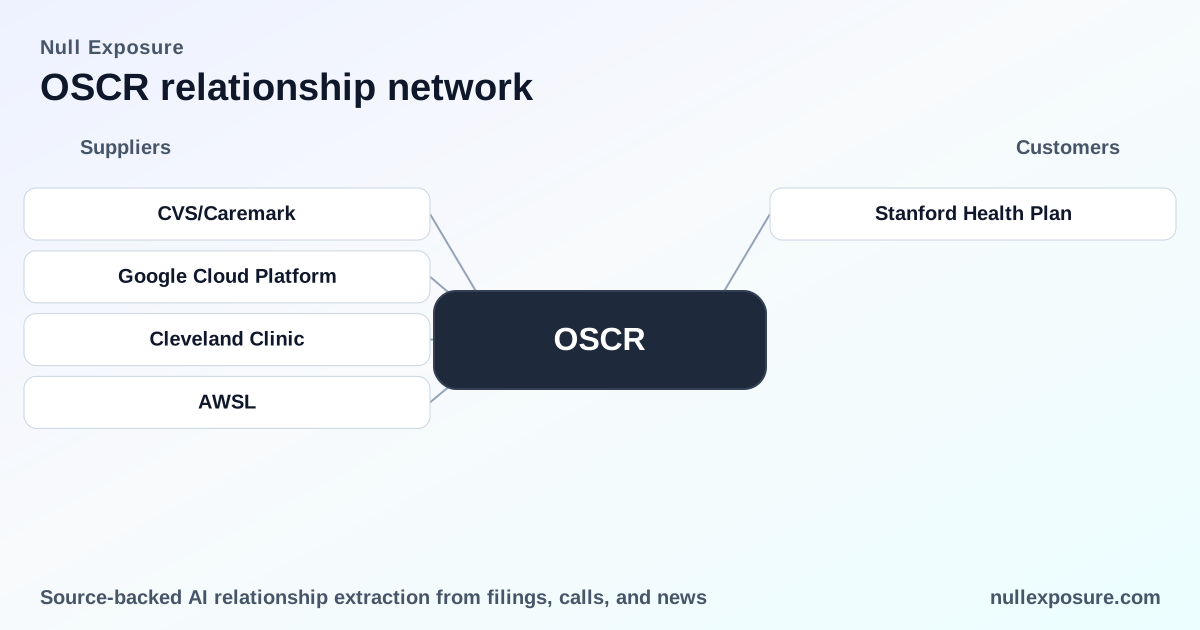
Oscar Health’s supplier map: what underwrites the product and where the operational risk lives
Oscar Health is a technology-driven health insurer that monetizes through member premiums, provider arrangements, and value-add care services, scaled by a digital front end and delegated vendor operations. The company writes individual, family and small-group business, collects premiums, and outsources key operational functions—most notably pharmacy benefits and cloud infrastructure—so investor returns hinge not only on enrollment and underwriting but also on the reliability and economics of a small set of critical suppliers. For a closer look at how those supplier relationships influence margins, resilience and strategic optionality, read on. For broader supplier intelligence on healthcare platforms visit https://nullexposure.com/.
Why suppliers matter to Oscar’s business model
Oscar’s operating model is platform-first but vendor-dependent. The firm uses its consumer-facing website and mobile app to acquire and service members, while delegating several backend functions to specialists. That contractual posture delivers two structural effects for investors: it reduces Oscar’s fixed-cost profile and accelerates scaling, but it also concentrates operational risk in a handful of large third parties whose pricing and performance directly affect claims administration, network management and member experience.
Key company-level signals:
- Oscar discloses a formal contracting posture with third-party vendors for both product administration and internal functions, signaling a deliberate reliance on external service providers (company 10‑K, FY2025).
- The supplier mix favors established, large-scale vendors for critical infrastructure and claims services, indicating mature supplier selection rather than boutique vendors.
- Use of multiple major cloud platforms suggests intentional diversification of infrastructure risk, albeit with continued dependency on a small number of hyperscalers.
The relationships that move the P&L and operations
CVS/Caremark
Oscar delegates pharmacy claims and network management to CVS/Caremark, creating an operational dependency for pharmacy benefit administration that influences cost of goods sold and member fulfillment. This delegation is explicitly described in Oscar’s FY2025 Form 10‑K and is called out as an example of third‑party service arrangements. (Oscar Health 2025 Form 10‑K)
AWS (Amazon Web Services)
Oscar operates its customer‑facing products on cloud infrastructure provided by AWS, making AWS a core provider for hosting, data processing and uptime for the website and app; outages or pricing shifts at AWS would directly impact customer experience and operational costs. The FY2025 Form 10‑K identifies AWS as a provider of cloud infrastructure services used to deliver Oscar’s digital products. (Oscar Health 2025 Form 10‑K)
Google Cloud Platform (GCP)
In addition to AWS, Oscar uses Google Cloud Platform for cloud computing to support its website and online app, indicating a multi‑cloud approach to infrastructure. The FY2025 Form 10‑K notes GCP as one of the platforms supporting Oscar’s digital delivery. (Oscar Health 2025 Form 10‑K)
Cleveland Clinic
Oscar formed a co‑branded distribution and care coordination relationship with Cleveland Clinic to offer individual health plans in Northeast Ohio; members are matched with Cleveland Clinic care teams alongside Oscar’s concierge staff, blending provider brand strength with Oscar’s servicing model. This partnership is documented in a Cleveland Clinic–Oscar Health press release announcing co‑branded plans in 2017. (PR Newswire, Cleveland Clinic and Oscar Health co‑branded plans, FY2017)
(For more context on how supplier relationships influence insurer economics, explore analysis at https://nullexposure.com/.)
How these relationships affect concentration, criticality and execution
- Concentration: Delegating pharmacy claims to CVS/Caremark creates a single-provider concentration for a material component of claims processing. That concentration simplifies contract management but raises counterparty risk if terms change or integration degrades. This concentration is explicitly disclosed in Oscar’s FY2025 filing for pharmacy functions.
- Criticality: Both AWS and GCP are mission‑critical—they host the member enrollment, claims interfaces and telehealth features that drive retention and acquisition. Any sustained disruption or steep cost escalation at a hyperscaler would have immediate operational and financial consequences.
- Maturity and counterparty selection: Oscar’s choice of dominant market players (CVS/Caremark, AWS, GCP) signals a preference for stable, enterprise-grade suppliers rather than experimental vendors; that lowers execution risk but trades off higher negotiating leverage for those suppliers.
- Strategic partnerships versus vendor relationships: The Cleveland Clinic relationship functions as a distribution and clinical differentiation channel rather than a pure vendor contract; it improves market access and clinical credibility but imposes provider-network complexity and revenue‑share dynamics.
Investment implications and a risk checklist
- Margin sensitivity to supplier economics: Pharmacy benefit management fees and cloud costs are variable inputs to gross margin; changes in PBM pricing or hyperscaler contracts will flow through expense lines and impact reported gross profit.
- Operational risk that impacts growth: Customer experience depends on cloud uptime and claims processing fidelity—supplier failures translate into churn and reputational damage faster than internal system fixes can be deployed.
- Negotiation leverage is asymmetric: Oscar’s reliance on large PBMs and hyperscalers gives suppliers pricing power, particularly where integration is deep and switching costs are high. Oscar’s countermeasures—multi‑cloud adoption and provider partnerships—reduce but do not eliminate that leverage.
- Regulatory and market dynamics: PBM economics and provider contracting are subject to regulatory scrutiny and shifting payer models, creating a moving target for supplier cost and network strategy.
If you evaluate insurer counterparties, map supplier concentration and criticality next to underwriting metrics; Oscar’s FY2025 filing provides the primary disclosure for those assessments. For a supplier-concentration scorecard and vendor risk templates visit https://nullexposure.com/.
Bottom line for investors
Oscar Health operates as a digital-first insurer whose financial performance is a function of both underwriting execution and the economics of a few strategic suppliers. CVS/Caremark controls pharmacy administration; AWS and GCP underpin customer experience; partnerships like Cleveland Clinic shape distribution and care quality. Investors should treat supplier contracts as an extension of Oscar’s balance sheet—a source of operating leverage in good times and a vulnerability in stress—and prioritize monitoring PBM arrangements and cloud contract terms as part of ongoing diligence.
For deeper supplier mapping, contract risk signals and monitoring playbooks tailored to healthcare platforms, visit https://nullexposure.com/ and subscribe for updates.