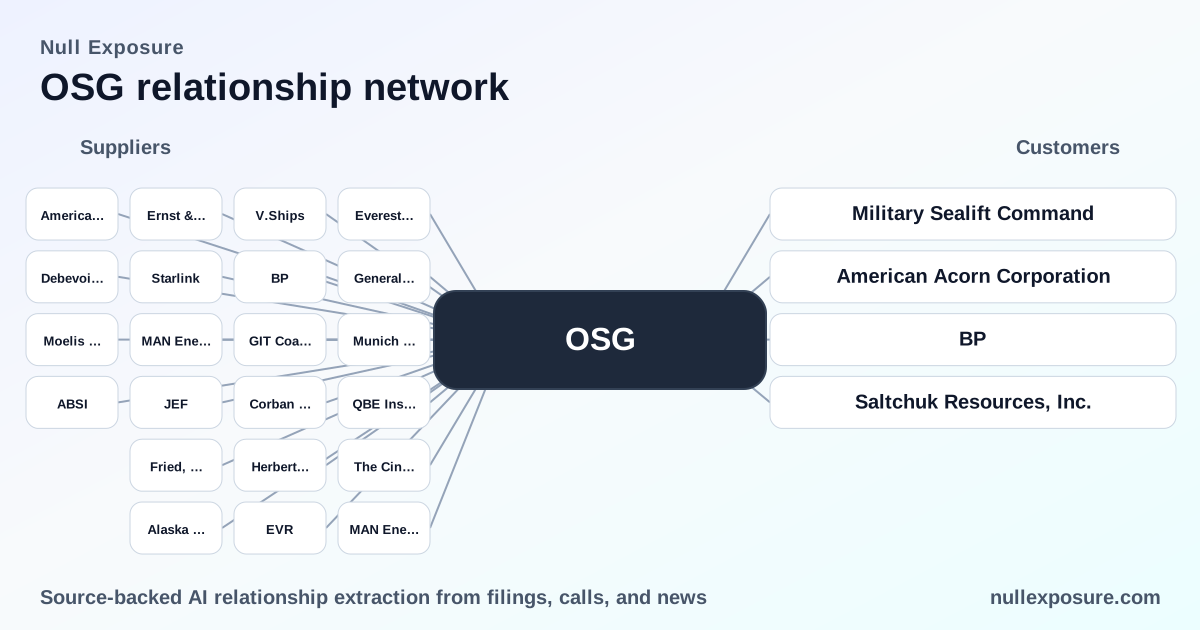
Supplier relationships that define OSG's operating economics
Overseas Shipholding Group (OSG) operates a U.S.-flag tanker and energy-transport fleet and monetizes through time and voyage charters, bareboat arrangements and specialized project contracts (including carbon-capture barges and Alaska crude tanker services). Revenue drivers are fleet utilization and charter counterparties while the cost base is driven by vessel maintenance, engine lifecycle programs, third‑party technical management and insurance/reinsurance programs that transfer operational risk. Investors should evaluate OSG by the mix of long-term charters versus short-term exposure, the concentration of large counterparties and the criticality of select technical and reinsurance suppliers. For an at-a-glance supplier intelligence overview visit https://nullexposure.com/.
How the supplier map ties to cash flow
OSG’s suppliers fall into four practical categories: (1) reinsurance and risk capital providers; (2) technical and ship-management vendors; (3) charter/asset counterparties and fleet operating subsidiaries; and (4) financial and legal advisors that shape capital transactions. Below I list every relationship surfaced in the public record and what each means for OSG’s business.
Reinsurance and risk partners (material to insurance recoverables)
-
General Reinsurance Company — Listed as one of OSG’s top reinsurers with reinsurance recoverable reported at $135,706 and unsecured recoverable of $117,537 in OSG’s 2024 10‑K. This is the largest single reinsurer exposure named in the filing (FY2024 10‑K).
Source: OSG 2024 Form 10‑K (Dec 31, 2024). -
QBE Insurance Corporation — Named among the five most significant reinsurers with reinsurance and unsecured recoverable both reported at $31,502 in the 2024 10‑K, indicating a material ceded exposure (FY2024 10‑K).
Source: OSG 2024 Form 10‑K (Dec 31, 2024). -
Munich Reinsurance Company — Included in the top five reinsurers with reinsurance recoverable of $20,052 and unsecured recoverable of $16,653 per the 2024 10‑K.
Source: OSG 2024 Form 10‑K (Dec 31, 2024). -
The Cincinnati Insurance Company — Reported as a significant reinsurer with reinsurance recoverable of $15,663 and unsecured recoverable of $14,933 in the 2024 10‑K.
Source: OSG 2024 Form 10‑K (Dec 31, 2024). -
Everest Reinsurance Company — Listed among the five most significant reinsurers with reinsurance recoverable of 8,641 and unsecured recoverable of 7,356 (figures as reported in the 2024 10‑K).
Source: OSG 2024 Form 10‑K (Dec 31, 2024).
Technical vendors, engineering and ship operations (impact capex/O&M)
-
MAN Energy Solutions SE / MAN Energy Solutions — Contracted for lifecycle engine upgrades on OSG’s Alaskan Class vessels; the program is intended to improve fuel efficiency and prepare engines for alternative fuels such as methanol, affecting long‑run fuel and capex profiles (coverage in VesselFinder, Splash247 and MarineLink, FY2023).
Sources: VesselFinder news (2023); Splash247 (2023); MarineLink (2023). -
V.Ships — Engaged to provide third‑party technical management services for OSG’s international-flag conventional tanker fleet as part of a strategic outsourcing move (MarineLog, FY2014).
Source: MarineLog (2014). -
GIT Coatings — OSG expanded use of GIT’s graphene-based propeller coating (XGIT‑PROP) across seven additional crude tankers, a maintenance decision that impacts fuel efficiency and O&M costs (MarineLink, FY2025).
Source: MarineLink (FY2025). -
Herbert Engineering Corporation — Listed as an engineering contributor on projects OSG is pursuing (Maritime Executive, FY2025).
Source: Maritime Executive (FY2025). -
Corban Energy Group — Cited alongside engineering contributors on specialized projects, indicating participation in OSG’s technical project pipeline (Maritime Executive, FY2025).
Source: Maritime Executive (FY2025). -
ABS (American Bureau of Shipping) — Awarded Approval in Principle (AIP) for OSG’s liquefied CO2 (LCO2) barge preliminary design, a milestone for OSG’s project diversification into carbon logistics (Maritime Executive and gCaptain, FY2025).
Sources: Maritime Executive (FY2025); gCaptain (FY2025). -
Starlink — OSG announced installation of Starlink across 100% of the fleet, a connectivity decision with implications for crewing, voyage optimization and safety monitoring (company sustainability release, FY2024).
Source: OSG sustainability release / FinancialContent (FY2024).
Charter, asset and fleet relationships (affirming revenue sources and asset strategy)
-
BP Oil Shipping Company, USA / BP Oil Shipping Company USA — OSG completed purchases and bareboat charters tied to four Alaskan‑class vessels acquired from BP affiliates, directly shaping OSG’s Alaska crude business and fleet composition (GlobeNewswire and gCaptain reporting, FY2020 and FY2023).
Sources: GlobeNewswire (2020); gCaptain (2023); MarineLink (2023). -
BP AMI Leasing Inc. — Named in the 2020 transaction that delivered multiple U.S.‑flagged tankers and a bareboat charter arrangement; this historical deal underpins OSG’s Alaskan fleet concentration (GlobeNewswire, FY2020).
Source: GlobeNewswire (FY2020). -
Alaska Tanker Company LLC (ATC) — Acquired by OSG and made a wholly owned subsidiary in connection with the BP vessel purchases; ATC remains the operating affiliate for Alaska‑class vessels (GlobeNewswire, FY2020).
Source: GlobeNewswire (FY2020). -
American Shipping Company — OSG redelivered three conventional tankers leased from American Shipping Company in December 2022; fewer vessels reduced shipping revenues, illustrating sensitivity to lease rollovers (MarineLog, FY2024).
Source: MarineLog (FY2024).
Financial, legal and advisory counterparties (shape capital structure and sale processes)
-
Jefferies Finance LLC — Led exit financing at OSG’s emergence from Chapter 11 with multiple loan facilities totaling $1.35 billion, defining the company’s post‑restructuring capital structure (Offshore‑Energy, FY2014).
Source: Offshore‑Energy (FY2014). -
Evercore — Acted as exclusive financial advisor to OSG in the definitive agreement to be acquired by Saltchuk Resources, Inc., steering M&A execution (Cyprus Shipping News, FY2024).
Source: Cyprus Shipping News (FY2024). -
Fried, Frank, Harris, Shriver & Jacobson LLP — Served as OSG’s legal advisor in the same acquisition process referenced alongside Evercore (Cyprus Shipping News, FY2024).
Source: Cyprus Shipping News (FY2024). -
Ernst & Young, LLP — Ratified by shareholders as OSG’s independent registered public accounting firm in a historical proxy/8‑K filing (MarketExclusive, FY2019).
Source: MarketExclusive (FY2019). -
Debevoise & Plimpton LLP and Moelis & Company LLC — These firms appear in the broader news hit list for unrelated transactions (MarketScreener items); the referenced articles do not establish a direct supplier engagement with OSG within the cited items.
Source: MarketScreener (FY2025).
Constraints that shape procurement and risk transfer
OSG’s public disclosures and associated evidence reveal a set of company-level operating constraints:
-
Contracting posture: Reinsurance and many risk-transfer arrangements are renewed annually, creating recurring negotiation points and short‑term exposure in the insurance program. (Evidence: reinsurance contracts renewed annually statement.)
-
Framework agreements: OSG uses quota‑share style reinsurance frameworks where the company cedes large portions of program liability (company‑level signal describing ceding 70% or more). This produces stable loss transfer mechanics but concentrates counterparty exposure.
-
Counterparty profile: Reinsurers and many suppliers are large, highly rated enterprises, which reduces counterparty credit risk but centralizes exposure to a small set of large providers.
-
Materiality and legal risk: The company acknowledges litigation and contingent liabilities that can be material to results; legal exposure is an operating constraint on capital allocation and cash conservation.
-
Service provider role: OSG relies on external technical managers, engineering firms and equipment vendors for routine and lifecycle maintenance—these relationships are service critical for safety, compliance and fuel efficiency.
Investment implications and next steps
- Concentration risk is clear: a handful of reinsurers and large charter counterparties underpin recoverables and revenue; any shock to these providers would have outsized impact.
- Technical suppliers drive margin: MAN, V.Ships, GIT and ABS engagements directly affect fuel and maintenance cost curves; these are operational levers investors should stress‑test.
- Project diversification increases optionality: approval of an LCO2 barge design and participation in carbon projects position OSG beyond pure crude transport.
If you want a concise supplier risk scorecard for OSG or a comparative view against peers, explore our intelligence tools at https://nullexposure.com/. For transaction-level diligence support and tailored counterparty reports, request an analyst briefing via https://nullexposure.com/.