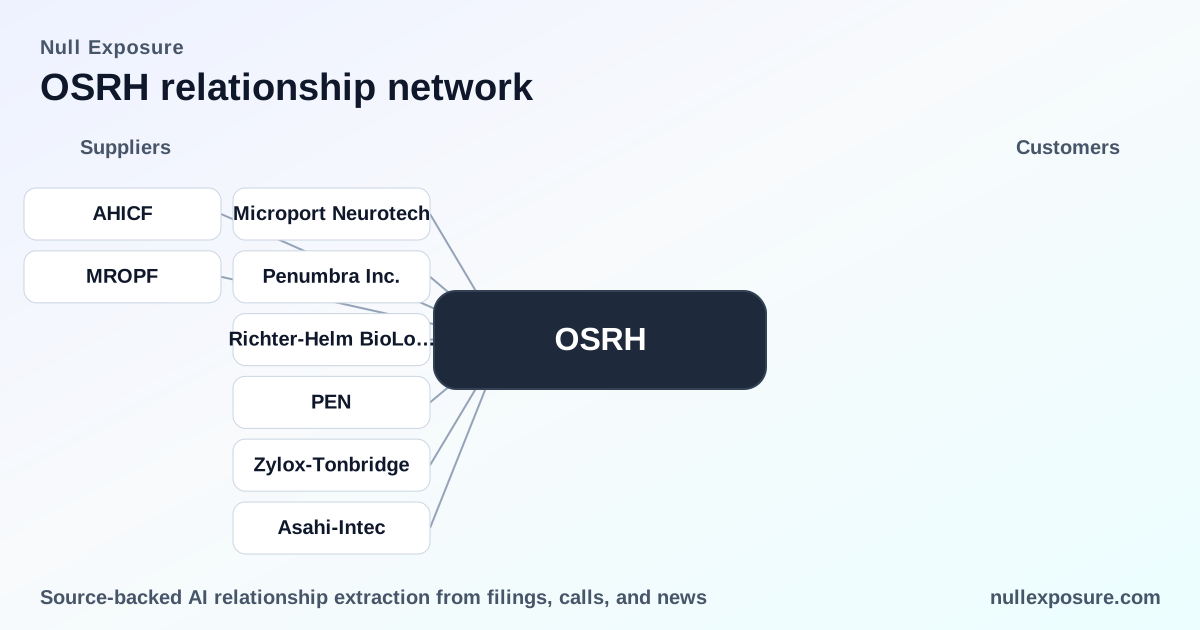
OSR Holdings (OSRH) — supplier relationships that reveal an execution-focused, distributed operating model
OSR Holdings runs an integrated managed-services platform that monetizes through advisory and asset-management fees, plus a distribution arm (RMC) that resells medical device products to clinical and institutional customers. Revenue is a blend of services contract fees and product distribution margins, supported by third‑party manufacturing and commercial distribution agreements. For investors, the critical signal is that OSR’s model leans on partner-sourced product supply and contract services rather than vertically integrated manufacturing. Explore further company intelligence at https://nullexposure.com/.
Who OSR actually deals with — the relationship roll call
Below are every supplier relationship cited in OSR’s public materials and related coverage. Each entry is drawn from either OSR’s FY2024 10‑K filing or a March 2026 market report. These partnerships collectively define the company’s product supply, CMO dependence, and distribution footprint.
-
Microport Neurotech (10‑K, FY2024). OSR references Microport Neurotech’s Numen coil system, a single‑use endovascular device for intracranial aneurysm embolization, as a product within RMC’s distributed portfolio (OSR 10‑K, filed FY2024).
Source: OSR Holdings 2024 10‑K (excerpt referencing Microport Neurotech). -
Penumbra Inc. (10‑K, FY2024). RMC historically distributed Penumbra’s reperfusion and neuron delivery catheter systems; OSR notes that its distribution agreement with Penumbra expired on June 30, 2024. This indicates prior commercial ties that are not guaranteed ongoing (OSR 10‑K).
Source: OSR Holdings 2024 10‑K (distribution agreement expired June 30, 2024). -
Richter‑Helm BioLogics GmbH & Co. KG (10‑K, FY2024). OSR discloses that Vaximm (an affiliated program) has a master service agreement with RHB, a German CMO, for cell‑line development, process development, manufacturing and related services — a framework manufacturing relationship in place since April 2012. This is a formal CMO partnership providing clinical‑scale manufacture for product candidates.
Source: OSR Holdings 2024 10‑K (master service agreement with RHB). -
Penumbra (news coverage, FY2023 context). A March 2026 market article described RMC as distributing products from Penumbra among other vendors, underscoring RMC’s vertical integration into device resale (SpaceInsider, March 2026).
Source: SpaceInsider deal announcement (March 2026) noting RMC’s distribution of Penumbra devices. -
Zylox‑Tonbridge (news coverage, FY2023 context). The same Market/press coverage lists Zylox‑Tonbridge among manufacturers whose devices RMC distributes, indicating RMC’s multi‑vendor distribution strategy (SpaceInsider, March 2026).
Source: SpaceInsider deal announcement (March 2026) citing Zylox‑Tonbridge inclusion. -
Asahi‑Intec / Asahi Intecc (news and 10‑K, FY2023/FY2024 context). OSR’s RMC distributes Asahi devices; the 10‑K specifically mentions the Asahi Intecc Chikai Guide Wire used in neurovascular procedures, while press coverage groups Asahi‑Intec with other distributed vendors. RMC is a reseller, not a designer or manufacturer, for these products.
Sources: OSR Holdings 2024 10‑K (Asahi Intecc Chikai Guide Wire); SpaceInsider (March 2026) noting Asahi‑Intec distribution. -
Microport (news coverage, FY2023 context). Market reports repeat Microport as part of RMC’s distributed vendor set, confirming the 10‑K reference and illustrating overlap between filings and industry coverage.
Source: SpaceInsider deal announcement (March 2026) listing Microport among RMC suppliers.
What these relationships reveal about OSR’s operating model
OSR runs a low‑capital, partner‑centric operating posture. The mix of evidence shows:
- CMO dependence for manufacturing. OSR (via affiliated programs like Vaximm) relies on external CMOs such as Richter‑Helm for cell‑line and process development and manufacture under a long‑standing master services agreement that has been active since 2012 (OSR 10‑K). This is a formal framework contract that provides continuity but also creates supply‑chain concentration around external manufacturers.
- Distribution as a core service line. RMC resells neurovascular devices from Penumbra, Microport, Asahi and smaller vendors like Zylox‑Tonbridge; OSR acts as a commercial distributor rather than a product innovator for these devices (OSR 10‑K; SpaceInsider March 2026). Distribution expands revenue channels while limiting manufacturing capex.
- Commercial and administrative outsourcing. OSR pays recurring administrative/subscription style fees (e.g., $7,500/month for office and support to a sponsor affiliate) and reports modest administrative support spend ($90k in 2024), which indicates low fixed overhead but ongoing vendor payments (OSR 10‑K).
- Intellectual property and trade‑secret exposure. Reliance on third‑party manufacturers and service providers requires information sharing and elevates operational risk around IP protection, which the company explicitly flags (OSR 10‑K).
Constraints and financial posture — actionable signals
OSR’s filings and disclosures present several practical constraints investors should price into models:
-
Contract types: Presence of framework CMO agreements (RHB), licensing obligations for certain product commercialization, and subscription/affiliate administrative fees. These are structural — framework agreements support continuity but limit direct control; licensing obligations can create royalty or indemnity exposure; subscription fees are modest but recurring.
Source: OSR 10‑K (framework CMO with RHB; licensing language; $7,500/month affiliate fee). -
Roles and maturity: OSR acts as distributor/service provider and is CMO‑dependent rather than a primary manufacturer. The RHB relationship is mature (in force since 2012) and active, indicating a stable manufacturing partner for affiliated programs.
Source: OSR 10‑K (RHB master service agreement). -
Spend profile: Administrative support expense is small (sub‑$100k annually reported), suggesting low near‑term capex commitment but reliance on variable vendor spend. This keeps fixed costs down while maintaining operational agility.
Source: OSR 10‑K (Administrative Support Fees: $90,000 in 2024 and $75,000 in 2023). -
Concentration and governance signals: Public disclosures show high insider ownership and minimal institutional holdings, which affects governance dynamics and liquidity for suppliers and counterparties evaluating credit or commercial terms.
Source: OSR company overview (insider and institution ownership metrics).
If you want a deeper, sourced relationship map or risk model for OSR’s supplier network, see full coverage at https://nullexposure.com/.
Investment implications — risk checklist for operators and allocators
- Operational risk from outsourced manufacturing. A dispute or disruption at RHB or other CMOs would be immediately consequential for clinical programs.
- Commercial fragility in distribution contracts. The expiration of the Penumbra distribution agreement in mid‑2024 illustrates contract churn risk for revenue derived from resales.
- Low fixed costs but limited scale leverage. Small recurring administrative fees reduce overhead but also signal limited captive capacity to scale manufacturing quickly.
- Information security and IP exposure. Routine sharing with CMOs and vendors increases the need for robust contractual IP protections.
Considerations for diligence: secure copies of current distribution agreements, evaluate CMO capacity and redundancy plans, and review IP protection clauses.
For investors and procurement teams seeking a vendor‑level risk scorecard or tailored supplier diligence, start your analysis with our platform: https://nullexposure.com/.
Bottom line — where this supplier picture leaves investors
OSR’s supplier relationships show a deliberate strategy: lean operating overhead, commercial distribution to create revenue diversity, and reliance on seasoned CMOs for manufacturing. That structure is capital‑efficient and nimble, but it concentrates operational risk in external partners and distribution contracts. For investors, the priority is monitoring the status of key distribution agreements (Penumbra, Microport, Asahi) and the ongoing terms with CMOs such as Richter‑Helm. For operators, the focus is on contract robustness, supply redundancy, and IP safeguards.
To commission a bespoke supplier risk brief or to map these relationships into a portfolio risk model, visit https://nullexposure.com/ and request provider‑level intelligence.