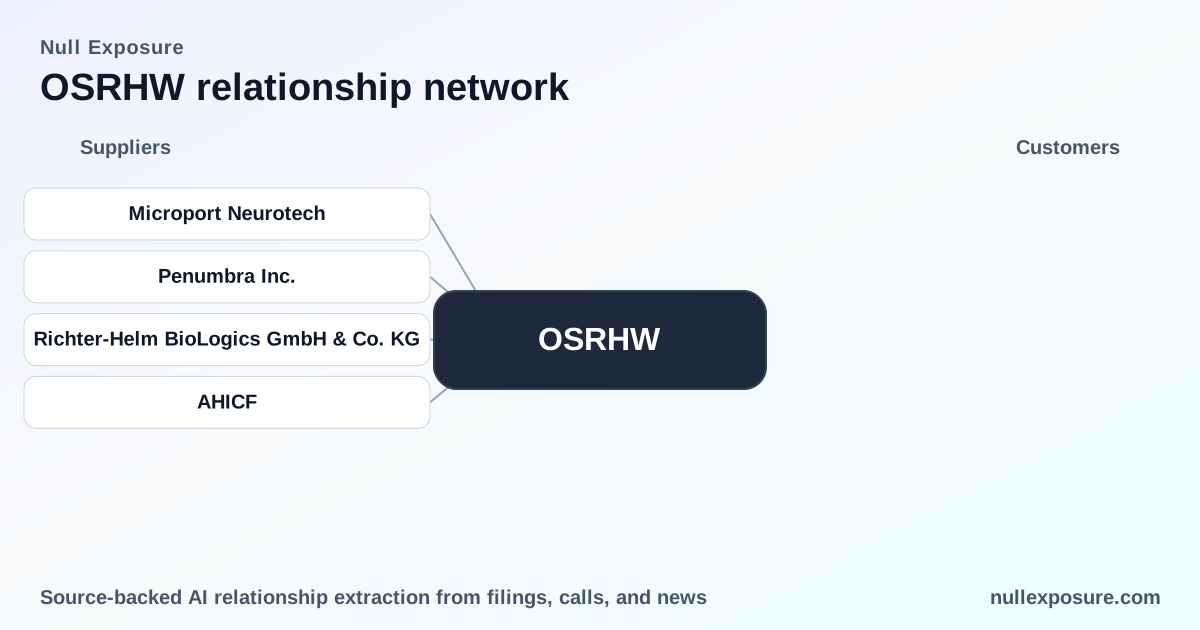
OSR Holdings (OSRHW): Supplier Map and What It Means for Investors
OSR Holdings operates as a strategic investment vehicle that sources, develops and monetizes high‑potential businesses across technology and life sciences by taking active management roles and forming third‑party commercial and manufacturing relationships. The company earns value through equity appreciation of portfolio companies and cash management of corporate expenses, while outsourcing core operational functions such as manufacturing, distribution and administrative services to external providers. For investors evaluating supplier counterparty risk, the 2024 Form 10‑K lays out a compact but telling set of external relationships and contractual patterns that drive both cost structure and operational vulnerability. For a quick refresher on the full supplier profile and to compare peers, visit https://nullexposure.com/.
The high‑level investor thesis: outsourced operations, concentrated exposures
OSR does not operate large in‑house manufacturing or distribution platforms; instead it relies on third parties for manufacturing, clinical development and routine administrative services. That operating model delivers capital efficiency but creates supplier concentration and single‑point operational risk—especially where long‑running framework agreements or minimum purchase obligations exist. The company’s filings show a mix of short‑term cash advances, recurring subscription arrangements for administrative support, and at least one long‑running master service framework with a Contract Manufacturing Organization (CMO). These contracts define where cash flow and operational continuity are most exposed.
- Contracting posture: a blend of short-term promissory lending and subscription‑style administrative fees combined with at least one enduring framework CMO agreement.
- Concentration and criticality: OSR outsources manufacturing and clinical work to CMOs and service providers, making those vendors operationally critical.
- Maturity and stage: relationships span active service agreements and recent terminations, reflecting an evolving supplier base that impacts near‑term stability.
For a concise portal into OSR’s supplier intelligence, consult https://nullexposure.com/.
Supplier relationships — what is on the ledger right now
Below are the supplier relationships disclosed in OSR’s FY2024 10‑K, with a plain‑English takeaway for each.
Microport Neurotech
OSR’s filing references the Microport Neurotech Numen coil system, a single‑use endovascular embolization device used in neurovascular procedures, indicating OSR’s portfolio exposure to neuro‑interventional product lines. According to OSR Holdings’ 2024 Form 10‑K, this product is listed as part of the companies or technologies the firm works with in the neurovascular field (OSR Holdings 10‑K, FY2024).
Penumbra Inc.
OSR’s RMC distributor entity historically distributed neuro‑intervention devices manufactured by Penumbra, including reperfusion and neuron delivery catheters; however, that distribution agreement expired June 30, 2024 and negotiations to renew terminated November 20, 2024, leaving OSR without an active Penumbra resale relationship. The FY2024 10‑K documents RMC’s prior distribution role and the expiration/termination timeline (OSR Holdings 10‑K, FY2024).
Richter‑Helm BioLogics (RHB)
OSR’s filing notes a master service agreement between Vaximm and Richter‑Helm BioLogics GmbH & Co. KG for manufacturing product candidates; this framework agreement became effective in 2012 and persists until termination by either party, indicating a long‑standing CMO relationship for clinical‑stage manufacturing. The 10‑K explicitly references the RHB master service agreement for manufacturing (OSR Holdings 10‑K, FY2024).
Asahi Intecc
OSR’s disclosures include the Asahi Intecc Chikai Guide Wire, described as a device to facilitate placement and exchange of therapeutic cerebral catheters in endovascular therapy, signaling supply relationships for procedural devices used across the company’s neurovascular assets. The mention appears in the FY2024 Form 10‑K (OSR Holdings 10‑K, FY2024).
What the constraints and contract excerpts reveal about OSR’s operating model
The filing excerpts reinforce the same strategic pattern: OSR’s cost base and operational continuity depend on a mix of short‑term financing and ongoing service arrangements. Key operating signals extracted from the filing are:
- Short‑term funding posture: The company used unsecured promissory notes and short‑dated sponsor loans to fund working capital, indicating a reliance on near‑term external liquidity. The 10‑K documents a $200,000 promissory note repaid in December 2023 and a $1.2 million note to a sponsor disclosed in 2024 filings.
- Subscription/administrative spend: OSR pays recurring administrative fees (notably $7,500 per month to BCM for office and back‑office services) and recorded around $90k and $75k of Administrative Support Fees in 2024 and 2023 respectively, signaling predictable, low‑scale overhead commitments.
- Framework manufacturing relationships: The RHB master service agreement is a multi‑year framework that governs manufacturing for product candidates; this is a strategic, operationally critical relationship because OSR relies on CMOs rather than owning production capacity.
- Role mix: The firm classifies multiple external entities as service providers and manufacturers, while some partners function as buyers or distributors; the mix increases the number of external touchpoints requiring vendor management.
- Spend profile: Recorded financing and note amounts place several suppliers/transactions in the $1m–$10m spend band, while administrative fees fall in the sub‑$100k band—indicating a two‑tiered spend structure with a handful of larger exposures and routine small recurring payments.
These points are drawn from the company’s FY2024 Form 10‑K and related excerpts.
Investment implications and a short action checklist
OSR’s outsourced model is capital‑efficient but operationally levered to third parties. For investors and operators evaluating exposure:
- Assess single‑source risk for CMOs and clinical manufacturers. The RHB master service agreement is central for clinical supply; any disruption would be material.
- Monitor distributor contracts and renewals. The termination of the Penumbra distribution agreement is a concrete example of revenue/exposure loss from non‑renewal.
- Track sponsor funding rollovers and liquidity cadence. Short‑term promissory financing requires scrutiny because it influences cash runway and negotiating leverage with suppliers.
- Validate supplier SLAs and inventory buffers for procedural devices. Devices like guide wires and coil systems are critical for commercialization timelines.
For a deeper vendor‑level intelligence view and peer comparisons, visit https://nullexposure.com/.
Final take and next steps for due diligence
OSR Holdings demonstrates a deliberate model of outsourcing that reduces capital investment but concentrates operational risk in a small set of external manufacturers and distributors. Investors should prioritize verification of the RHB manufacturing pipeline, the status and alternatives to the expired Penumbra relationship, and the company’s liquidity plan to support ongoing supplier commitments. For direct access to the underlying filings and an analyst‑grade supplier index, go to https://nullexposure.com/.
Bold, focused monitoring of supplier continuity, contract durations, and sponsor financing cadence will determine whether OSR’s capital‑light strategy converts into sustainable portfolio value or exposes the company to delivery and clinical execution risk.