OraSure Technologies (OSUR): supplier and advisor relationships that shape operational risk
OraSure Technologies designs, manufactures and sells oral-fluid diagnostic products and sample collection devices and monetizes through product sales and third-party manufacturing arrangements that support international distribution. With trailing revenue of $115.0M and a market capitalization near $229M, OraSure’s margins and working capital profile are heavily influenced by contract manufacturing relationships and a small set of critical suppliers. Investors should evaluate supplier concentration, contract tenure and recent governance activity together to judge execution risk and optionality. For a consolidated view of supplier and advisor exposures, visit https://nullexposure.com/.
Why these relationships matter to returns and operations
OraSure operates with a deliberate reliance on external manufacturers and long-term supply agreements; that structure lowers fixed manufacturing capital but transfers execution and supply-chain risk to partners. Long-term contract posture reduces near-term capital intensity but increases dependency and operational concentration, which magnifies the financial impact of delays, quality issues or renegotiation of pricing terms. The company’s reported metrics — negative operating margins and EPS — make steady supply and predictable cost of goods sold a critical path to profitability.
What the public filings and releases show about contracting posture
Company disclosures and public statements signal a set of company-level supply characteristics: long-term supplier contracts are established, there are sole-source or limited-source components that are functionally critical, and third-party contract manufacturers play a manufacturing role that has persisted for decades in some cases. These are company-level signals rather than vendor-specific claims, but they establish a clear operating model: outsourcing production under multiyear agreements to preserve commercial flexibility while accepting concentration risk. A reported schedule of future purchases indicates an identifiable spend band (~$1.443M in 2025 under one agreement), which is material for a company at OraSure’s scale.
Advisor and supplier relationships reported in the press
Below are the relationships captured in recent company releases and coverage; each entry includes a plain-English summary and the source.
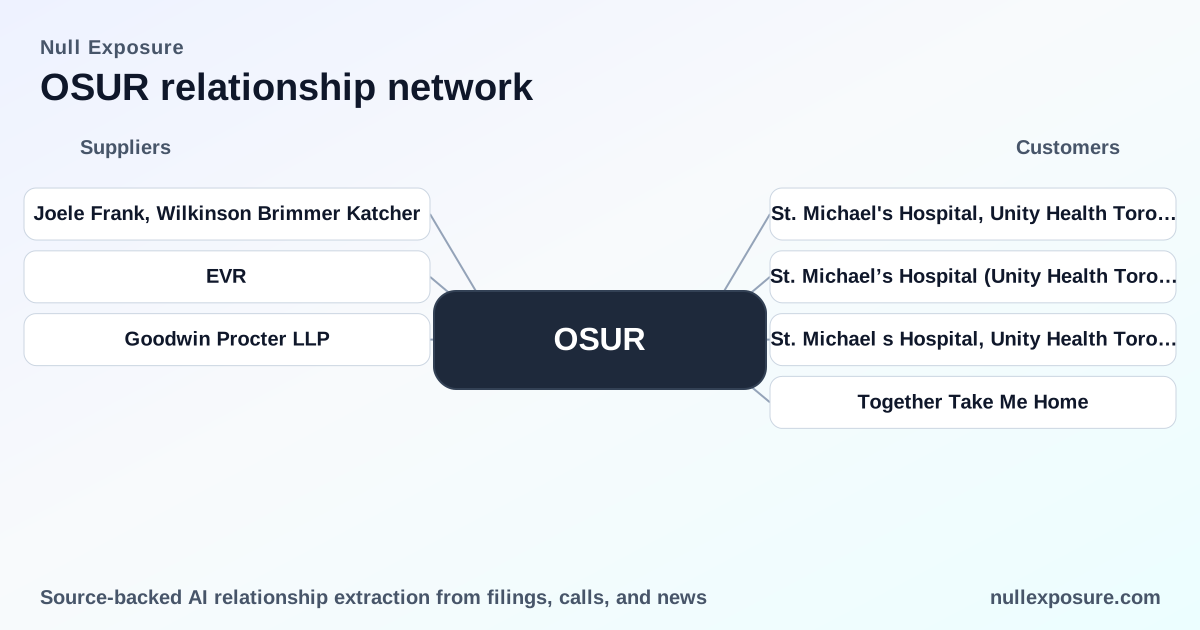
Evercore — financial advisor
Evercore is serving as OraSure’s financial advisor in connection with recent director nominations and related governance matters. Source: GlobeNewswire press releases from December 17, 2025 and January 15, 2026 identifying Evercore as financial advisor.
Goodwin Procter LLP — legal advisor
Goodwin Procter LLP is retained as the company’s legal advisor in the same engagement tied to governance activity and director nominations. Source: GlobeNewswire press releases (Dec 17, 2025; Jan 15, 2026) naming Goodwin Procter LLP as legal counsel.
Joele Frank, Wilkinson Brimmer Katcher — strategic communications advisor
Joele Frank, Wilkinson Brimmer Katcher has been engaged as OraSure’s strategic communications advisor to manage messaging around the director nominations and shareholder communications. Source: GlobeNewswire press releases dated January 15, 2026 and December 17, 2025.
Putting the advisor roster in context for investors
The simultaneous engagement of financial, legal and communications advisors is a governance signal: the company is managing a contested or high-stakes shareholder engagement (Altai Capital’s director nominations). For investors, that raises the probability of strategic re-evaluation, governance change or accelerated cost/portfolio reviews — outcomes that interact directly with supplier contracts and capital allocation priorities. See the company statements filed in late 2025 and early 2026 for the operative timeline.
Discover how supplier and advisor linkages affect valuation and execution risk at https://nullexposure.com/.
Operational constraints that drive risk and optionality
The public constraint signals form a coherent picture for operations and procurement:
- Contracting posture: Long-term supply and contract manufacturing agreements are core to OraSure’s production model, which preserves unit economics at scale but locks the company into multi-year commitments for critical products.
- Concentration and criticality: Certain components and finished products are bought from sole or limited vendors, meaning any disruption would produce outsized delivery delays and cost increases relative to the company’s revenue base.
- Manufacturer role and maturity: Third-party manufacturers assemble key products (including international production in Thailand) and one supplier has manufactured for the company for ~20 years, indicating mature operational relationships but also entrenched dependency.
- Spend signal: Publicly disclosed purchase estimates show an identified $1.443M purchase commitment in 2025 under a named agreement, a meaningful fixed outflow for a company with sub-$150M annual revenues.
These operational constraints are company-level characteristics and should factor into any operational due diligence or valuation stress test.
What investors and operators should watch next
- Monitor any amendments to long-term manufacturing agreements or announcements of dual-sourcing initiatives; moves toward diversification materially reduce execution risk.
- Track progress in governance discussions and any strategic reviews initiated by newly engaged advisors; board composition changes often precede portfolio or management shifts that affect supplier strategy.
- Watch quarterly procurement disclosures and inventory commentary for signs of rising input-cost pressure or delivery shortfalls; negative operating margins amplify the impact of cost overruns.
Quick checklist for investment decisions
- Confirm whether OraSure has formal contingency or dual-sourcing plans for sole-source components.
- Validate the tenure and qualification of the contract manufacturers supporting international sales, particularly the facility in Thailand.
- Assess the financial implications of any renegotiated supplier pricing in a downside scenario given current margin profile.
Final takeaways and next steps
OraSure’s operating model gains scale efficiency through long-term contract manufacturing but concentrates operational risk in a small set of suppliers and manufacturing partners. Governance engagement has prompted the company to retain Evercore, Goodwin Procter and Joele Frank to manage financial, legal and communications workstreams — a development that raises the prospect of strategic change with direct implications for supplier strategy. For a consolidated supplier-impact assessment and tailored monitoring for OSUR, visit https://nullexposure.com/ to see our supplier analytics and alerts.